
Most event planners know the feeling. You pay for floor space, build a respectable stand, brief the team, print the collateral, and still watch people slow down, glance over, and keep walking. Internal events can feel no better. The room is tidy, the buffet is acceptable, and the energy never gets above polite.
That's where corporate sports entertainment earns its place. Not as a gimmick, and not as a last-minute bolt-on, but as a commercial tool. A good activation gives people a reason to stop, compete, stay longer, share contact details, and remember who put the experience in front of them.
The mistake is treating it like “something fun for the stand”. The better approach is to treat it like any other event channel. It needs an objective, a format that suits that objective, and a way to measure whether it worked.
Moving Beyond the Beige Buffet
There's a reason so many live events blur together. Too many rely on passive attention. A branded backdrop, a bowl of sweets, a looping screen, and staff hoping the right people wander over. That setup rarely creates a meaningful interaction, and it almost never gives sales or marketing teams a clean way to qualify interest.
Corporate sports entertainment changes the exchange. Instead of asking attendees to absorb a message, it gives them something to do. That shift matters because participation creates dwell time, conversation, and a natural opening for data capture.
Why novelty alone isn't enough
A lot of entertainment fails because it's chosen for spectacle rather than fit. Bigger isn't automatically better. The most commercially effective activation is often the one that can be timed, branded, and inserted neatly into the delegate journey, as noted in this sports and entertainment districts analysis.
That's a useful filter for buyers. If an attraction creates a crowd but no useful follow-up, it may look busy without doing much for the business. If it supports structured play, queue management, leaderboard output, and a clear call to action, it starts working much harder.
The activation people remember isn't always the loudest one. It's the one that gives them a moment of participation tied to your brand.
What planners are really buying
At a trade show, you're buying attention in a crowded hall. At a conference, you're buying energy and interaction between sessions. At a staff event, you're buying shared experience rather than passive attendance. In each case, the mechanism is the same. Put people into the action, then design the interaction around a result you care about.
That result might be stronger footfall. It might be better quality lead capture. It might be audience segmentation, sponsor visibility, or a more engaged room. The point is that corporate sports entertainment works best when it serves a commercial purpose first and an entertainment purpose second.
What Is Corporate Sports Entertainment
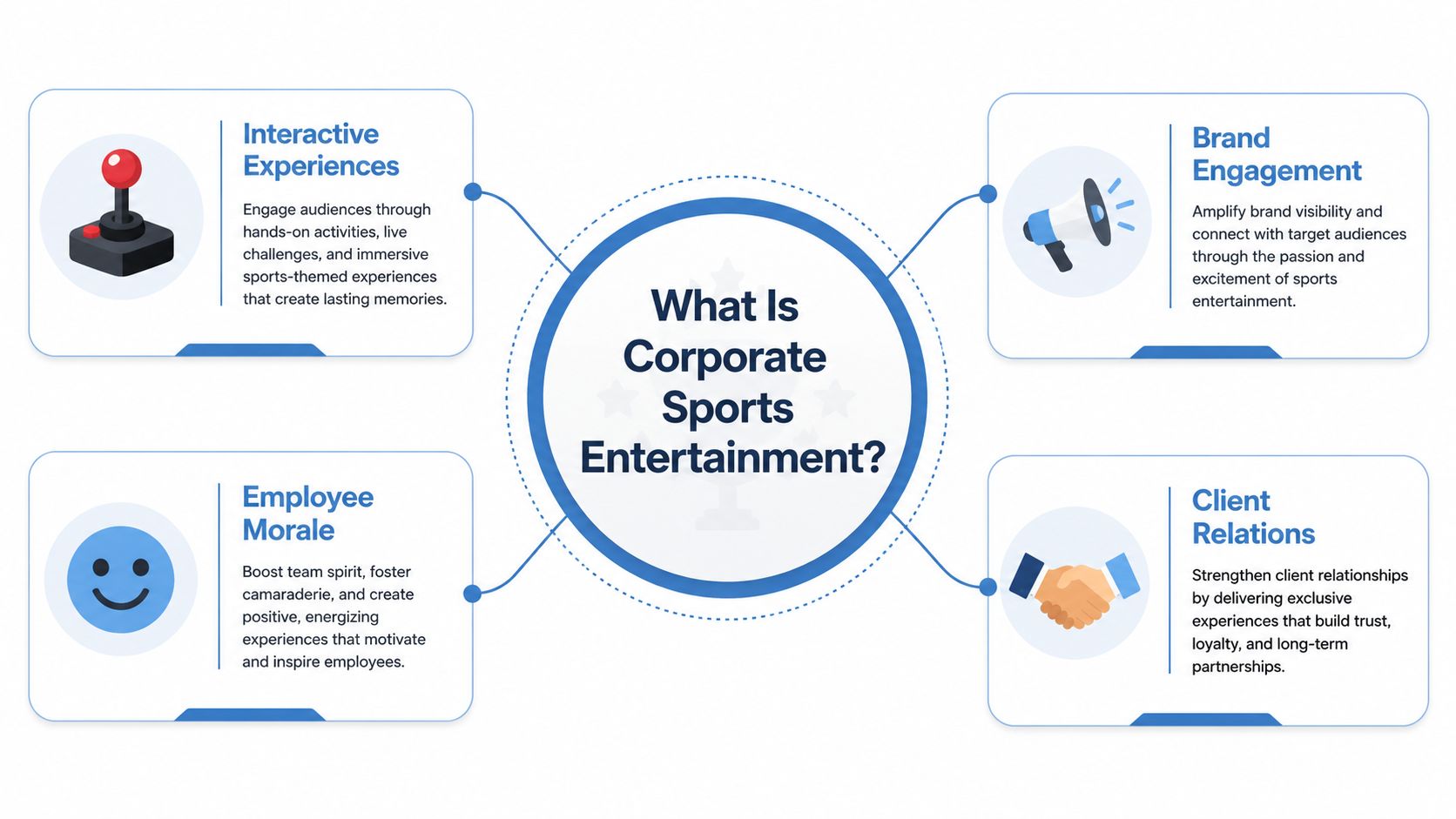
Corporate sports entertainment is the use of interactive, sports-themed experiences in business settings to create engagement with a brand, event, sponsor, client group, or employee audience. That can include racing simulators, football and rugby skill games, reaction walls, golf challenges, boxing machines, branded fan-zone activations, and competitive multiplayer formats.
It sits somewhere between entertainment, experiential marketing, and event operations. The core difference is participation. Watching a screen is passive. Taking a seat in a racing simulator, stepping up to a reflex game, or posting a leaderboard score turns the attendee into the event.
More than entertainment hire
Buyers often misunderstand the category. They think in terms of equipment hire, when the stronger model is activation design. The hardware matters, but value is derived from how the experience is packaged. Is there a timed session? A visible scoreboard? Staff who can host the interaction properly? A branding opportunity before, during, and after each play?
That's why corporate sports entertainment overlaps so closely with experiential marketing strategy. It isn't just there to amuse people while they wait for coffee. It's there to shape behaviour.
Why the market keeps moving this way
Brands haven't shifted toward live, sports-led experiences by accident. The broader global sports-event market was estimated at USD 485.14 billion in 2025 and is forecast to reach USD 884.69 billion by 2033 at a 7.9% CAGR, according to this sports industry market overview. Those are global projections, but they explain why UK brands keep investing in activations that feel live, competitive, and immersive.
When events become more crowded and attention becomes harder to win, passive formats lose ground. Buyers need stands and event areas that generate their own momentum. Sport works well because people understand the rules quickly. Score higher. React faster. Finish the lap. Beat the colleague next to you. That simplicity is commercially useful.
The business case in plain terms
A strong corporate sports entertainment activation does four things at once:
| Business need | What the activation does |
|---|---|
| Footfall | Gives people a reason to stop rather than pass by |
| Engagement | Extends interaction beyond a quick greeting |
| Data capture | Creates a natural exchange for score entry, prizes, or follow-up |
| Recall | Links the brand to a memorable, active moment |
That's why the category keeps growing inside exhibitions, conferences, hospitality events, and internal engagement programmes. It gives commercial teams something much more useful than background amusement. It gives them a structured interaction.
Formats and Strategic Use Cases
Choosing the right format starts with one question. What are you trying to move? Footfall, leads, energy in the room, sponsor visibility, or team interaction. If you skip that step, you end up choosing the flashiest piece of kit instead of the one that fits the job.
For exhibitions and lead capture
At trade shows, the strongest performers are usually formats that stop people quickly and explain themselves without a long briefing. Racing simulators do this well because the proposition is immediate. Sit down, drive, post a lap time. Reaction games such as Batak-style units work for the same reason. They're visual, competitive, and fast to cycle through.
The commercial advantage is control. You can run short sessions, keep queues moving, and route participants into a simple follow-up mechanic such as score registration, prize draws, or post-play conversations with the stand team. That's why many exhibitors choose driving simulator hire for UK events when the brief is part attraction, part lead tool.
A few practical truths apply here:
- Fast explanation wins: If a passer-by needs a long briefing, you'll lose them.
- Visible competition helps: Lap times and leaderboards pull in the next participant.
- Short cycles matter: A brilliant experience that takes too long can choke the stand.
For internal team building
Internal events need a different balance. You're not trying to stop strangers on an aisle. You're trying to create shared energy without making guests feel exposed or awkward. Multiplayer racing, giant Scalextric, and team-versus-team challenge formats tend to work well because they encourage banter and low-pressure competition.
The trick is to avoid over-engineering the experience. If the activity is too technical, the confident minority dominate and everyone else watches. If it's intuitive, people join in.
Practical rule: For staff events, favour formats that reward participation over specialist skill.
For fan zones and public engagement
Public-facing activations need scale, visibility, and broad accessibility. Football, rugby, golf, boxing, and reflex-based sports games work well because the themes are familiar and the audience doesn't need prior gaming experience. The challenge here isn't just entertainment. It's throughput.
A fan-zone activation has to absorb volume while still looking branded and well managed. That means clear queuing, visible score output, and staff who can keep energy up without creating confusion. The format has to work from a distance, not just once someone is already standing in front of it.
Match the format to the follow-up
One of the most overlooked decisions is what happens after the game ends. If the attraction sits inside a wider launch or campaign, the post-activity moment should be planned in advance. That might be a sales conversation, a product demo, a content capture point, or a prize announcement.
If your team is promoting a sports-related event, fixture, or partnership around the activation, practical messaging tools help. Resources like these sports team press release templates can help teams shape event announcements and supporting communications around the live experience.
A useful way to assess options is to compare them against operating reality:
| Format | Best use | Watch-out |
|---|---|---|
| F1 or racing simulators | Exhibitions, launches, hospitality | Needs good queue control and clear session timing |
| Reflex games | High-footfall stands, fast competitions | Can become throwaway if there's no follow-up mechanic |
| Multiplayer racing | Team building, networking events | Needs enough space for spectators and staff hosting |
| Sports skill simulators | Fan zones, family days, public events | Works best with simple rules and strong branding integration |
The attraction isn't the strategy. It's the vehicle. The strategy is the business outcome wrapped around it.
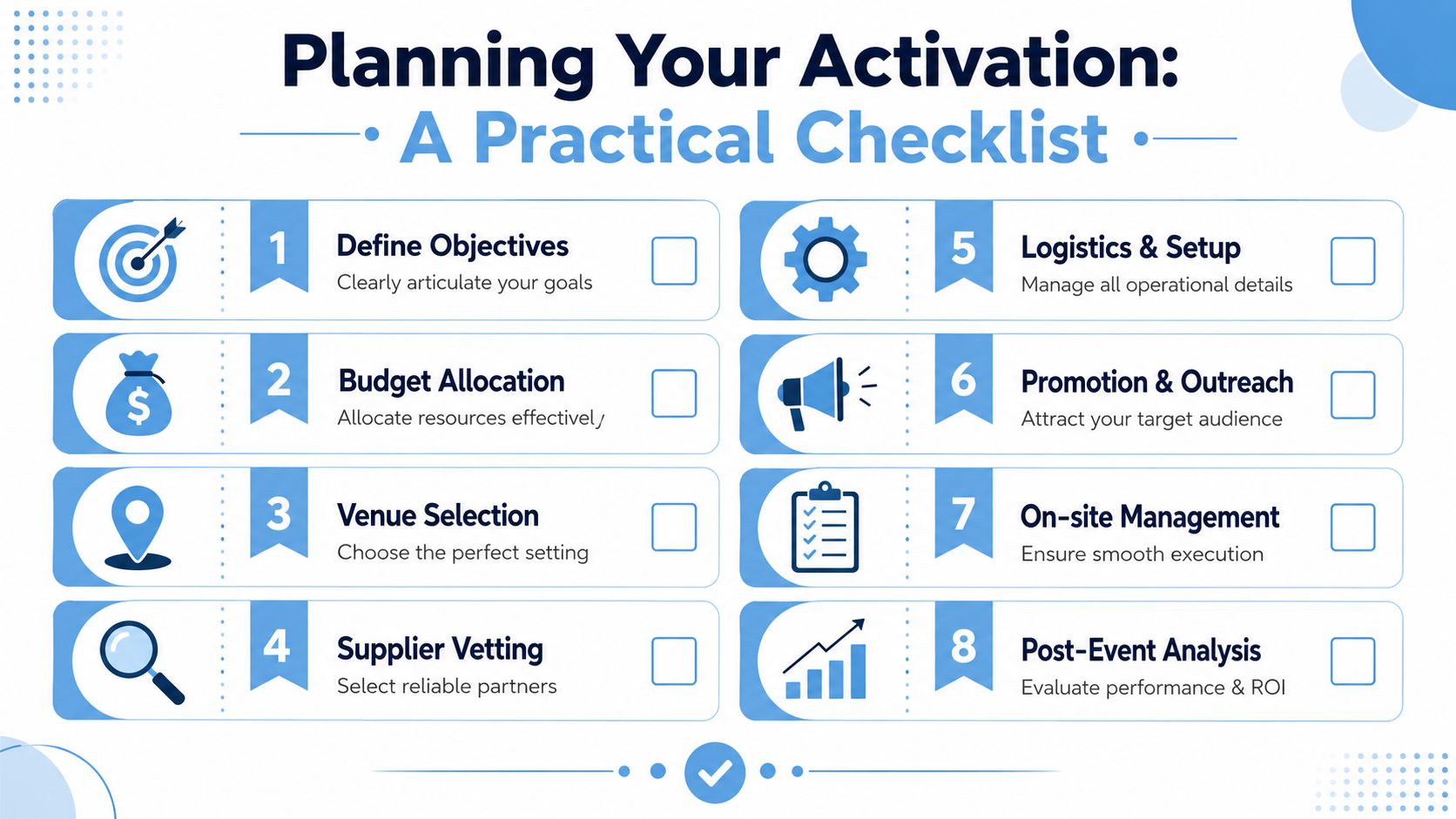
Planning Your Activation A Practical Checklist
Most problems with corporate sports entertainment happen before the event opens. Poor access planning, unrealistic session times, weak staffing, last-minute branding, and vague objectives can turn a high-potential activation into a complicated prop. The easiest way to avoid that is to treat it like a venue-grade installation from day one.
Start with the commercial objective
Don't begin with “what looks exciting”. Begin with what has to happen on the day. Is the stand meant to generate qualified conversations? Is the activation there to support a sponsor? Is it for internal morale, hospitality, or content capture?
That answer shapes everything else, including session length, staffing model, and branding.
Use this early checklist:
- Set the primary outcome. Choose one lead objective and one secondary objective.
- Define the audience. Prospects, clients, employees, delegates, families, or general public all need different formats.
- Decide the call to action. Score entry, badge scan, prize draw, content share, or hosted conversation.
A short visual example helps when briefing internal teams and agencies:
Treat the installation properly
Experiential units such as racing simulators perform best when they are engineered as modular, sponsor-ready assets with configurable branding surfaces, timed play cycles, and leaderboard output that supports both crowd flow and sponsor visibility, as outlined in this event marketing and sponsorship learning resource.
That's the right mindset. This isn't the same as placing a casual game in a corner. A corporate activation needs to work inside venue rules, brand standards, and live event pressure.
The operational questions are straightforward:
- Space and access: Can the kit get in, turn, and be installed without drama?
- Power and positioning: Is the activation visible without blocking circulation?
- Queue design: Where do waiting participants stand?
- Branding surfaces: What can be skinned, wrapped, or shown on screen?
- Staffing plan: Who hosts the experience, manages the queue, and handles resets?
Build for safety and reliability
A smooth event usually looks simple because somebody handled the complexity before arrival. Risk assessments, venue paperwork, equipment checks, and insurance confirmation are all part of the actual job. They're rarely glamorous, but they're what make the experience usable in a corporate environment.
If the supplier talks only about the game and not about access, staffing, branding, and safety, they're not talking about the whole activation.
Make the branding part of the game
Branding works best when it's integrated into the participant journey. Branded side panels, screen graphics, leaderboards, host uniforms, and winner announcements all matter more than a lonely logo board nearby.
A practical checklist for the final production round:
| Checkpoint | What good looks like |
|---|---|
| Pre-event brief | Everyone agrees the objective, audience, and success criteria |
| Venue coordination | Access, power, floorplan, and timings are confirmed early |
| Brand integration | Graphics appear on the asset, not just around it |
| On-site hosting | Staff know how to run the experience and manage people |
| End-of-day wrap | Scores, leads, photos, and notes are collected cleanly |
Corporate sports entertainment works best when the operational side is invisible to the guest and very visible to the organiser.
Measuring Success Beyond Just Fun
If the only post-event comment is “people seemed to enjoy it”, you haven't measured enough. Enjoyment matters, but it isn't a business outcome on its own. The value of corporate sports entertainment comes from turning participation into evidence.
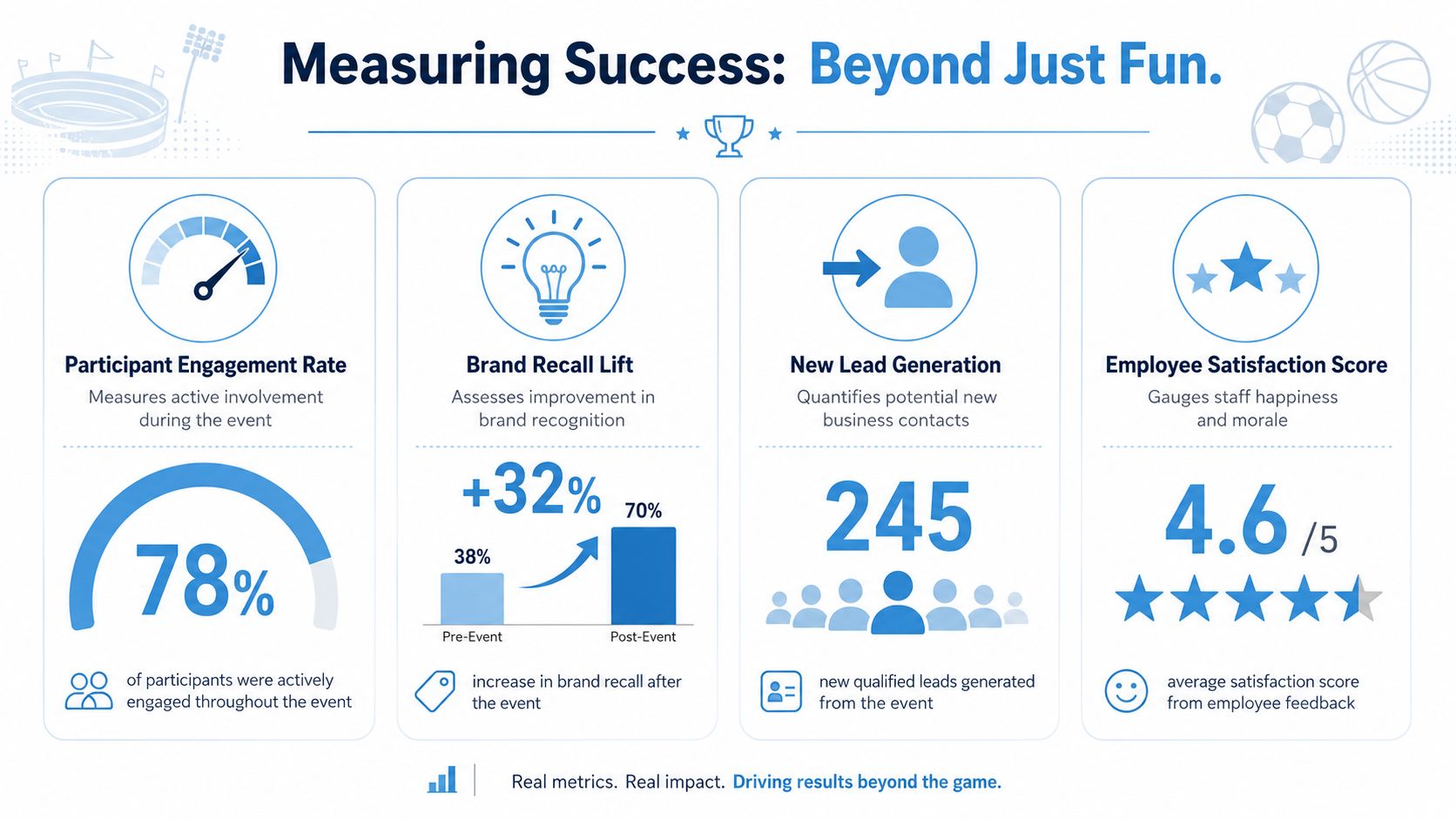
The metrics that actually matter
Attendance is the loosest measure on the list. A better view looks at how people behaved around the activation and what that behaviour produced.
Track these instead:
- Dwell time: How long did participants and spectators stay in the zone?
- Throughput: How many people completed the experience in each time block?
- Lead capture: How many usable contacts were collected through the interaction?
- Audience quality: Which participant groups matched the target profile?
- Follow-up conversion signals: Which interactions led to meaningful sales or marketing actions later?
These numbers don't need to be complicated. They need to be consistent.
Instrument the activation properly
The technical trend shaping this category is real-time, data-driven personalisation. A simulator or interactive sports asset should be instrumented with session-duration logging, participant-scoring, and lead-form integration so performance can be segmented and correlated with business outcomes, as explained in SAP's overview of sports and entertainment industry trends.
In practice, that means the activation should tell you more than how busy it looked. It should help you compare time slots, staffing setups, audience types, and event layouts.
A simple measurement model
A useful framework is to break reporting into three layers:
| Layer | Question |
|---|---|
| Interaction | Did people stop and take part? |
| Data | Did the activity capture usable information? |
| Commercial result | Did those interactions support pipeline, meetings, or brand recall? |
That's the difference between an attraction and an asset. An attraction creates activity. An asset creates activity you can use.
For teams that want a broader framework for judging event performance, this guide to experiential marketing ROI is a sensible place to align event metrics with commercial reporting.
Measurement note: If you can't connect the game to a form, a score, a badge scan, or a hosted follow-up, you'll struggle to prove what it did.
What usually goes wrong
The most common reporting mistakes are predictable. Teams count footfall without separating participants from passers-by. They collect names without qualifying them. They run a leaderboard but never export the data. Or they ask staff for anecdotal feedback and treat that as performance reporting.
A better habit is to decide the KPI before the activation is built. If lead capture matters, design the interaction around lead capture. If sponsor visibility matters, build branding and content moments into the timed play cycle. If dwell time matters, configure the format to support spectators as well as players.
That's how corporate sports entertainment stops being “good fun on the stand” and starts behaving like a measurable event channel.
Choosing the Right Supplier The Turnkey Advantage
The right supplier doesn't just drop off equipment. They remove operational risk. That difference matters more than most buyers expect, especially when the activation is sitting inside a major exhibition, a sponsor-led event, or a live venue with strict delivery rules.
What to check before you book
A useful supplier review should cover four areas.
Equipment quality and fit. The asset has to suit the audience and the objective, not just look impressive in a product sheet.
Delivery capability. Ask who handles transport, install, derig, staffing, branding, and venue coordination.
Compliance and insurance. Corporate event environments need proper paperwork and clear cover. PSW Events, for example, provides simulator-based activations along with planning, logistics, staffing, and health and safety support, backed by £10 million products, employee, and public liability insurance.
Track record in real venues. Experience inside large exhibition halls, arenas, and busy conference environments matters because access windows, floorplans, and on-site rules can be unforgiving.
Why turnkey usually wins
Using separate providers for hardware, staffing, branding, and event management can work, but it adds handoffs. More handoffs usually mean more gaps. Nobody owns the full picture, and problems surface on-site when they're hardest to fix.
A turnkey supplier gives the organiser one line of accountability. That simplifies approvals, timing, and troubleshooting. It also helps commercial performance because the branding, queue flow, hosting style, and reporting approach can be planned as one joined-up system.
If you're comparing options across exhibition spend more broadly, a tool like the Arklavo trade show analysis tool can help frame the wider return picture around space, activation, and follow-up activity.
The question worth asking
Don't ask only, “What games do you have?” Ask, “How will this run in my venue, with my audience, against my objective?” That question tends to separate event partners from equipment vendors very quickly.
Frequently Asked Questions
How much space does a typical simulator need?
It depends on the format, the surrounding queue, and whether spectators will gather around it. The right way to plan space isn't to ask for the machine footprint alone. Ask for the full operating footprint, including access, safe clearance, host position, and waiting area.
Can the equipment be branded?
Usually, yes. The practical options often include branded panels, screen graphics, leaderboards, surrounding set elements, and staff presentation. The most effective branding appears inside the participant journey, not just on nearby signage.
What kinds of events suit corporate sports entertainment?
Trade shows, conferences, product launches, hospitality, family fun days, fan zones, roadshows, and internal events can all use it well. The format just needs to match the audience and the objective. A rapid-fire reflex challenge suits a busy exhibition aisle. A multiplayer racing setup may suit a team social better.
Is this only for sporty audiences?
No. The appeal is wider than many buyers assume because the interaction is usually simple and playful rather than athletic. That makes the category commercially useful for broad audiences. In 2022/23, around 60.1% of adults in England met the recommended level of activity, according to this market reference citing UK activity data, which helps explain why sports-themed brand experiences can connect with a large, relevant audience.
How do you stop queues becoming a problem?
Use timed play cycles, visible hosting, and a format that's easy to understand from a distance. If the experience takes too long or needs too much explanation, queues become friction instead of social proof.
What should the organiser prepare in advance?
Have a clear objective, a floorplan, a branding brief, a lead-capture plan if needed, and one person authorised to make quick decisions during build and live operation. Most activation issues come from ambiguity, not from the equipment itself.
Is corporate sports entertainment worth it for smaller events?
It can be, if the format matches the scale. The goal isn't to overpower the event. It's to create a moment that's interactive, on-brand, and commercially useful. Smaller activations often outperform larger ones when they're better integrated.
Corporate sports entertainment works when it's selected with intent, installed properly, and measured like any other event investment. The smart question isn't whether people will enjoy it. They usually will. The better question is what that enjoyment is designed to produce.