
You're probably looking at an event format that needs more energy.
Maybe it's an exhibition stand that's getting polite passers-by but not enough real conversations. Maybe it's a conference breakout area that feels functional rather than inviting. Maybe marketing wants a branded touchpoint, operations wants something simple, and procurement wants a straight answer on cost.
That's where a popcorn rental machine earns its place. Not because it's quirky, but because it combines smell, movement, warmth, and service in a way that naturally slows people down. Used well, it becomes a small engagement engine. Used badly, it becomes a sticky corner with a queue in the wrong place.
The difference is rarely the machine itself. It's the planning around it.
Why Rent a Popcorn Machine for Your Next Event
A popcorn station works best when the event needs footfall, dwell time, and an easy conversation starter.
At exhibitions, fresh popcorn gives your stand a live element without the production burden of a full catering setup. At conferences, it softens the feel of a networking zone. At internal company events, it adds theatre without forcing guests into a formal food moment. People understand it instantly. They don't need explaining, and they don't hesitate to take part.
That matters because most event interactions are short. A popcorn machine gives attendees a reason to pause, look, wait a moment, and engage with the space around it. For a sales team or brand team, that extra pause is useful. It creates a natural opening for staff to say hello, scan a badge, point to a product demo, or invite someone into a deeper conversation.
Why it performs better than a static snack drop
Pre-packed snacks disappear into bags. A live popcorn station does more than feed people.
It creates:
- A sensory draw: the smell travels further than signage does.
- A visible focal point: movement behind glass and fresh serving attracts attention.
- A social pause: queues, when managed properly, create micro-moments for conversation.
- A low-friction giveaway: guests don't need cutlery, a table, or a long dwell commitment.
Practical rule: If your event goal is lead generation or meaningful networking, place the popcorn station where people can stop without blocking your main traffic route.
There's also a solid commercial backdrop behind hire-led event extras. Grand View Research values the global party supply rental market at USD 15,225.4 million in 2023, projected to reach USD 32,025.9 million by 2030, with a projected 11.2% CAGR from 2024 to 2030 in its party supply rental market report. For UK planners, that matters less as a headline number and more as confirmation that rental-based event delivery is well established.
Where it fits in a corporate event mix
A popcorn machine won't replace strong programming, trained staff, or a clear event objective. It supports them.
It's especially useful when paired with:
- An experiential stand feature: product demo, simulator, prize mechanic, or photo moment
- A brand activation: sampling, launch messaging, or campaign hashtag
- A guest flow plan: welcome zone, breakout lounge, or post-session networking area
If you're building a wider event brief, these guides on For Corporate Events and corporate entertainment event ideas are useful references because they frame attractions in terms of audience engagement rather than novelty.
The strongest use case is simple. You need a live, approachable feature that feels generous, doesn't overcomplicate logistics, and gives your team more chances to speak to the right people.
Choosing the Right Popcorn Machine and Supplies
The right machine depends less on taste and more on throughput, footprint, and presentation.
A small office social, a hotel foyer activation, and a busy exhibition stand don't need the same setup. Many booking mistakes happen because planners choose on appearance alone. The machine looks charming in a brochure, then arrives too large for the allocated space or too small for the queue it creates.
Match the machine to the event environment
For practical planning, think of machine types like vehicles.
A compact countertop model is the event equivalent of a city car. It's easier to place, easier to power, and usually right for a smaller room or short service window. A larger cart-style machine is more like a van. It takes up more room, but it's easier to spot from a distance and better suited to public-facing service where visibility matters.
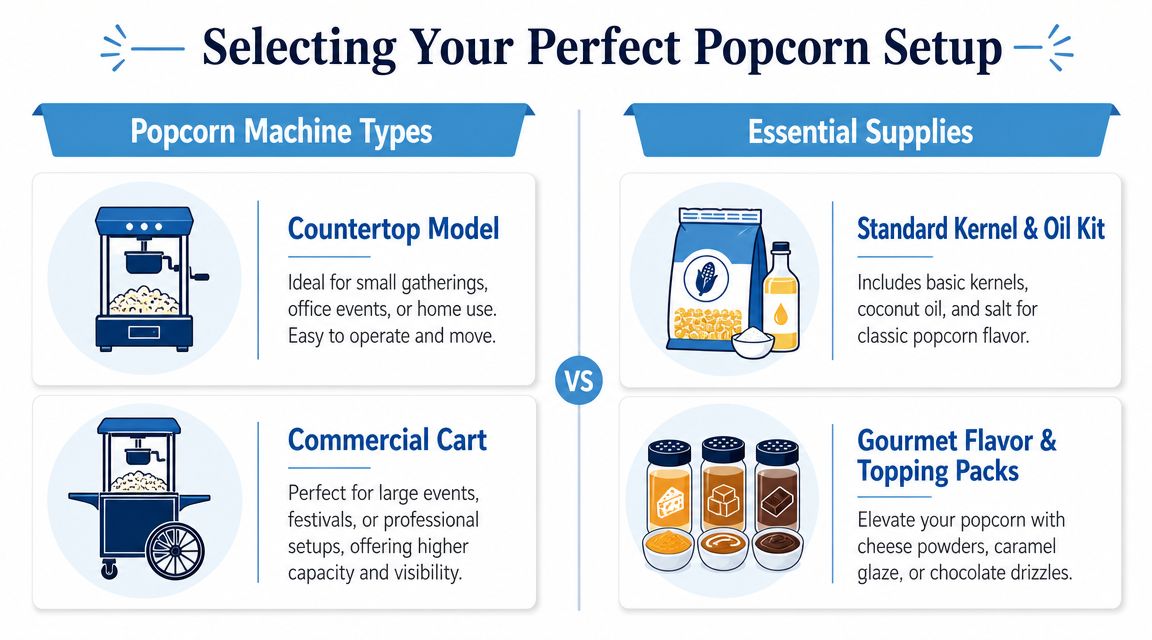
Use this shortlist when comparing options:
- Countertop machine: best for offices, meeting spaces, hospitality suites, and compact breakout areas
- Cart machine: better for exhibitions, receptions, atriums, family fun days, and branded public activations
- Styled machine with visual dressing: suitable when the machine itself is part of the set design
Capacity is only useful if service can keep up
Don't ask only, “How big is the machine?” Ask, “How fast can servings get into guests' hands?”
A higher-capacity unit is useful if the event has clear peaks, such as registration, session breaks, or exhibition lunch gaps. A smaller unit can still work if service is staggered and the machine is there for ambience rather than volume.
What works:
- placing the station near a natural pause point
- using a larger visual setup where passing traffic matters
- pre-agreeing whether popcorn is served continuously or in bursts
What doesn't work:
- hiding it in a corner with no approach space
- using a decorative cart for an event that needs fast turnover
- assuming “self-serve” will be fine in a professional venue
The machine should fit the service model, not just the floorplan.
Supplies matter more than most planners expect
A popcorn rental machine isn't just the machine. The full setup usually involves kernels, oil, salt or seasoning, serving bags or cups, scoops, waste handling, and cleaning materials. If branding is involved, add custom packaging and approvals.
There's also a useful historical reason these hires are now so practical. Commercial popcorn was long associated with fixed-site venues such as cinemas and carnivals, using hot oil, while later portable formats made temporary event use far more viable. Market Research notes that older commercial popcorn machines are associated with hot oil popping, with about 45% of calories from fat, and that hot-air poppers emerged in the late 1970s with about 5% of calories from fat, as outlined in this popcorn machines research overview. For event planners, the key point isn't nutrition. It's portability. Modern hire units are built for temporary install, service, and removal.
When comparing quotes, ask whether supplies are:
- Included as a package
- Charged by expected servings
- Charged only on use
- Matched to dietary or branding requirements
That's where one supplier can look cheaper upfront but become harder to manage on site.
Understanding Operational and Staffing Needs
At 11:45, the expo hall is still half-empty. By 12:10, your popcorn station has a line six people deep, a sales rep is trying to answer product questions over the popping noise, and venue ops wants to know who is clearing used bags from the aisle. That is how a simple snack station turns into an operations issue if nobody has planned service properly.
For corporate events, the question is not just whether the machine works. The question is whether the station supports traffic flow, brand interactions, and lead capture without creating mess, delay, or safety problems.
Placement affects queue quality and engagement time
A popcorn machine needs working space, not just floor space. Put it too close to registration and you create congestion at the worst possible touchpoint. Put it too far from your stand and you lose the benefit of the footfall it generates.
The best positions usually give guests a clear approach, a natural queue lane, and enough room for an operator to restock and serve without backing into attendees. I also look at what happens after collection. If guests grab popcorn and immediately drift away, the station is feeding the room but not your activation. If they collect, pause, and stay near your team, the station is doing real commercial work by increasing dwell time.
Check these details with the venue before load-in:
- Power location and load requirements
- Queue path that does not block aisles or fire routes
- Ventilation and detector sensitivity nearby
- A back-of-house spot for stock, waste liners, and cleaning items
- Collection access and pack-down timing
Small placement mistakes cost more on site than they do on paper.
Staffing is usually the difference between a novelty and a usable event asset
DIY service can work at a small internal gathering. At a client-facing conference, exhibition stand, or high-traffic networking event, it often falls short by mid-session. Someone still has to manage heat, portioning, refills, spills, and guest questions, while your event team is already covering registration, speakers, VIPs, and schedule changes.
A staffed station protects presentation and throughput. It also gives you better control over the guest experience. Clean counters, consistent serving speed, and a friendly handoff matter more than planners expect once the room gets busy.
An on-site attendant typically handles:
- Machine operation and batch timing
- Portion control to keep queues moving
- Surface cleaning and spill response
- Waste checks around the station
- Pack-down coordination at the end of service
If the popcorn point sits inside a larger activation, coordinate it with your wider event staffing support for corporate activations. That avoids the common split where one team is serving snacks while another team, a few metres away, is trying to start conversations with no shared plan.
Brief the supplier like an operations partner
The strongest popcorn hires run well because the supplier gets a proper brief early. Send more than the venue name and event date.
Include:
- Exact machine position on the floorplan
- Access times, loading rules, and lift restrictions
- Available power at the service point
- Service window and expected peak periods
- Named on-site decision maker
- Venue rules on food handling, waste, and end-of-night clearance
- Any dietary, packaging, or approval requirements
That level of detail helps the supplier size labour, stock, and setup correctly. It also reduces the problems that slow service and hurt ROI. Missing extension leads, nowhere to store cups, no bin nearby, and no plan for queue direction all sound minor until your busiest break starts.
A popcorn station should earn its footprint. Good operations planning is what turns it from a fun extra into a reliable touchpoint that keeps guests nearby, gives staff an opening for conversation, and supports the commercial goals of the event.
Branding Your Popcorn Experience for Maximum Impact
Unbranded popcorn is a snack. Branded popcorn is a touchpoint.
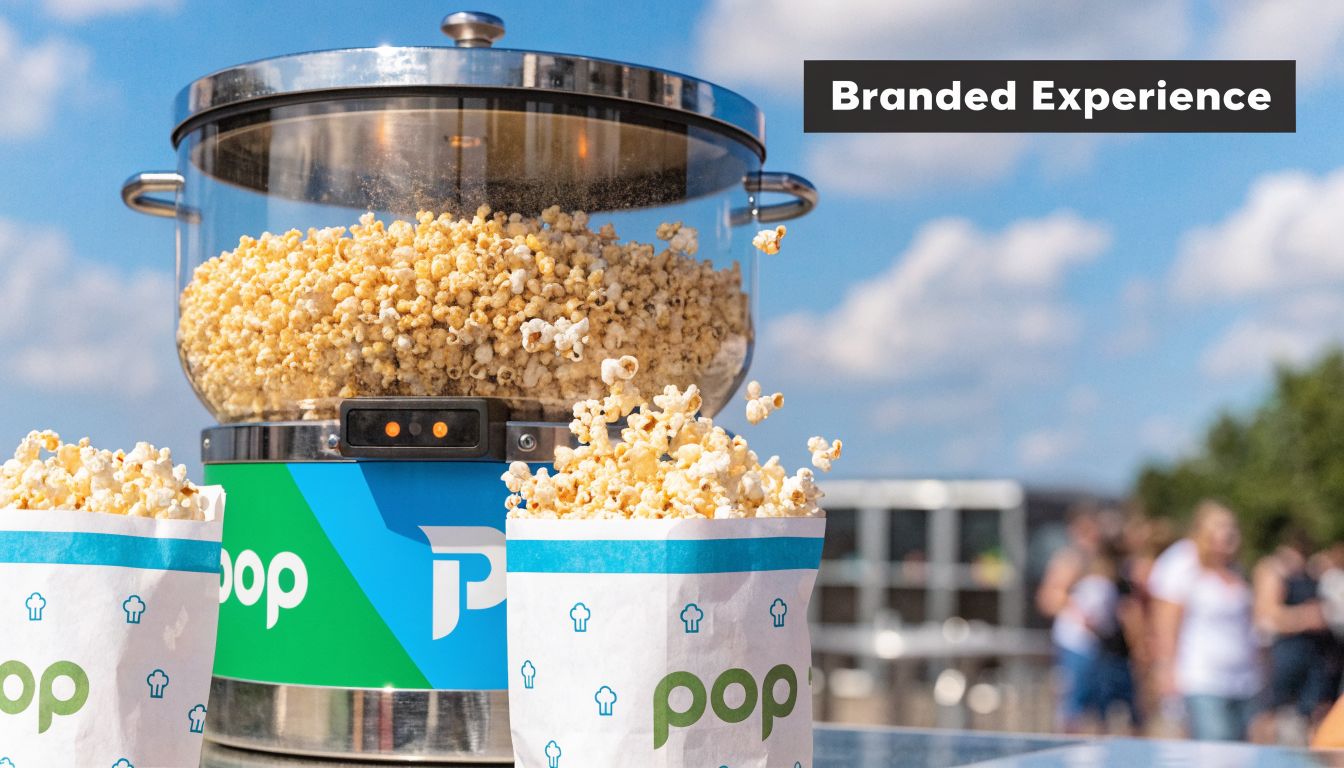
If the machine is sitting on your stand or inside your activation, it shouldn't feel like an afterthought. The station can carry campaign colours, slogans, logo placement, packaging design, and even team scripting. That turns a simple concession into part of the event story.
Where branding actually works
The highest-impact branded elements are usually the ones guests hold, photograph, or carry away.
That includes:
- Printed popcorn bags or boxes
- Machine header boards
- Cart panels or vinyl wraps
- Branded uniforms or aprons for staff
- Counter cards with campaign messaging or QR codes
A fully wrapped cart can work well in public-facing environments. In a tighter B2B setting, custom packaging often gives a cleaner result because it's close to hand and naturally appears in photos.
If guests are posting images from the event, packaging does more for recall than a logo hidden on the side of the cart.
Tie the snack to a campaign action
The mistake is stopping at logo placement.
A better approach is to connect the station to one clear action:
- collect popcorn after scanning a badge
- print a message or product line on the bag
- use the queue moment to invite guests into a demo
- pair the giveaway with a social prompt or competition
That's where experiential thinking matters more than decoration. If you're planning a wider branded environment, this guide to experiential marketing activations is a useful benchmark for how every touchpoint should support the same objective.
What doesn't work is overdesigning it. A bag crammed with legal text, multiple logos, and a QR code no one can scan while holding popcorn won't help anyone. Keep the message short. Make the visual cues obvious. Give staff one sentence to say when they hand it over.
Your Popcorn Rental Booking and Logistics Checklist
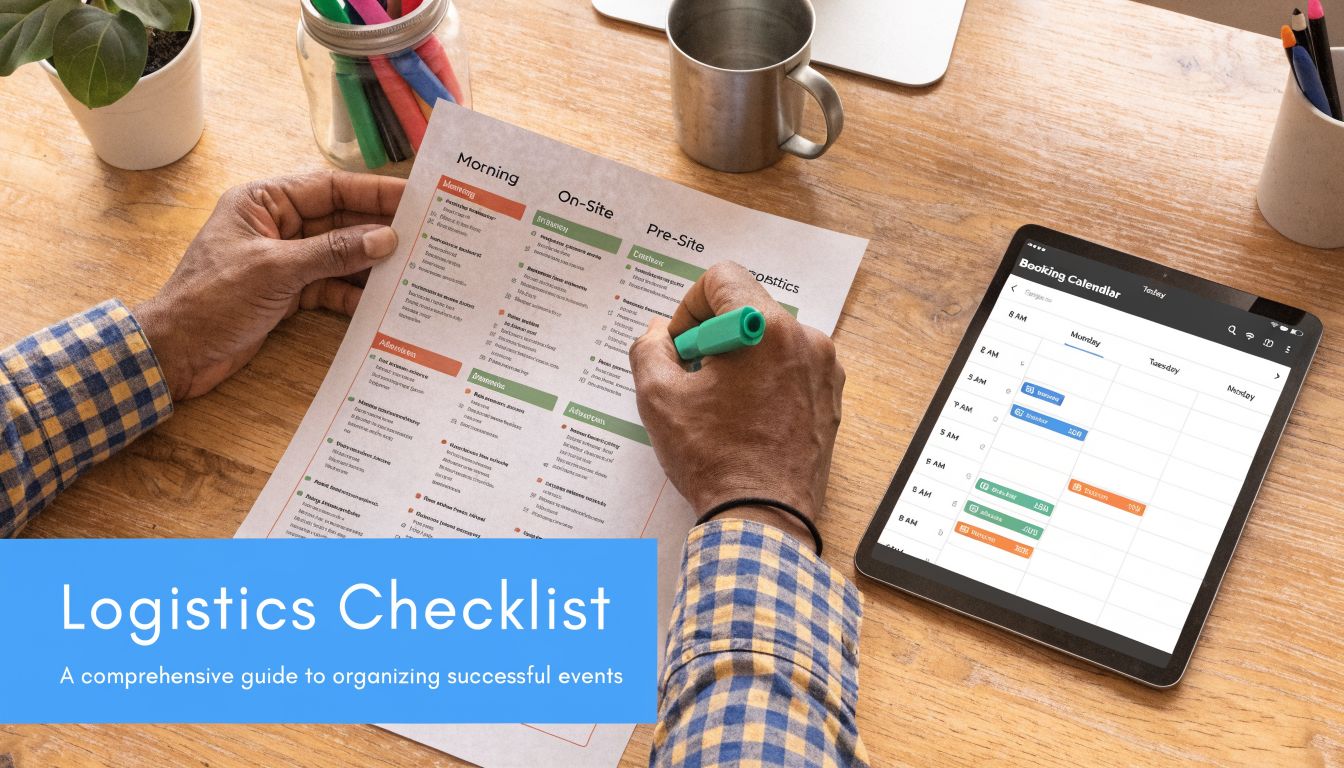
A popcorn rental machine booking runs smoothly when you treat it like any other live supplier workstream. Brief it properly, lock down assumptions early, and confirm who owns each part of the day.
Start with the basics.
At enquiry stage
Ask for a quote that clearly separates:
- Machine hire
- Consumables
- Staffing
- Delivery and collection
- Branding extras
- Cleaning or damage terms
Also ask practical questions that save trouble later:
- What power is required
- How much space is needed around the unit
- Whether the operator is included
- Who provides bags, bins, and waste support
- What happens if access times change
If the event also includes guest photography or branded memories, it can help to review adjacent engagement ideas at the same planning stage. Teams running social or celebration-heavy formats often pair food moments with content capture, and this guide on how to capture every party moment with Eventoly is a useful example of how those pieces can complement each other.
Before you confirm the booking
Send the supplier:
- venue address and postcode
- loading bay details
- access times
- contact numbers for event day
- floorplan mark-up
- branding artwork, if needed
- any venue rules on food preparation or equipment use
This is also the point to confirm whether the station is there for free-flow hospitality, timed service, or a campaign mechanic.
A short visual demo can help internal stakeholders understand what the setup involves on site:
On the day
Use a simple operational check:
- Load-in complete on time
- Position matches the approved floorplan
- Power tested
- Supplies present
- Waste point in place
- Branding installed correctly
- Operator briefed on timings and audience
- Named organiser signs off the setup
At breakdown
Don't leave the close-down vague.
Confirm:
- last service time
- cool-down period
- who removes leftover stock
- who signs off any damage check
- collection window
- whether the venue needs the area returned to a clean handover standard
The handover matters because problems usually surface then, not during the serving period.
Budgeting for Your Popcorn Machine Hire
A popcorn quote can look inexpensive right up until procurement asks what the event will cost to run.
That gap matters more at corporate events than at private parties. A machine on its own is only one line item. The actual budget sits in throughput, staffing, stock, branding, and whether the setup supports the result you want, whether that is longer stand dwell, better footfall conversion, or a stronger brand impression.
The line items that actually shape cost
Budget the station as a live service point, not as a piece of equipment.
A proper quote may include:
- Base hire fee for the machine
- Consumables such as kernels, oil, sugar or salt, seasoning, cups, and bags
- Staffing if you need an operator for service quality, food handling, or queue control
- Delivery and collection
- Branding production and installation
- Cleaning, waste handling, and venue compliance costs
The biggest pricing mistake is comparing a low hire number with a fully managed service quote. They are not the same product. One supplier may price for drop-off only. Another may include setup, service stock, branded packaging, and collection at a fixed time. If you do not standardise the brief, the cheaper quote often becomes the more expensive one on event day.
Ask suppliers one direct question: what will it cost to serve the expected number of guests, at the required standard, for the full service window?
Sample popcorn machine hire budgets
Use the table below as a planning tool, not a rate card. It helps procurement and event teams compare suppliers on scope, not package names.
| Cost Component | Half-Day Office Party (~50 Guests) | Full-Day Conference (~200 Guests) | 3-Day Exhibition Stand |
|---|---|---|---|
| Machine hire | Compact unit for a short service period | Mid-sized or display-led setup | Commercial display machine for repeated daily service |
| Consumables | Basic servings with simple packaging | Higher stock allowance plus refill contingency | Multi-day stock planning with daily replenishment |
| Staffing | May be optional depending on venue and service model | Usually advisable for consistency and queue management | Usually required for presentation and reliable service |
| Delivery and collection | Local drop and timed return | Scheduled delivery around venue access restrictions | Coordinated multi-day install and final breakdown |
| Branding | Often minimal | Branded bags or counter signage | Higher-value branding such as cart wrap or campaign graphics |
| Cleaning and waste | Light end-of-event tidy | Ongoing wipe-down and waste handling | Daily reset plus final clean-down |
This format exposes trade-offs quickly. A lower quote may be fine for an internal staff social with light traffic. It is a riskier choice for an exhibition stand where every queue, delay, or empty stock bin affects lead capture.
How to think about ROI
For corporate events, popcorn earns its place when it supports a measurable objective.
The strongest cases usually fall into four areas:
- More sales conversations because the station gives people a reason to stop
- Longer dwell time near a stand, lounge, or product demo area
- Better brand recall through packaging, signage, and repeated visibility
- A better guest experience that reflects well on the organiser
I usually treat popcorn spend the same way I treat any other hospitality line. If it helps the team hold attention longer, creates a natural opening for staff to start conversations, or keeps visitors in the space while demos run, it is not just a snack cost. It is part of the engagement budget.
If you want a more disciplined way to assess ingredient-heavy event spend, the food cost percentage formula gives a useful framework for checking how consumables relate to total outlay.
Set the outcome first. Then build the quote around service level, guest volume, and brand visibility. That is how you keep the station fun and commercially sensible at the same time.
Frequently Asked Questions About Popcorn Machine Hire
Can we use our own popcorn kernels or branding
Usually, branding is easier to customise than ingredients.
Most suppliers are comfortable with branded bags, sleeves, header boards, or cart graphics if artwork is supplied on time. Bringing your own kernels, oil, or seasonings is more variable because the supplier may prefer approved consumables for consistency, allergy control, or machine performance. Ask before booking, not after payment.
What happens if the machine stops working during the event
This should be covered in writing before the event.
Ask the supplier who the on-site contact is, whether a spare part or backup plan exists, and what the response process looks like if service is interrupted. For high-visibility corporate events, a staffed setup is usually safer because the operator can spot problems early and respond before guests notice.
How much space and power do we really need
More than the machine footprint alone.
You need room for the unit, the operator, serving space, stock, and a short queue that doesn't block circulation. Power needs vary by machine, so get the requirement confirmed in advance and cross-check it with the venue's technical team. Don't assume a nearby socket solves the problem.
Is popcorn suitable for different dietary requirements
Plain popcorn can suit some dietary preferences, but you shouldn't make assumptions.
The ingredients used for oil, flavouring, sweet coatings, or butter-style toppings change the answer. Some events choose a simple salted option because it's easier to brief and label. Always request a full ingredient list and allergy information from the supplier if dietary suitability matters.
Is a popcorn rental machine worth it for B2B events
Yes, when it supports a clear objective.
If your team needs a reason for people to stop, engage, and spend a little longer in your space, it can work very well. If you only need to put snacks on a table, a live station may be more operationally heavy than necessary.
Should we choose self-serve or staffed service
For most corporate settings, staffed service is the better call.
It protects presentation, controls mess, keeps queues moving, and gives you one accountable person managing the station. Self-serve can work in informal settings, but it often looks untidy quickly.
If you need a supplier that can integrate food stations into a wider engagement plan, PSW Events can support corporate activations, branded experiences, logistics, and on-site delivery across the UK. Explore the wider event entertainment and management offer at PSW Events.