You’ve got the venue booked. The invites are out. The catering is sorted. What’s still missing is the part guests will actually talk about afterwards.
That’s the gap most corporate events run into. A drinks reception keeps people comfortable, but it rarely creates energy. A speaker programme can hold attention for a while, but it doesn’t always spark interaction between people who don’t already know each other. If you want a room to feel active, competitive and social, you need an attraction that people can play, watch and compare.
A cricket simulator does that unusually well. It gives guests something instantly understandable, visibly competitive and easy to gather around. It also works across very different event formats, from exhibition stands and conferences to staff events, hospitality lounges and fan zones. The key isn’t just the novelty. It’s that the right simulator can be planned as part of the event strategy, not bolted on as a gimmick.
Beyond Canapés The Search for Unforgettable Event Entertainment
Most planners I speak to aren’t looking for “something fun” in the abstract. They’re looking for something that solves a real event problem.
Sometimes the problem is footfall. The stand looks good, but people walk past. Sometimes it’s networking. Guests arrive, take a drink, speak to the two people they already know and drift back to their phones. Sometimes it’s brand recall. The event happens, it’s pleasant enough, then it disappears from memory by the next morning.
A cricket simulator changes the rhythm of a room because it gives people a reason to stop and a reason to stay. One person plays. Others watch. Scores get compared. Colleagues challenge each other. Clients join in. Suddenly the atmosphere isn’t passive.
Why cricket works in the UK
Cricket carries cultural weight that a generic digital game doesn’t. The sport’s earliest definitive UK reference comes from a 1598 court case, where a witness described playing “creckett” around 1550, giving the game deep roots in British life and making it a naturally resonant theme for modern events, as recorded in the documented history of cricket in Britain.
That heritage matters in event design. It turns the experience into more than a bat-and-ball challenge. It feels familiar even to guests who don’t follow the professional game closely.
Cricket works because it sits at the intersection of heritage, competition and easy spectator appeal.
For planners exploring alternatives to standard reception formats, it fits neatly alongside other corporate event entertainment ideas that need to do more than fill space. The best interactive attractions create a crowd, start conversations and produce a visible focal point.
What makes it memorable
The strongest event entertainment has three qualities:
- It’s easy to understand: Guests don’t need a long briefing to get involved.
- It attracts spectators: A queue isn’t always a problem. Sometimes it’s proof the feature is working.
- It creates replay value: People want another go, or they want to beat the current top score.
That’s why a cricket simulator works so well in corporate settings. It gives the room a pulse.
What Exactly Is A Corporate Cricket Simulator
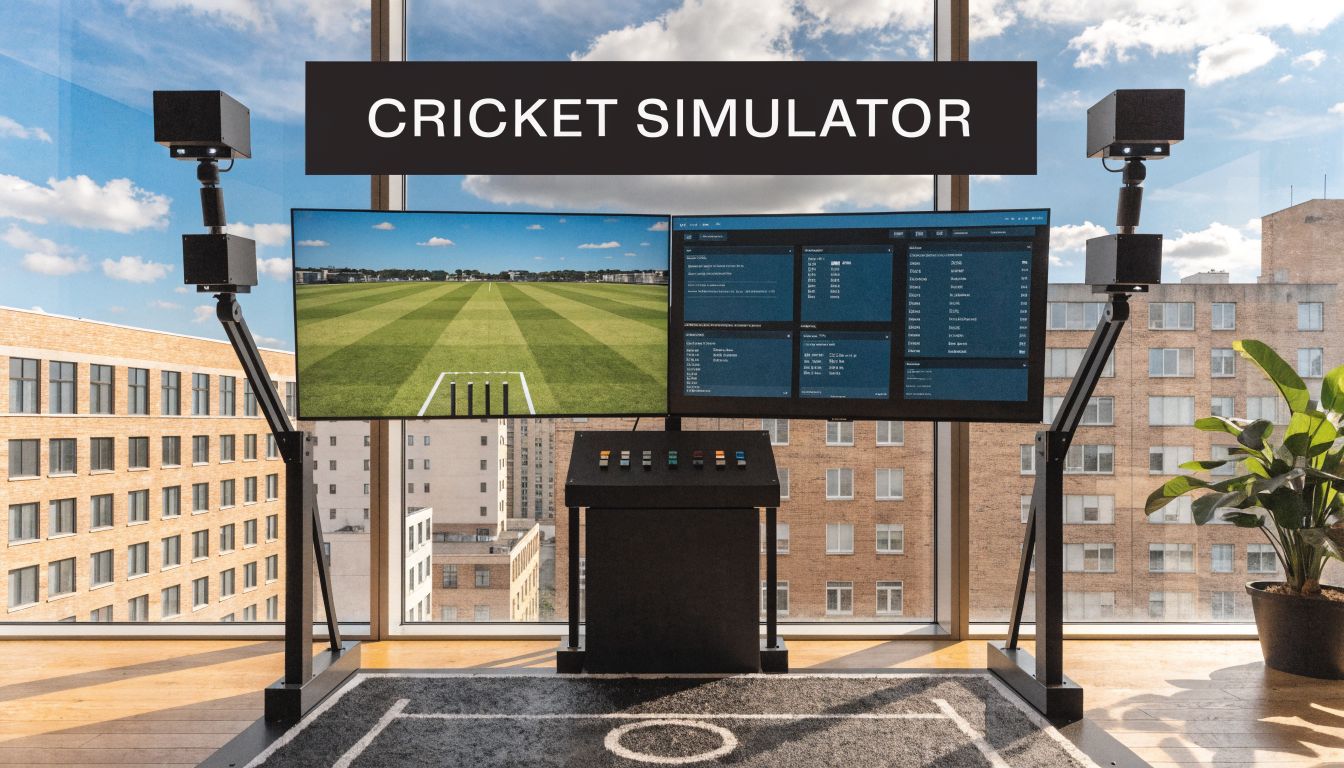
A professional cricket simulator isn’t a console game on a big screen. It’s closer to a premium golf simulator or race simulator, where physical action and digital feedback are tightly linked.

The player stands in a controlled batting area, faces projected or screen-based bowling visuals, and plays with a real bat against delivered balls or a ball-feed system designed for repeatable event use. Scoring is handled through sensors and software, so every shot has an outcome the audience can see immediately.
At event level, that combination is what makes it feel substantial. Guests aren’t pressing buttons. They’re stepping into a live, physical challenge.
The core parts that matter
When clients ask what they’re hiring, I usually break it down into function rather than hardware labels.
- The batting lane: This is the safe play area, enclosed and set up for controlled use.
- The visual system: Projected or screen-based bowler and stadium visuals create context and realism.
- The ball delivery and feed system: This keeps the experience consistent and suitable for repeat play.
- The scoring layer: Sensors and software translate each shot into points, outcomes and leaderboard results.
The result is accessible for beginners, but still credible enough for cricket fans who’ll judge whether it feels authentic.
Why realism matters at events
If the experience feels cheap, guests try it once and move on. If the visuals are convincing and the timing feels right, the simulator becomes a gathering point.
The technology behind higher-end systems is built to replicate actual batting decision-making rather than just provide a target game. That’s a major difference between a professional event activation and a novelty fairground setup.

A short look at the format helps:
Who it suits
A good corporate cricket simulator works for mixed audiences because it can be framed in different ways.
For an exhibition crowd, it’s a lead-generation magnet. For internal events, it creates team rivalry. For hospitality, it gives clients something interactive without requiring full sporting ability.
Practical rule: If guests can understand the challenge in a few seconds and spectators can read the outcome instantly, the attraction will hold attention.
That’s the benchmark I’d use when deciding whether a simulator belongs at your event.
How A Simulator Can Transform Your Event Experience
The strategic value of a cricket simulator is simple. It does several jobs at once.
It entertains, but it also stops traffic, creates a conversation point and gives your event team a natural opening with guests. That’s why it works particularly well at exhibitions and branded activations, where passive displays rarely hold attention for long.
It pulls people in
A simulator creates visible action. Bats swing. Balls travel. Scores appear. People instinctively turn towards movement and competition, which is why these installations often become the busiest part of a stand or hospitality area.
That matters because attracting people is only the first step. What you really want is a reason for them to remain long enough for a useful interaction. A cricket challenge gives them that reason.
It changes the social dynamic
Many event formats suffer from the same problem. Attendees need a way in.
A simulator gives them one. Instead of opening with awkward small talk, they can start with, “What did you score?” or “Have you had a go yet?” That sounds minor, but in practice it softens the room immediately. People who wouldn’t normally volunteer for formal networking often join a game.
Where it works best
Different event goals call for slightly different uses:
- Exhibitions and trade shows: Use the simulator as a front-of-stand attention point, then move players into a sales conversation once they’ve engaged.
- Team building events: Split groups into departments or mixed teams so the experience becomes collaborative rather than just individual.
- Client hospitality: Frame it as light competition, not serious sport. That keeps participation broad.
- Brand activations: Build campaign messaging into the scoring flow, visuals or prize mechanic.
It gives branding a job to do
Branding works best when it’s attached to action. A logo on a backdrop is fine. A logo embedded into a live leaderboard or branded challenge carries more weight because guests interact with it repeatedly.
In practice, the strongest activations usually include:
- Branded score displays: These keep the sponsor or host visible every time a guest checks the rankings.
- Themed challenges: Fastest run, best over, target score or team league formats all support campaign messaging.
- Staffed engagement: Hosts can explain the game, manage flow and connect the moment back to the wider event objective.
If the simulator is busy but your team hasn’t built a capture or conversation mechanic around it, you’ve only solved half the problem.
That’s the trade-off planners should keep in mind. Pure entertainment creates buzz. Structured entertainment creates business value.
Planning Your Setup Technical and Logistical Requirements
The first practical question is usually, “Will it fit?” The second is, “How much venue management will this create for us?”
For most corporate events, the answer depends less on the simulator concept and more on whether the provider has designed the installation properly for venue realities. A cricket simulator can be straightforward to run, but only if the basics are handled early.
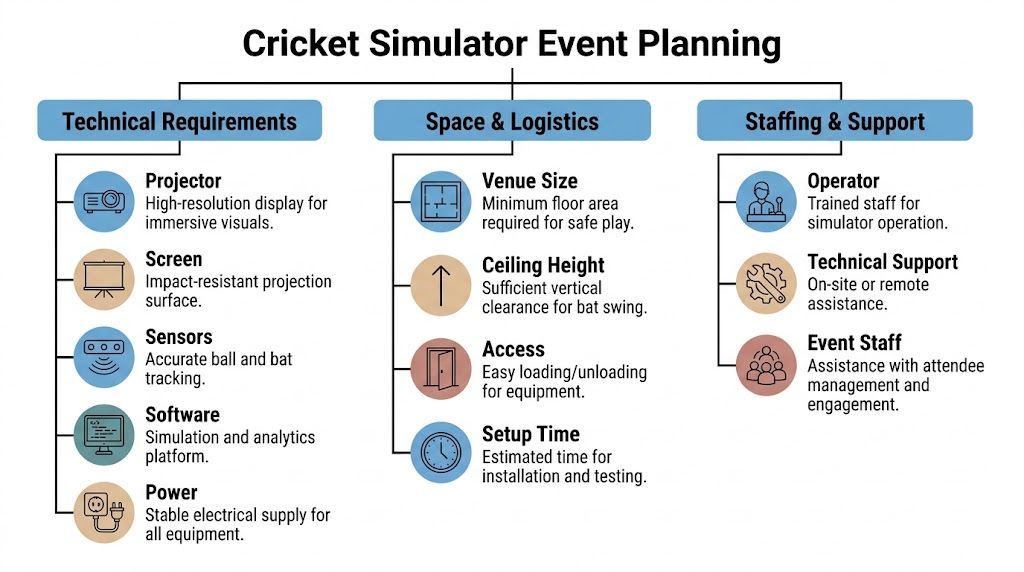
Space, power and projection
In UK exhibition venues, a cricket simulator needs a minimum 15m pitch length to preserve realistic ball flight, and professional turnkey hire is typically around £10,000 to £15,000, with automatic feeders and sensor-based scoring supporting over 100 plays per day according to the venue and hire specifications referenced here.
That number matters because anything shorter starts to compromise the feel of the experience. You can still create an interactive batting game in a smaller footprint, but it won’t behave like a proper cricket simulator in the same way.

Projection setup is another area where corners cause problems. Top-mounted projectors and proper screen alignment usually produce a cleaner image and a better batting read than improvised floor-level projection. At event level, that affects more than appearance. It affects whether guests trust what they’re seeing.
Cricket Simulator Hire Checklist
| Requirement | Specification | Notes |
|---|---|---|
| Space length | Minimum 15m pitch length | Needed for realistic ball flight in exhibition environments |
| Power | 220V | Standard supply for simulator operation |
| Staffing | Minimal staffing | Professional setups can run efficiently with a small event team |
| Throughput | Over 100 plays per day | Useful for high-footfall activations |
| Scoring | Sensor-based scoring | Supports quick play and visible competition |
| Ball handling | Automatic ball feeders | Reduces reset time between turns |
| Budget | Around £10,000 to £15,000 | Typical turnkey hire range |
Venue questions to answer early
Before booking, I’d pin down these points with the venue and your supplier:
- Access routes: Can the kit get from loading bay to event space without awkward manual handling?
- Ceiling conditions: Is there adequate overhead positioning for projection and safe bat swing?
- Lighting control: Can the simulator visuals remain clear in the wider exhibition environment?
- Floor condition: The area needs to be level and stable for the batting lane and surrounding structure.
If you’re already comparing simulator formats, it’s useful to look at how other sports activations are planned too. The same venue logic often applies across driving simulators for UK events, particularly around access, power, staffing and spectator flow.
What turnkey should mean
A true turnkey hire shouldn’t just mean the equipment arrives. It should mean the provider handles delivery, installation, testing, operation and pack-down in a way that protects the event schedule.
That includes thinking about queue lines, safe waiting areas, bat handover, scoring visibility and who resets the game between users. The logistics aren’t difficult, but they do need ownership.
Maximising Engagement and Measuring Return on Investment
A cricket simulator earns its place fastest when it’s tied to a measurable outcome. That might be leads, dwell time, repeat visits, brand visibility or structured team interaction. The mechanism matters as much as the machine.
Professional systems can replicate delivery speeds from 60 to 160 KPH over a standard 22-yard cage distance, and their realism is associated with a 25 to 30% improvement in batting timing and rhythm. In event settings, that same realism has been linked to an average 15-minute increase in attendee dwell time and 500+ sessions per week in high-traffic fan zones, according to the ProBatter PX3 simulator specifications and event-use data.
That’s useful because dwell time is one of the clearest indicators of activation value. If people stay longer, your team gets more chances to talk, qualify and convert attention into opportunity.

The mechanics that actually work
The strongest cricket simulator activations usually rely on simple competition formats rather than overcomplicated game design.
- Top score leaderboard: This creates a public reason to play and replay.
- Timed prize windows: Best score before lunch or best score of the afternoon keeps traffic moving across the day.
- Team challenge format: Useful when departments, clients or invited groups need a shared objective.
- Registered play entry: If players submit an email address or badge scan to post a score, the attraction becomes a lead-capture tool.
What doesn’t work as well is leaving the simulator as an unstructured free-play unit with no visible scoring narrative. People enjoy it, but the event team loses the chance to turn attention into data.
Measuring more than queue length
A queue looks positive, but it isn’t enough on its own. I’d look at four operational indicators:
- How long people stay in the activation zone
- How many return for a second attempt
- How many conversations the sales or host team starts from play
- How many usable contacts are captured through registration
Those measures are common across immersive event formats. If you want a wider framework for evaluating interactive attractions, Studio Liddell’s guide to throughput, safety, and ROI in Location-Based VR is a useful parallel read because the same operational thinking applies.
Turning play into a business outcome
The simulator does the attraction work. Your event design needs to do the conversion work.
That might mean routing players from the batting lane to a hosted demo, pairing scores with branded follow-up, or making the leaderboard part of a broader experiential marketing activation rather than a standalone novelty.
A simulator creates attention. The activation plan decides whether that attention becomes pipeline, recall or qualified engagement.
That’s the difference between hiring equipment and designing an experience.
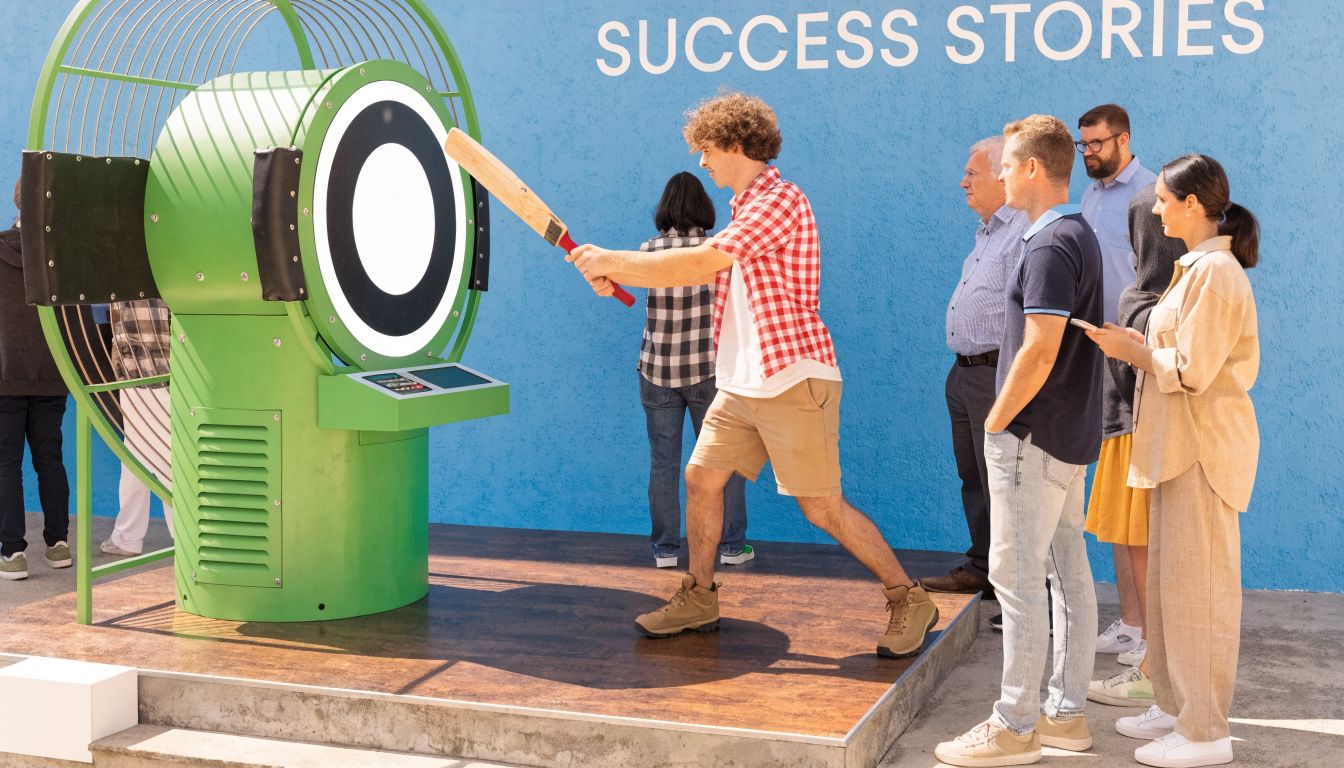
Real-World Success Cricket Simulators in Action
The easiest way to judge whether a cricket simulator belongs at your event is to look at how it behaves in different settings. The use case changes. The logic doesn’t.

Exhibition stand traffic
A trade show stand often has a narrow window to attract attention. Static graphics can explain a brand, but they don’t always stop people in motion.
In that environment, the simulator works as a front-edge magnet. Passers-by notice the batting action, spectators gather around the score display and stand staff suddenly have a reason to begin a conversation that doesn’t feel forced. The best version of this setup uses the game as the first touchpoint, then moves the participant into a product or service discussion while their score is being logged.
Corporate team building
Internal events need a slightly different tone. The goal is usually participation, not pure spectacle.
A cricket simulator helps because it gives mixed-ability groups a common challenge. One person might be competitive. Another might only join in because colleagues are watching and laughing. Both outcomes are useful. In practice, inter-department leaderboards, rotating mini-competitions and light hosting usually produce better energy than trying to make the experience too serious.
The best team-building format isn’t the one with the hardest game. It’s the one that gets the most people involved without embarrassment.
Public fan zone activation
Fan zones need pace. They also need something visually legible from a distance.
A cricket simulator suits that environment because the story is obvious. Someone’s batting. The crowd can see whether they connect cleanly. The score gives immediate context. That makes it easier for brands and organisers to build atmosphere around the installation, especially when there’s a presenter, branded challenge or rolling leaderboard.
The common thread across all three settings is that the simulator performs best when the event team decides what success looks like before the first guest picks up a bat. Is the aim lead capture, social energy, hospitality value or crowd animation? The setup, staffing and scoring format should follow that answer.
Booking Your Simulator A Checklist for Success
A smooth cricket simulator hire usually comes down to decisions made early. The later you leave the operational details, the more likely the event team ends up solving avoidable problems on site.
One point should sit near the top of the list. Health and safety isn’t an afterthought with interactive attractions. It’s part of the booking decision. A source discussing simulator compliance notes a 34% rise in interactive simulator incidents at UK exhibitions, and it also notes that professional turnkey providers address this through trained on-site staff and £10 million in liability insurance, as outlined in the Arc Simulations reference on simulator safety and compliance.
The booking checklist I’d use
Start with purpose, not equipment.
Define the event objective
Decide whether the simulator is there to drive footfall, support lead capture, reward staff, host clients or create fan-zone atmosphere. One unit can serve all of those jobs, but not in the same way.Confirm the venue realities
Check floor space, access, loading, ceiling conditions, power availability and where spectators will gather. This avoids trying to squeeze an active installation into a layout designed only for static display.Choose the game format
Open play suits casual hospitality. Leaderboards suit exhibitions. Team scoring suits internal events. The format should match the behaviour you want from the audience.Agree branding and data capture
If the simulator is part of a campaign, decide where branding appears and how scores, registrations or contact details will be captured.
What a professional hire should include
A proper package should cover more than the simulator itself. You want clarity on:
- Delivery and installation
- On-site operation
- Risk assessment and safe play management
- Pack-down after the event
- Insurance position
- Any branding or leaderboard options
Provider experience matters. For example, PSW Events supplies cricket simulator hire as a turnkey service for corporate events, including planning, installation, staffing and insured delivery within a wider simulator and interactive entertainment offering. That’s useful for clients who want one supplier to manage the full activation rather than coordinating separate technical and event teams.
What works and what doesn’t
Some trade-offs are worth stating plainly.
- What works: Clear briefing, visible queue management, simple scoring, strong host presence and a defined event objective.
- What doesn’t: Hiding the simulator in a dead corner, making the rules too complicated, or assuming guests will convert into leads without a capture mechanism.
Booking advice: Ask who is responsible for safety on the day, who operates the equipment, and what happens when the queue builds.
Those answers tell you a lot about whether you’re hiring a feature or buying a managed experience.
If you’re planning a conference, exhibition stand, hospitality event or team day and need interactive entertainment that delivers both energy and structure, a cricket simulator is worth serious consideration. Contact PSW Events to discuss the venue, audience and event goals, then build the activation around what success needs to look like on the day.