
Forget what you think you know about children's assault courses. These aren't just glorified bouncy castles; they are powerful, engaging attractions that can become the centrepiece of your entire event. For an event planner, they’re a strategic tool designed to pull in crowds, get people talking, and provide a healthy, active form of fun.
Why Assault Courses Are a Modern Event Must-Have

Let's get past the idea of assault courses as simple inflatables. Today’s attractions are sophisticated engagement pieces that create a focal point for everything from corporate family days to large public festivals.
They've come a long way, but their roots go deep. In the UK, assault courses became a physical education staple after World War II to boost national fitness. The Ministry of Education started pushing schools to build outdoor obstacle courses around 1950, and by 1965, over 80% of secondary schools had one.
Creating a Strategic Focal Point
Modern event planners now use these attractions to hit key targets. A well-placed assault course isn't just a bit of fun; it’s a magnet that draws attendees in and dramatically increases how long they stick around.
This increased "dwell time" is gold. It gives you more opportunities for brand interaction, whether you’re at a huge venue like the NEC in Birmingham or hosting a local company fun day.
Think about the visual impact. A large, colourful, and active structure becomes an instant landmark. It generates a buzz that pulls people in, creating an anchor point you can build the rest of your event layout around.
Driving Social Engagement and Teamwork
In the age of social media, shareable moments are everything. A child conquering a climbing wall or friends racing through a tunnel is a perfect photo op for parents. These organic posts create authentic social media buzz, amplifying your event's reach far beyond the venue gates.
But it’s not just about individual fun. These courses are brilliant for encouraging teamwork and friendly competition. The challenges are structured to get kids helping and cheering each other on, building a real sense of camaraderie. This makes them a fantastic choice for community or team-building events. For more ideas on how to integrate attractions like these, check out these unforgettable fun activities for a family day.
A children's assault course transforms passive attendees into active participants. It's not just something to look at; it's something to do, creating memorable experiences that define a successful event.
If you’re looking to create a true playtime paradise, assault courses are one of the best outdoor toys for active kids you can offer. They blend physical challenge with pure fun, perfectly tapping into a child's natural urge to climb, run, and explore. It’s time to see these courses as a strategic investment in your event’s success.
Choosing the Right Assault Course for Your Event
Picking the right assault course isn't just about finding something big and bouncy; it's a decision that directly impacts guest flow, experience, and even how people see your brand. The trick is to stop thinking about it as just another activity and start matching the format to your specific crowd and what you want to achieve on the day.
Your choice usually boils down to two main types: high-throughput inflatable runs or the more complex, modular courses. Each has its place and is built for different kinds of events.
If you’re running a big public festival or a school fayre, your main goal is getting as many people through as possible. For that, a long, linear inflatable assault course is your best bet. They’re designed for a constant stream of kids, which keeps queues moving and prevents frustrating bottlenecks. Their sheer size and bright colours also do a fantastic job of pulling families in from across your event site.
Matching the Course to Your Audience
The first thing you have to lock down is the age of your participants. An assault course built for teenagers will be far too difficult and potentially unsafe for children in the 5-8 age bracket. On the flip side, a simple course for the little ones won't hold the attention of older kids for more than a minute.
Always check the supplier’s recommended age range. A good hire company will have different models designed for specific age groups, making sure the obstacles are fun but achievable.
Think about the event's purpose, too. Is it a relaxed family fun day or something more competitive?
- Competitive Events: A twin-lane inflatable run is perfect for head-to-head races. This setup naturally fuels a bit of friendly competition, which is great for company sports days or community games.
- Team-Building Focus: Modular courses, with separate challenges like climbing nets, balance beams, and tunnels, are brilliant for encouraging teamwork. Kids (and adults!) often need to help each other through, which gets them communicating and working together.
- Brand Activations: When you're launching a product or on a promotional tour, you need to make a visual splash. A bespoke, branded inflatable that uses your company's colours and logos isn't just an activity; it's a massive, interactive billboard.
The best results happen when the assault course feels like a core part of your event, not just a last-minute addition. What story are you trying to tell? Pick a course that helps you tell it.
Assault Course Format Comparison for Event Planners
Choosing the right format can feel overwhelming, but breaking it down by event type and participant profile makes the decision much clearer. This table compares the most common options we see requested by event organisers.
| Course Type | Best For | Age Range | Key Features | Space Requirement |
|---|---|---|---|---|
| Linear Inflatable Run | Large public events, festivals, school fayres | 5-16+ | High throughput, continuous flow, strong visual appeal. | Long and narrow (e.g., 30m L x 5m W) |
| Twin-Lane Inflatable | Competitive events, company sports days | 8-Adult | Head-to-head racing, digital timers, scoreboards. | Wide and long (e.g., 25m L x 8m W) |
| Modular Course | Team-building, corporate family days, varied age groups | All Ages | Separate obstacles (nets, beams, tunnels), flexible layout. | Highly variable; can be spread out or compact. |
| Bespoke Branded | Brand activations, product launches, roadshows | Varies | Custom colours, logos, themed obstacles, photo opportunities. | Custom; designed to fit a specific footprint. |
| Toddler Play Zone | Crèche areas, family zones, events with young children | Under 5 | Soft play shapes, mini slides, safe, low-level obstacles. | Small and contained (e.g., 6m x 6m) |
Ultimately, the format you choose sets the tone for the activity. A twin-lane course creates a high-energy, competitive atmosphere, while a modular setup encourages a more collaborative and exploratory vibe.
Scenarios in the Real World
Let's walk through a few real-world examples.
Imagine you're organising a family fun day for a large corporation. The main goal is a relaxed, enjoyable atmosphere for employees and their kids. A large, colourful inflatable course with lots of different, non-intimidating obstacles would be perfect. It provides high-energy fun without feeling too competitive.
Now, picture a product launch for a new sports drink targeting active families. You need something that shouts energy and performance. A striking, custom-branded Energy Run assault course with a digital timer and a live leaderboard is the way to go. This turns the activity into a memorable brand experience that people will want to share on social media.
Finally, think about a community festival that needs to bring lots of different people together. A sprawling, modular course with distinct "zones" could be the answer. You might have a climbing zone, a balance zone, and a speed zone. This allows for different kinds of engagement and works for various skill levels and age groups all at once. You can see a huge variety of inflatables for rent to get a better feel for what might match your specific event.
When you carefully weigh up your event's goals and who will be attending, you can pick a children's assault course that not only works, but delivers a real impact and creates fantastic memories for everyone involved.
Mastering Space, Flow, and Throughput Logistics
Getting the logistics right for your children's assault course is what separates a roaring success from a frustrating bottleneck. It’s not just about finding a spot to inflate the thing; you have to plan the entire area around it, from the queues right down to where parents will stand.
If you get the space or flow wrong, you can kill an event’s atmosphere pretty quickly. Long, static queues mean bored kids and unhappy parents – the exact opposite of the energetic vibe you're aiming for. A well-thought-out plan, on the other hand, keeps a constant, smooth flow of participants and makes sure everyone has a great time.
Calculating Your Total Space Footprint
The first mistake I see planners make is only thinking about the dimensions of the assault course itself. You need to think bigger. A professional supplier will give you the footprint of the equipment, but it’s your job to add the crucial extra space needed to run it safely and smoothly.
A solid rule of thumb is to add a safety perimeter of at least 1.5 to 2 metres around the whole course. This buffer zone is non-negotiable. It keeps spectators at a safe distance and gives your staff room to move and help anyone who needs it.
Next, you have to account for the people. Where will they queue? Where will parents watch from?
- Queuing Area: This needs to be clearly defined, ideally with barriers, and placed so it doesn't block other event traffic. The size will depend on your estimated throughput numbers.
- Spectator Zone: Give parents a comfortable spot to watch and take photos. This encourages them to stick around longer and keeps them engaged while their kids are on the course.
- Entry and Exit Points: Make sure these are separate and clearly marked to create a one-way system. An exit that just funnels kids into a disorganised crowd is a recipe for chaos.
Pro Tip: Always ask your supplier for a scaled floor plan or CAD drawing. This helps you visualise the entire setup, including the essential buffer and queuing zones, and ensures it all fits within your event layout without any nasty surprises on the day.
The ground surface is another key logistical point. Flat, well-drained grass is perfect because it allows for secure anchoring with pegs. Hard surfaces like concrete or tarmac are doable, but they need heavy water or sand ballasts for anchoring and extensive safety matting. This will almost certainly increase your cost and setup time.
This visual guide shows how different event goals influence the type of children's assault course you might choose.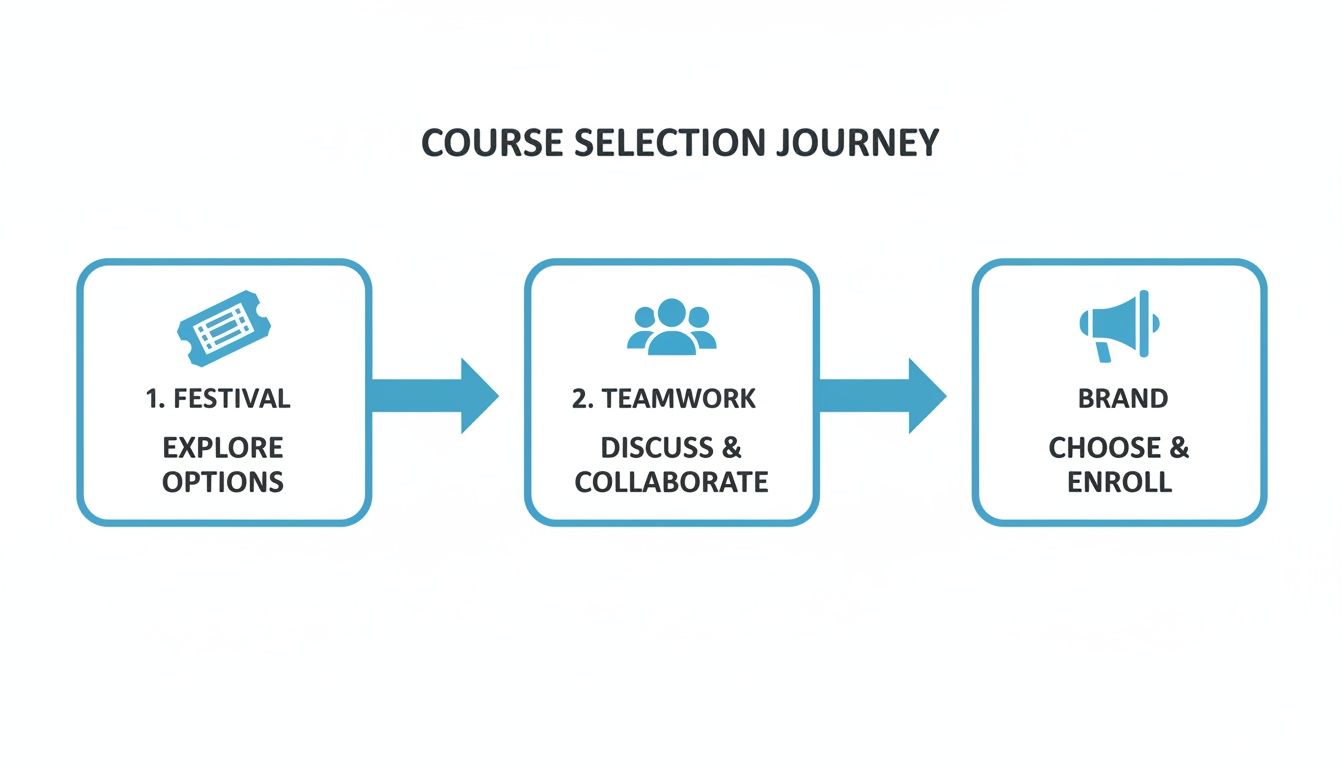
The flow here makes it clear: whether you're planning for a high-volume festival, a team-building day, or a brand activation, your logistical needs will change with your goals.
Estimating and Managing Participant Throughput
Once you have your space sorted, you need to manage expectations about how many children can actually use the course. We call this throughput, and getting it right prevents disappointment. Your first step is to ask the supplier for the estimated throughput per hour for the specific course you're hiring.
Let's walk through a real-world scenario. Imagine you're organising an activity for a corporate family day. You're expecting 500 children over a 4-hour event window.
You've picked a medium-sized inflatable assault course, and the supplier has told you it has a throughput of 150 participants per hour. On paper, this sounds perfect (150/hr x 4 hrs = 600). But hang on – that's a maximum figure, assuming ideal conditions.
In reality, you have to account for variables. You'll have peak times with a surge in demand and quieter periods with fewer participants. A much more realistic estimate is to plan for 70-80% of that maximum capacity. This brings your effective throughput down to around 105-120 participants per hour.
Over your 4-hour event, this means you can realistically handle between 420 and 480 children. That's much closer to your expected 500 and lets you manage expectations properly. If the queue starts looking a bit long during a peak period, your staff can simply let parents know the estimated wait time. This one simple act of communication can make all the difference.
Getting Safety and Compliance Right
Let's be blunt: when it comes to children's assault courses, safety isn't just a priority; it's the only thing that matters. As an event organiser, getting this right protects your reputation, your client, and most importantly, every single child taking part.
This isn't about wading through legal documents for the sake of it. It’s about knowing what to ask your supplier for and what a truly professional operation looks like. Any good company will have this information ready, but knowing the specifics yourself is how you can spot the difference between a great supplier and a potential liability.
The good news is that the UK has a rock-solid framework for these kinds of activities. The numbers back this up. Between 2020-2025, HSE's RIDDOR data recorded just 147 reportable incidents from an estimated 10 million uses. That gives us a safety rate of 99.998%, a figure largely thanks to tough rules like the Adventure Activities Licensing Regulations 2004. If you're interested in how these courses have developed over time, it's worth checking out the history of obstacle courses.
The Non-Negotiable Paperwork
Before you even think about signing a contract, you need to see some key documents. Think of these as the supplier's licence to operate. They are absolutely non-negotiable.
Here’s your essential checklist:
- Public Liability Insurance: Ask for the certificate. It needs to show a minimum of £10 million of cover. This is the industry benchmark and protects you if an accident happens.
- Risk Assessments and Method Statements (RAMS): Don't accept a generic, one-size-fits-all document. A proper RAMS will be specific to your venue, detailing exactly how they’ll handle hazards from a sloping field to a nearby car park.
- Equipment Test Certificates: This is critical. For any inflatable, you must see a valid PIPA or ADIPS certificate. For other equipment like A-frames or balance beams, they must meet BS EN 1176 standards.
To get a head start, you can use a standard event risk assessment template to cross-reference against your supplier's documents. It helps ensure nothing gets missed.
Don't just take their word for it. A reputable company will have digital or physical copies of these documents ready to send over without any hesitation. If they can't provide them, walk away.
Staffing and Supervision: More Than Just Watching
The best equipment in the world is useless without the right team on the ground to manage it. A professional hire company won't just drop off the gear; they'll provide fully trained, uniformed staff to run it. Their job is to actively manage the course, not just stand around. They enforce rules, keep the flow of kids moving, and help anyone who gets stuck.
The number of staff you need depends entirely on the course. A small inflatable might only need one or two people. But for a massive, multi-part course, you’ll want a supervisor at every major obstacle.
A good rule of thumb for staffing is:
- Start & Finish Lines: Always have staff posted at the entry and exit points. This prevents bottlenecks and ensures a safe, one-way system.
- Tricky Obstacles: Any section with a big climb, a tricky balance beam, or a slide needs a dedicated staff member close by to guide and assist.
- The Rover: You should have at least one senior supervisor who has eyes on the entire operation, ready to jump in and act as your main point of contact.
Go through the staffing plan with your supplier before you book. They should be able to explain exactly why they’re recommending a certain number of staff based on your chosen course and expected attendance. If you're weighing up your options, our guide on hiring an inflatable obstacle course offers more detail on what a complete, professionally run package looks like.
Making It Yours: Branding, Tech, and Accessibility

Any children's assault course is going to be fun. But a well-branded one? That’s an entirely different beast. You’re not just hiring an activity; you’re creating a powerful marketing asset that people will remember long after they’ve gone home.
The trick is to go beyond just slapping a few logos on the side. Real brand integration means weaving your identity right into the attraction itself. It stops feeling like an advert and starts feeling like an exciting, cohesive world built just for them.
Think about it from a distance. A generic blue inflatable is just another inflatable. But one in your specific company colours? That becomes your assault course, instantly recognisable and drawing people straight to your stand.
Weaving Your Brand into the Fabric of the Course
Effective branding on an assault course comes down to the details. When you customise multiple elements, you create a polished, professional look that says you've invested in the visitor experience.
Here are the branding opportunities we always recommend focusing on:
- Custom Colours: This is your biggest win. Work with your supplier to get the inflatable or modular pieces produced in your primary brand colours. It’s the fastest way to make the attraction feel completely bespoke.
- Branded Arches: A custom-printed start/finish arch is non-negotiable. It looks fantastic and, crucially, becomes the main photo spot for parents. Your brand will end up all over social media.
- Obstacle Logos: Get your logo onto key parts of the course—climbing walls, tunnels, slides. It reinforces your brand as kids tackle each challenge.
- Staff Uniforms: Don’t forget your team. Branded t-shirts or jackets make them easy to spot and ensure they look like a professional part of the whole operation.
The real aim here is to make your brand synonymous with the fun itself. When a child is buzzing about the "massive red and white climbing wall," they’re talking about your brand. That's the power of smart, integrated branding.
Turning Up the Fun with a Bit of Tech
Visual branding is one thing, but technology can add a whole new dimension of excitement. Adding some friendly competition can turn a fun activity into a day-long obsession for kids and parents.
The best tool for this is a digital leaderboard. Picture a large screen right by the finish line, flashing up the day's best times, 'Top Gear' style. This one simple addition introduces a competitive streak that encourages repeat plays and gets everyone talking.
A digital timer system can automatically log each child’s time as they cross the finish line, updating their rank on the big screen instantly. It fuels the competition, yes, but it also creates a natural gathering point where families can cheer and check the scores. It transforms an individual run into a shared spectacle.
Designing for Everyone: Accessibility and Inclusion
A genuinely successful event is one where everyone feels they can join in. When you're planning your assault course, it’s vital to think about how you can open up the fun to children with a wider range of abilities and needs.
This doesn't have to mean a complete redesign. More often than not, small tweaks and thoughtful planning can make all the difference and ensure every family has a positive experience.
Here are a few simple but effective ways to improve accessibility:
- Create "Chill-Out" Zones: Set aside a quieter space near the course. This gives children who might feel overwhelmed by the noise and crowds a place to decompress.
- Offer Alternative Routes: Where you can, work with your supplier to create simpler paths around the more physically intense obstacles. This ensures no one feels left out.
- Use Clear, Visual Signage: Simple icons and large, easy-to-read text for rules and directions help children who might struggle with reading or processing lots of verbal instructions.
By building these practices into your plan, you're not just ticking a box. You’re showing that your event and your brand value every single participant. That kind of thoughtful approach builds huge goodwill and makes sure people associate your name with positivity.
Your Children's Assault Course Hire Questions Answered
After years in the events game, you start to see the same questions pop up. We've worked with hundreds of planners, and when it comes to hiring a children's assault course, there are a few key details that always need clarifying.
This is your quick-reference guide. The no-fluff answers to the most common queries, designed to help you nail down the final details and book with confidence.
What Is Included in a Standard Hire Package?
When you hire a professional assault course, you're not just renting equipment. You're bringing in a fully managed activity. The goal is for it to be as hands-off for you, the organiser, as possible.
A proper, professional package will always cover:
- The Course Itself: Every inflatable, module, and obstacle you've picked out.
- Full Delivery & Professional Setup: An experienced crew handles the entire build.
- Essential Safety Matting: Placed at all entrances, exits, and along any open sides.
- Trained, Uniformed Staff: This is the big one. You need experienced supervisors to run the activity safely.
- Complete H&S Documentation: Non-negotiable. This must include site-specific risk assessments (RAMS) and proof of at least £10 million in Public Liability Insurance.
The price also covers the full de-rig and pack-down after the event. It’s a turnkey service, leaving you to focus on your guests while the supplier takes care of the logistics from start to finish.
How Much Space Do I Really Need for an Assault Course?
This is where things can get tricky, as the answer varies massively. A simple, linear inflatable might only need a 15m x 5m patch of grass. In contrast, a huge, multi-part modular course could easily demand a 40m x 20m area.
The single biggest mistake people make is only accounting for the inflatable's footprint. You absolutely must factor in the surrounding space needed for safe operation.
The Golden Rule: Always add a safety perimeter of at least 1.5 to 2 metres around the entire structure. This creates a clear, non-negotiable buffer zone that staff use to move around and supervise.
On top of this buffer, you also need to plan space for:
- A defined queuing area: Use barriers to keep the line organised and stop it from spilling into other zones.
- A spectator area: Give parents and guardians a dedicated spot to watch from.
- Clear entry and exit points: These should be separate to create a one-way flow of traffic and prevent bottlenecks.
Flat grass is always the best surface because it can be securely pegged down. Hard surfaces like tarmac or concrete can work, but they require a lot of heavy ballast and much more extensive safety matting, which will almost always increase the cost.
What Is the Plan for Bad Weather like Rain or High Wind?
When it comes to weather, safety is the only thing that matters. For inflatable assault courses, the rules are strict: operations must stop if wind speeds hit the legal limit, which is around 24 mph (Force 5). Any reputable hire company will be monitoring this on-site with an anemometer. There are no grey areas here.
Light, passing showers are often fine. Many modern inflatables have sewn-in roofs that keep the main play surfaces dry. However, heavy or persistent rain is a different story. It will make surfaces dangerously slippery, and the activity will have to be paused until they are properly dried and safe to use again.
With non-inflatable courses (made from wood, metal, and rope), the equipment itself is tougher against the elements. But this means your staff have to be even more on the ball, constantly checking for slick surfaces on balance beams or climbing elements. Always have a clear chat with your supplier about their specific weather contingency plan before you sign on the dotted line.
How Can I Measure the ROI of an Assault Course?
You absolutely can measure the return on investment from an attraction like this. The trick is to be clear on what you're trying to achieve from the outset. You need to align your metrics with your event's goals.
This is especially true for brand activations and corporate family days. The demand for these kinds of activities has exploded. The Active Lives Children and Young People Survey for 2025/2026 found that 47% of kids aged 5-16 took part in outdoor adventure activities, a massive leap from 32% back in 2015. This engagement translates into real results; a 2026 study showed experiential activations with obstacle elements boosted brand recall by a huge 35% among family attendees. To find out more about the importance of protecting children, you can review national statistics and safety resources available from child advocacy organisations.
Here are a few practical ways to track its impact:
- Footfall & Throughput: The easiest win. Give your staff clicker counters or use beam counters at the entrance to get a precise number of participants.
- Dwell Time: A crucial metric for brand activations. How long are families staying at your stand? A brilliant assault course can turn a fleeting visit into a lengthy stay, giving your brand team more time to interact.
- Lead Generation: Why not tie participation to data capture? You could offer a spot on a digital leaderboard in exchange for an email address, for example.
- Brand Awareness: Keep a close eye on your event hashtag on social media. Assault courses are incredibly visual. Parents will be snapping and sharing photos, giving you a fantastic stream of user-generated content that features your branding.