
In London's packed-out event scene, you've got to do something different to get noticed. Virtual clay pigeon shooting gives you that edge—it’s interactive, genuinely fun, and instantly becomes the talking point of any corporate event. It's not just another game; it's how you get people to connect and engage.
The New Must-Have For London Corporate Events
How do you make an event memorable in a city that's seen it all? Event planners are constantly fighting to cut through the noise. This is where virtual clay pigeon shooting simulators are making a real impact, becoming less about simple entertainment and more about active engagement.
Picture a busy exhibition hall at ExCeL London. Most stands have passive displays, but yours has a virtual shooting setup. The sounds of cheering and friendly competition act like a magnet, pulling attendees in, boosting your footfall, and creating a brand activation people actually remember.
Sparking Genuine Connection
You can forget the stilted small talk. A simulator throws people into a shared experience, breaking the ice from the get-go. It’s a natural starting point for conversation and a bit of friendly rivalry between guests who might otherwise just stand around.
This works brilliantly whether you're at a formal conference or a casual team-building day. We've seen it time and again: senior execs and new starters queuing up for a turn, all on the same level. The inclusivity is a massive part of its appeal:
- Accessible to all: You don't need any experience or to be particularly sporty. Guests of any age or ability can have a go and enjoy it.
- Breaks down hierarchies: Everyone’s a beginner. It creates a relaxed, collaborative feel where job titles don't matter.
- Creates a central hub: The simulator naturally becomes the heart of the event, drawing people together and creating a buzz.
The real value of an attraction like this is how it completely changes the atmosphere. It pulls people from being passive spectators into being active participants, making the whole event feel more dynamic and alive.
A Strategic Choice for Event Planners
Bringing virtual clay pigeon shooting to your London event isn’t just about adding a fun activity. It’s a smart move to hit specific event goals. For marketing teams and event agencies, it delivers tangible results.
Think about a branded leaderboard showing the day’s top scores. It keeps your company logo right there in front of everyone, all day long. That kind of constant visibility is far more powerful than a forgotten banner in the corner. We've also seen clients use the "Top Shot" competition as a slick lead-generation tool—just ask for an email to enter the prize draw.
This is exactly why the best planners are always on the lookout for unique corporate event entertainment ideas that do more than just pass the time. They need attractions that engage, connect, and show a clear return on investment. The virtual clay shooting simulator delivers on all fronts, making it a reliable choice for any London event. It’s a proven asset for driving footfall, boosting engagement, and making sure your brand is the star.
How To Plan Your Virtual Shooting Experience
Booking a virtual clay pigeon shooting simulator for your London event is actually pretty straightforward. But getting it right—making it a real centrepiece that people remember—comes down to a little bit of planning upfront. It all starts with one simple question.
What's the main goal here? Are you after high-quality leads at an exhibition? Looking to get different departments mingling at a staff party? Or just want to inject some pure, competitive fun into a client reception? Nailing this down first makes every other decision fall into place.
Defining Your Event Goals
Before you start worrying about floor plans or power supplies, you need to define what a successful outcome looks like for you. Is the simulator a magnet to pull people onto your stand, or is it a tool for getting your own team to work together?
A marketing team at a trade show, for instance, will want to use the leaderboard competition to capture contact details from top players. In that scenario, branding and data capture are everything. But for an internal company do, the focus might shift to team-based game modes to get people laughing and breaking down those usual office barriers.
We’ve run hundreds of these activations, and the best ones always start with a crystal-clear objective. When you know exactly what you want to achieve, we can align everything—from the on-screen graphics to how our operator engages with guests—to hit that target.
Thinking about this from the get-go turns the simulator from a fun distraction into a strategic part of your event’s success.
Assessing Your London Venue
One of the first things we're always asked is, "Will it actually fit in our venue?" The answer is almost always yes. Virtual shooting simulators are incredibly versatile, which is why they work so well across London. We've set them up in everything from grand, historic halls in the City to sleek conference suites in Canary Wharf and quirky warehouse spaces in Shoreditch.
The on-site requirements are refreshingly minimal. All you really need is:
- A flat, level indoor space: An area of about 3m x 3m is the standard footprint. This gives you plenty of room for the screen, the player, and a safe buffer zone around them.
- A standard power source: Just one normal 13-amp plug socket is all it takes to power the entire setup. No special wiring needed.
- Decent ambient lighting: The system is robust, but for the best visual clarity, it’s best to avoid setting up where bright, direct sunlight can hit the screen.
We’ve seen it all, from tight exhibition stands at Olympia to sprawling ballrooms in Mayfair. A quick look at a floor plan or a few photos of the space is usually all a good supplier needs to give you the green light.
The reality is, London events have evolved. It's no longer enough to just have something for people to look at; guests expect to do something. Interactive entertainment has become essential for pulling in a crowd and sparking genuine conversation.
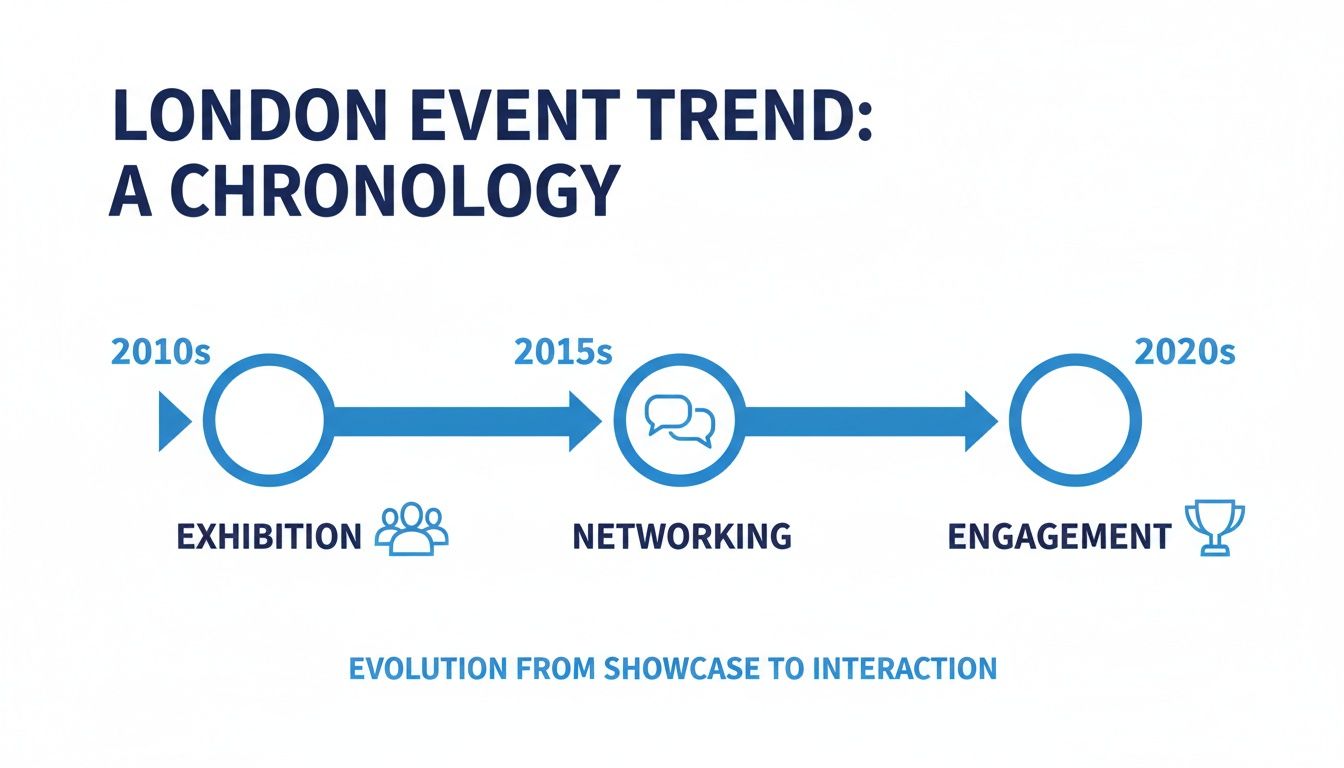
As you can see, the trend is clear: engagement is king. An attraction like this isn't just fun, it's a strategic tool for boosting networking and keeping your event buzzing.
A Sample Planning Timeline
To give you a better idea of the process, here’s a look at the typical milestones from your first call to the day of the event. Having a clear timeline for organising virtual clay pigeon shooting in London means no last-minute surprises.
Here's what you can generally expect:
Sample Event Planning Timeline
| Timeframe | Action Item | Key Consideration |
|---|---|---|
| 8-12 Weeks Out | Initial Enquiry & Quote | Discuss your event goals, date, and venue. You'll get a detailed proposal with package options and costs. |
| 6-8 Weeks Out | Booking Confirmation & Deposit | To secure your date, you'll sign the agreement and pay the deposit. This locks in the kit and staff. |
| 4-6 Weeks Out | Branding & Customisation | This is when you send over your logos, brand guides, and any custom text for the leaderboard or simulator frame. |
| 2-3 Weeks Out | Logistical Coordination | Finalise venue access times, loading bay details, and the contact info for your on-site manager. |
| 1 Week Out | Final Checks | A quick call with your supplier to confirm staff arrival times, final branding proofs, and any last-minute details. |
| Event Day | Installation & Operation | The team arrives on-site, sets up the simulator, and runs the activity for your guests throughout the event. |
| Post-Event | Breakdown & Feedback | The equipment is packed down efficiently. If you were running a competition, you'll receive the lead data. |
Following a simple, structured timeline like this takes all the stress out of the process. It ensures every detail is ticked off professionally, leaving you free to focus on your guests.
Ultimately, a great event activity is about more than the game itself—it's about a seamless experience from start to finish. If you’re looking at other ideas for your next function, our guide to planning a corporate entertainment event has plenty more practical advice.
Mastering The On-Site Setup And Management
The on-site experience is where an interactive attraction either shines or falls flat. What surprises many London event planners is just how straightforward our setup is, making virtual clay pigeon shooting in London an incredibly flexible option for almost any space.
So, what actually happens on the day? You can forget about needing a cavernous hall or complicated technical riders. The whole operation has a refreshingly small footprint.
All we typically need is a dedicated indoor spot measuring just 3m x 3m. This gives us enough space for the screen, the player, and a safe perimeter for guests to watch the action unfold. The power needs are just as simple – the entire system runs off a single, standard 13-amp socket.
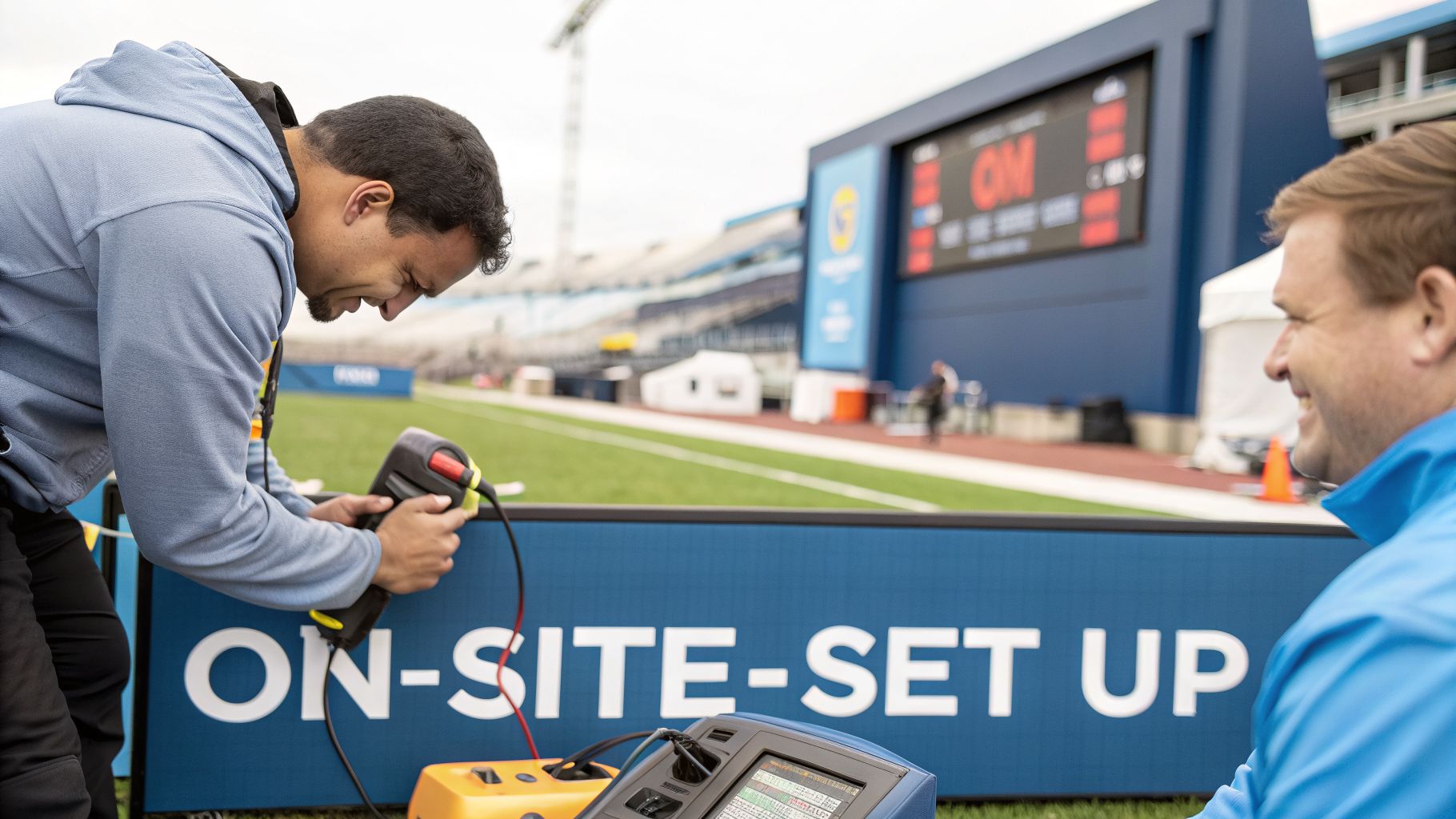
This logistical simplicity means we can get the simulator up and running in all sorts of London venues, from a compact exhibition stand at Olympia to a breakout room in a City conference centre.
Professionalism and Safety On-Site
While the technical side is easy, our approach to safety and professional management is anything but. This is where a quality supplier really shows their worth, and for us, it’s non-negotiable.
We always arrive on-site with full risk assessments and method statements (RAMS) and carry £10 million in public liability insurance. This isn’t just paperwork; it’s your peace of mind and essential for your venue’s compliance. It shows we’ve thought through every potential risk to ensure the activity is fundamentally safe for every single guest.
Of course, the display is the heart of the immersion. If you’re planning a large-scale event, it’s worth reading a guide to LED video wall rental to see what’s possible for creating a truly stunning visual centrepiece. Knowing your options helps you have the right conversation with us to make your setup look spectacular.
The Crucial Role Of Trained Staff
Our on-site team does a lot more than just plug things in. Think of them as extensions of your own event team and brand ambassadors for the day. Their input is what maximises guest engagement from the first minute to the last.
A skilled operator’s job is to:
- Coach the players: They’re brilliant at giving quick, enthusiastic instructions to get people started. They make sure everyone feels confident enough to have a go, no matter their experience level.
- Run the competition: They keep the energy buzzing by constantly updating the live leaderboard, calling out top scores, and building that friendly rivalry that pulls a crowd in.
- Keep the activity flowing: A great operator knows how to manage the queue, ensuring there’s always something happening and the simulator remains a constant hive of activity.
An experienced operator can read the room. They know when to inject more energy, when to encourage a new team-versus-team challenge, or when to spotlight a high score to get the crowd cheering. Their ability to dynamically manage the experience is what keeps guests engaged for hours.
The professionalism of the staff directly reflects on your event. You’re not just hiring equipment; you’re hiring the people who bring it to life. For a closer look at what makes an event team click, our guide on event staffing solutions offers some great insights. It's their expertise that guarantees a smooth, safe, and wildly entertaining activation that hits all your event goals.
Turning Fun Into Measurable Event ROI
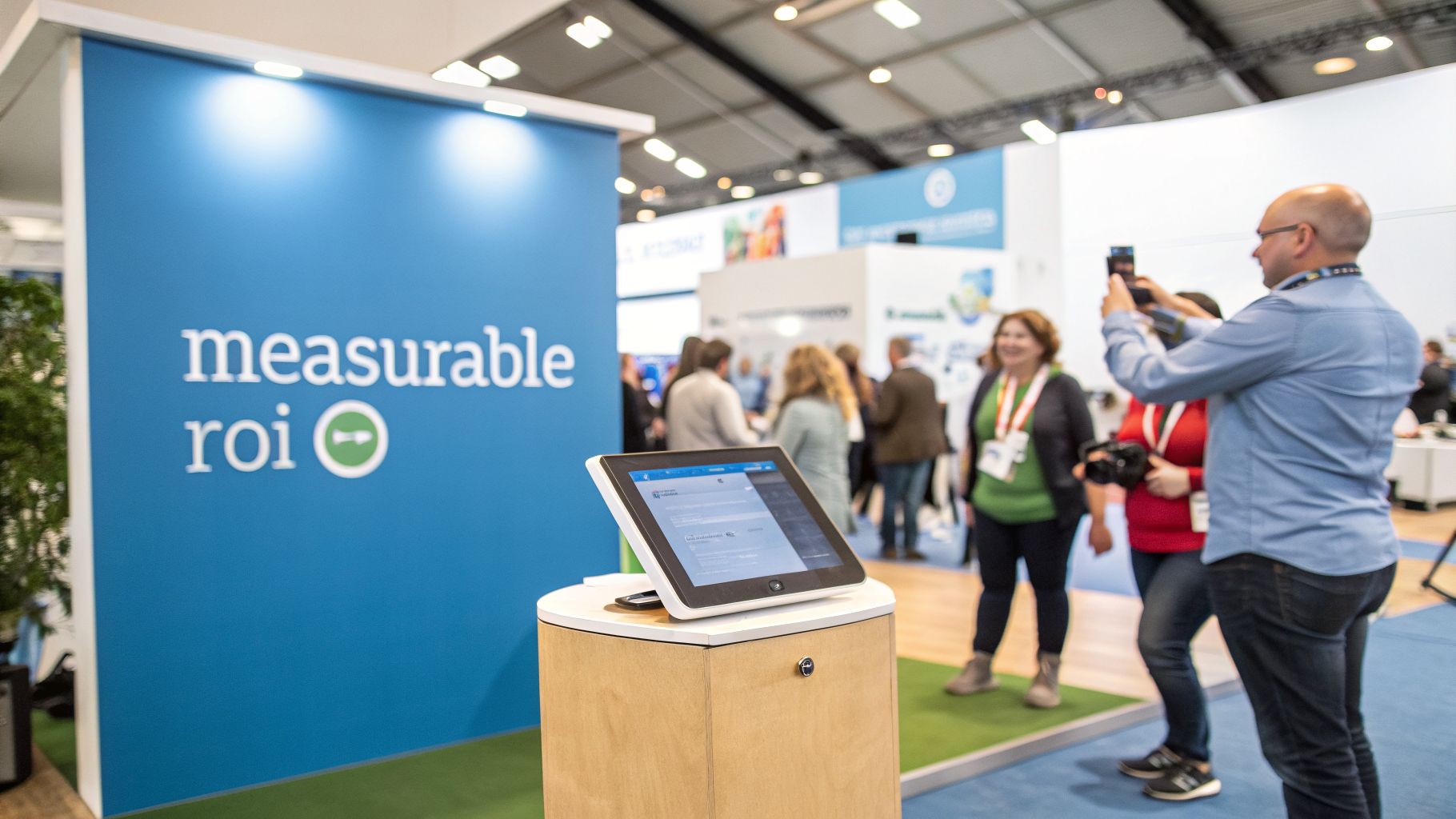
The buzz around a simulator is a given, but as an event planner in London, you’re rightly focused on one thing: what's the actual return? This is where a virtual clay pigeon shooting experience stops being just 'entertainment' and starts working as a serious marketing and engagement tool.
When you plan it right, the fun of the game feeds directly into solid, measurable business goals. The trick is to see the simulator not as a standalone gimmick, but as the centrepiece of your event strategy. It's a focal point you can completely mould to your brand, hoover up high-quality leads, and kickstart a social media buzz that echoes long after the event wraps up.
Driving Brand Visibility And Recall
Let’s be honest, most corporate activities are forgettable. A fully branded gaming experience, however, sticks in the mind. The simulator itself, both physically and digitally, offers a brilliant canvas for your brand.
Think bigger than a pop-up banner. Imagine your company logo wrapped around the entire simulator, making it a beacon that draws people in from across the exhibition hall. We can even customise the in-game targets. Instead of standard clays, players could be shooting at your product logo. Every single 'hit' becomes a direct, positive interaction with your brand.
This creates a level of immersion that a static display just can't compete with. When your branding is woven into the most exciting part of the event, that positive association is incredibly powerful.
Customising Your Way to Success
There are loads of ways to stamp your identity on the experience. From the hardware to the software, you can ensure your brand is front and centre. Here’s a quick look at the most effective options we offer.
Branding Customization Options
| Customisation Area | Description | Marketing Benefit |
|---|---|---|
| Simulator Frame Wrap | A full vinyl wrap covering the physical structure of the simulator with your company's branding, colours, and messaging. | Creates a highly visible, branded focal point that attracts attendees from a distance and looks great in photos. |
| In-Game Target Logos | Replacing the standard digital clay pigeons with your company logo, a product image, or a custom symbol. | Direct, interactive brand engagement. Every successful shot reinforces your brand in a positive, memorable way. |
| Branded Leaderboard | The digital leaderboard screen is fully skinned with your logo, colour scheme, and a custom background. | Reinforces brand identity every time a player checks their score, keeping your name top-of-mind throughout the competition. |
| Custom Intro/Outro Screens | Adding branded video clips or static images that appear before and after each game session. | A captive audience moment to display a key marketing message, a call to action, or your event hashtag. |
These customisations transform the simulator from a hired activity into your activity, making the investment work that much harder for your brand.
A Powerful Engine For Lead Generation
One of the most concrete ways to measure ROI is lead capture. A bit of friendly competition gives people a great reason to hand over their details, and it feels natural, not like a hard sell.
The 'Top Shot' competition is a classic for a reason—it works. Here’s how to nail it:
- Simple Entry: The "cost" to enter the competition is a simple business card drop or a quick badge scan. No friction.
- A Worthy Prize: It doesn't need to break the bank. A good bottle of champagne, a popular tech gadget, or a gift voucher is more than enough to get people interested.
- A Big, Bold Leaderboard: Displaying the top scores in real-time on a large, branded screen is crucial. It stokes that competitive fire and keeps people circling back to your stand to check their ranking (and see your branding again).
By the end of the day, you'll have a list of genuinely engaged prospects who have actively chosen to interact with you. These are warm leads, infinitely more valuable than names pulled from a random prize draw.
A well-run simulator competition isn't just a game; it's a data capture goldmine. We’ve seen clients walk away from a single day's exhibition with over 200 qualified leads, all because they offered an experience people genuinely wanted to be a part of.
Integrating With Your Wider Event Strategy
To truly get the most out of it, the simulator needs to sync up with your other event marketing. For example, come up with a unique event hashtag (like #YourBrandTopShot) and actively encourage players to post photos of themselves playing or their final score. This is a simple way to generate a wave of organic social media content.
You could even link it to your event's app, sending out push notifications when a new high score is set. This drives traffic back to your stand throughout the day and keeps you at the forefront of attendees' minds.
When you connect the hire cost to tangible results—leads captured, social media mentions, and boosted brand recall—the value of hiring virtual clay pigeon shooting in London becomes obvious. It’s an investment in an experience that pays for itself.
Budgeting For Your Virtual Shooting Hire In London
So, let's get down to the numbers. Figuring out the costs for a simulator hire in London can feel like a big question mark, but honestly, it's usually more straightforward than you’d expect. Any reputable supplier, like us at PSW Events, will quote you an all-inclusive price. This means the figure you see is the figure you pay.
This approach is all about giving you clarity and confidence in your budget, with no nasty surprises on the day. As you plan, it's always smart to have an idea of the typical service pricing in the market to make sure you're getting a fair deal. For a standard hire of virtual clay pigeon shooting in London, everything should be neatly bundled into one transparent cost.
What A Standard Package Covers
When that quote lands in your inbox, you need to know exactly what you're getting for your money. A proper, all-in package from a trusted provider will always cover these core elements, so you're not left with any hidden fees.
- The Complete Simulator System: This is the whole kit and caboodle – the large screen, deactivated replica shotgun, sensors, and the computer running it all.
- Transport Within London: Delivery and collection to your venue, typically anywhere inside the M25 motorway, is part of the deal.
- Full Installation & Breakdown: Our technical crew handles the entire setup before your guests arrive and the swift pack-down after the last shot is fired.
- Professional On-Site Staff: You'll have at least one trained operator on-site for the full hire. They’ll manage the game, give pointers to players, and oversee safety.
- Essential Safety Documents: This includes our full public liability insurance (we carry £10 million), plus the risk assessments and method statements (RAMS) that most London venues will ask to see.
A transparent, all-in-one price is the hallmark of a professional supplier. It shows they’ve thought through all the logistics, so you can focus on your guests instead of worrying about surprise charges for delivery or staffing.
Understanding Potential Add-On Costs
While standard packages are built to be comprehensive, there are a few things that might fall outside the typical scope. It’s always good to be aware of what might carry an extra charge so you can factor it in from the start.
Common add-ons could include:
- Complex Custom Branding: A branded leaderboard is usually standard, but if you want a full vinyl wrap for the simulator's structure or custom graphics within the game itself, that will be an additional investment.
- Extensive Travel: For events happening well outside the M25, a surcharge to cover travel time and mileage is pretty standard.
- Multi-Day or Long-Term Hires: If your activation spans several days, like at a week-long exhibition, the hire will be priced accordingly, often with a discounted daily rate to reflect the longer term.
Getting clarity on these points upfront means your budget stays locked in and predictable.
Remember, the true value of hiring virtual clay pigeon shooting in London isn't just about the line items on an invoice; it's about the return on engagement. A single, high-impact attraction that becomes the heart of your event almost always delivers more memorable interactions and better results than spreading the same budget thin across several smaller, less engaging activities. It creates a focal point, a shared memory, and a powerful buzz that people will tie directly back to your brand.
FAQs: Your Virtual Clay Shooting Questions Answered
When you're putting together a high-profile corporate event in London, every detail matters. You need complete confidence in every supplier and a clear picture of how each element will work on the day.
We get it. You're visualising the venue, running through logistics, and, most importantly, thinking about your guests' experience. So, let's tackle the most common questions we get from event planners just like you, clearing up any queries so you can see exactly how this simulator fits into your plans.
How Much Space Do We Really Need?
This is usually the first question we’re asked, and the answer often comes as a pleasant surprise. You don't need a huge, dedicated hall to host a top-tier virtual shooting experience.
The standard operational footprint is just 3m wide x 3m deep, with a ceiling height of at least 2.5m. That’s all the space we need for the screen, the player, and a safe perimeter. It’s a self-contained unit that can be neatly tucked into an exhibition stand, set up in a breakout room, or placed in the corner of a larger reception area. We've installed our simulators in some of London's most historic and space-conscious venues without a hitch.
Are The Guns Safe For A Corporate Event?
Absolutely. Safety is our top priority, and it's a point we take incredibly seriously. Our simulators use high-quality, realistic replica shotguns that have been professionally deactivated. They have the authentic look and feel that makes the experience so immersive, but they are completely safe and incapable of firing any projectiles.
Our Commitment to Safety: Every hire includes a trained and uniformed operator who supervises play at all times. They ensure guests handle the equipment correctly and that a safe distance is maintained. This professional oversight is non-negotiable and provides complete peace of mind for you and your venue.
We provide full risk assessments and method statements (RAMS) for every event as standard, and everything is backed by our £10 million public liability insurance. We're here to make sure the activity is not just fun, but fundamentally safe for every single person.
Is It Suitable For All Guests?
Yes, and this is where virtual clay pigeon shooting in London truly shines as a corporate activity. It's designed from the ground up to be incredibly inclusive, making it a fantastic icebreaker for diverse groups. Unlike the real sport, there's absolutely no recoil and no loud bangs.
We consistently find that it appeals to everyone, regardless of age, gender, or physical ability. Guests can step up with zero prior experience and be hitting targets within minutes. Our on-site operator excels at giving quick, friendly coaching to first-timers, making sure everyone feels welcome and gets a chance to shine. It's an activity that genuinely brings people together.
- No Experience Needed: Simple controls and expert guidance mean complete beginners can get competitive right away.
- Physically Accessible: No significant strength or fitness is required, so everyone can have a go.
- Engaging for All Ages: The competitive, game-like format captures the imagination of everyone from recent graduates to senior executives.
Can It Work In Our London Venue?
With a long track record of successful activations across the capital, the answer is almost certainly yes. We've set up our virtual shooting simulators in a huge variety of London locations.
We've been at major exhibition centres like ExCeL London and Olympia, in the grand ballrooms of five-star hotels in Mayfair, and even within the unique constraints of historic City of London livery halls. From modern conference centres in Canary Wharf to summer party marquees in Regent's Park, the system’s flexibility is one of its greatest strengths. If you have a venue in mind, chances are we've worked there before.