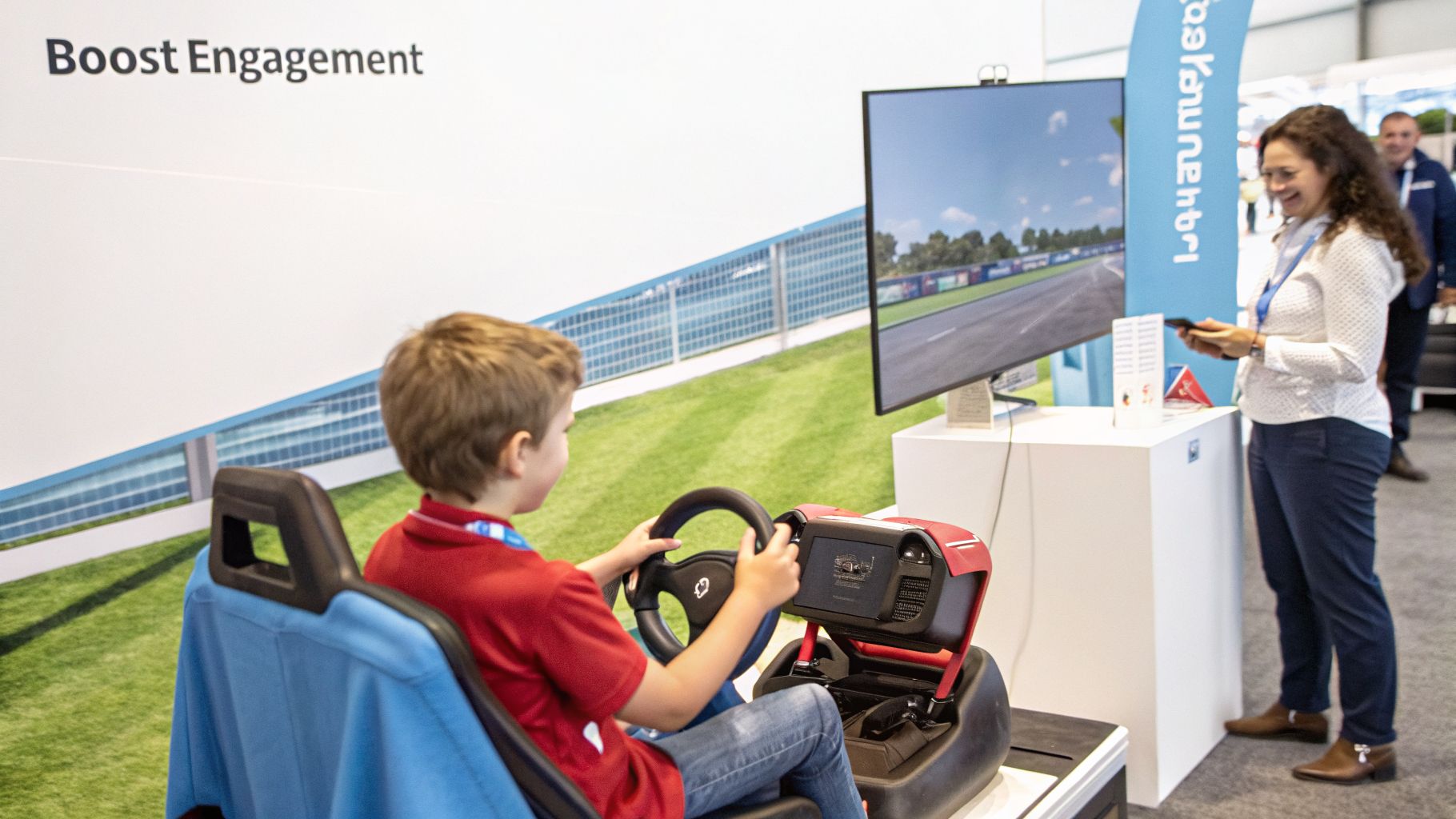
A kids' driving simulator isn't just another activity; it’s a surefire hit for any family-focused event. In essence, it's an interactive setup that blends the fun of a driving game with some basic road safety lessons. For kids, it's a safe, controlled, and seriously engaging way to get behind the wheel. For you, the event planner, it's a brilliant way to increase footfall and keep families on-site for longer.
Why a Kids Driving Sim Is an Unbeatable Attraction
Let's be honest, putting a kid in front of a realistic driving simulator—complete with a steering wheel, pedals, and a big screen—is a guaranteed crowd-puller. It’s not just another game; it has a magnetic quality that draws in families. The setup feels real, and that immersive experience is something children find absolutely irresistible.
You’re not just providing a bit of fun. You’re creating a standout feature for your event that also happens to be educational. This is a lot like how purpose-built video games for learning are designed to develop real skills through engaging play. It’s this clever mix of entertainment and learning that leaves a lasting positive impression on parents and kids alike.
Real-World Proof: How We Boosted Engagement
We recently ran an activation at a large UK exhibition where the goal was to create a family hub and increase dwell time. We set up a bank of four kids' driving simulators in their own dedicated zone. The impact was instant. Within minutes, a queue had formed, full of excited kids and curious parents.
The simulators immediately became a natural gathering point, turning what was just a patch of floor space into a buzzing interactive destination.
Our on-site team observed that families who used the simulators stayed at the event for an average of 45 minutes longer than other attendees. That kind of increase in dwell time is a huge win when you’re trying to maximise exposure for sponsors and other exhibitors.
It did more than just entertain, too. It sparked conversations. We saw parents cheering their kids on, taking photos for social media, and even chatting about road safety in a relaxed, positive way. The simulators quickly became the talk of the event. For more inspiration on creating this kind of interactive buzz, check out our guide to fun activities for a family day.
More Than Just Fun: The Educational Angle
The real genius of a kids' driving simulator is its ability to teach without feeling like a lesson. The software can be set up to introduce vital road safety concepts in a way that just feels like part of the game.
- Hazard Perception: The simulation can throw common road hazards into the mix, like a ball rolling into the street, teaching kids to spot potential dangers and react.
- Speed Awareness: A clear on-screen speedometer helps children grasp the idea of driving at an appropriate speed for the environment.
- Consequences of Actions: If a child gets distracted or makes a poor decision, the simulation shows the outcome instantly—all without any real-world risk.
This educational aspect is a massive selling point, especially for corporate family days, community festivals, or brand activations. It shows that your event is thoughtful and responsible, adding a layer of substance that goes far beyond simple amusement. When you offer an activity that’s both thrilling and genuinely beneficial, you’re creating an experience that families will remember and appreciate.
Choosing the Right Simulator for Your Event
When it comes to picking a kids' driving simulator for your event, it’s easy to get distracted by the flashiest models. But the real secret is matching the hardware to what you actually want to achieve. The goal is to find that perfect balance where the simulator fits your space, captivates your specific audience, and delivers the buzz you’re after.
It all boils down to one simple question: what’s the mission? For a busy exhibition stand, a compact, single-screen setup might be just the ticket for pulling in a steady stream of visitors. On the other hand, if you’re planning a big brand activation, a linked pair of full-motion racing simulators could be the high-impact centrepiece you need.
Think of it as a spectrum, from a simple arcade-style game right up to a full-on simulation experience. Each level offers a different kind of engagement, and your choice here will define how your guests remember the day.
Match the Machine to the Mission
Your audience is everything. A driving game that has an eight-year-old totally enthralled might be completely ignored by a teenager. The trick is to align the complexity and style of the simulator with the age group you’re expecting.
For Younger Kids (Ages 8-12): It’s all about fun, accessibility, and bright, vibrant graphics. You need simple controls and forgiving game physics. The aim is pure enjoyment, not a realistic driving exam. A single-seater with a colourful, action-packed game will be an absolute winner.
For Teenagers (Ages 13-17): This crowd usually craves more realism and a bit of healthy competition. Look for simulators with force feedback steering wheels, proper pedals, and software that offers competitive racing modes or even hazard perception challenges. Linked simulators with a live leaderboard are brilliant for this age group.
This simple flowchart shows how a driving simulator can directly influence visitor engagement and overall event buzz.
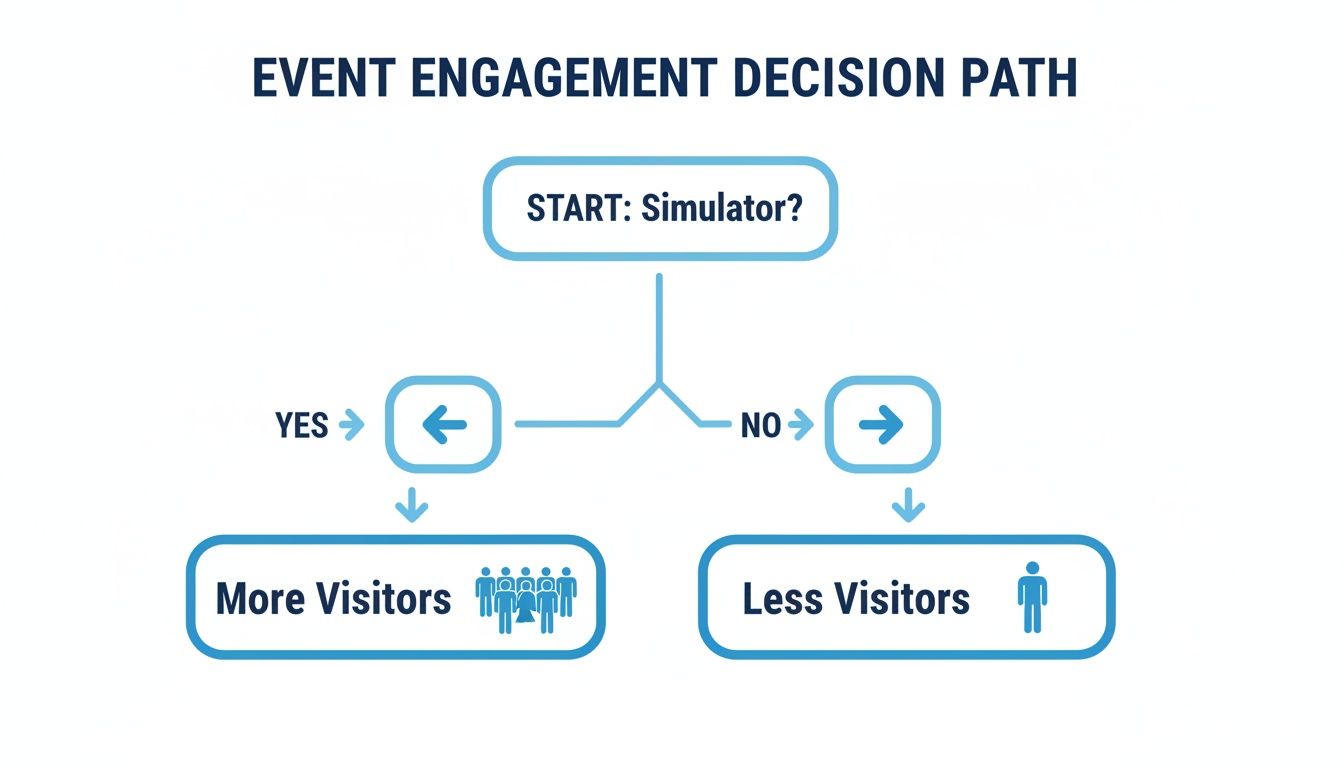
As you can see, adding a simulator is a proven way to boost footfall and create a more memorable, engaging atmosphere.
Thinking About Venue and Footprint
Before you get your heart set on a particular model, get the measuring tape out. A kids' driving simulator needs more than just the space for the machine itself; you have to plan for entry, exit, and queuing areas.
A standard single-seat simulator might need a footprint of roughly 2m x 3m. But if you're looking at a more complex setup, like two linked pods with large spectator screens, you could easily be looking at a 5m x 5m area. Always, always confirm these details with your supplier—they should provide a full technical spec sheet.
Power is another critical point. Most simulators will happily run off a standard 13-amp socket, but multi-unit installations or high-spec motion rigs might need more juice. Sorting this out early on saves you from any nasty surprises on the day.
Pro Tip: When you’re planning the layout, think about the flow of people. You want to position the simulator to draw people in without causing a logjam. Placing it near an entrance or in a central hub is a great way to maximise visibility and pull in a crowd.
A Quick Comparison of Simulator Types
To help you get a clearer picture of your options, we've put together a quick guide to the most common types of simulators available for hire. Each one has its own strengths, making it a better fit for different event scenarios. As you look through, you might find our full breakdown of car simulator hire in the UK helpful for your specific needs.
This table will help you choose the best simulator based on your available space, key features, and the age of your target audience.
Kids Driving Simulator Specification Guide
| Simulator Type | Typical Footprint (WxL) | Power Needs | Ideal Age Group | Best For |
|---|---|---|---|---|
| Compact Single-Seater | 1.5m x 2.5m | Standard 13A Socket | 8-12 years | Exhibition stands, small venues, and tight budgets. |
| F1 Style Cockpit | 1.8m x 4.5m | Standard 13A Socket | 12+ years | Brand activations, photo opportunities, and themed events. |
| Full-Motion Rig | 2m x 3m per unit | 2 x 13A Sockets | 14+ years | High-impact experiences where you want maximum 'wow' factor. |
| Linked Racing Pods | 4m x 4m (for two) | Standard 13A per unit | 10+ years | Fostering competition, team building, and running contests. |
Ultimately, choosing the right kids' driving simulator is about balancing your event goals with your audience and venue. Don't forget, a small, static rig can be just as effective as a huge motion platform if it's the right choice for the occasion. By thinking through these factors, you can pick a machine that doesn't just entertain but also delivers real, tangible results for your event.
Navigating Logistics: From Setup to Teardown
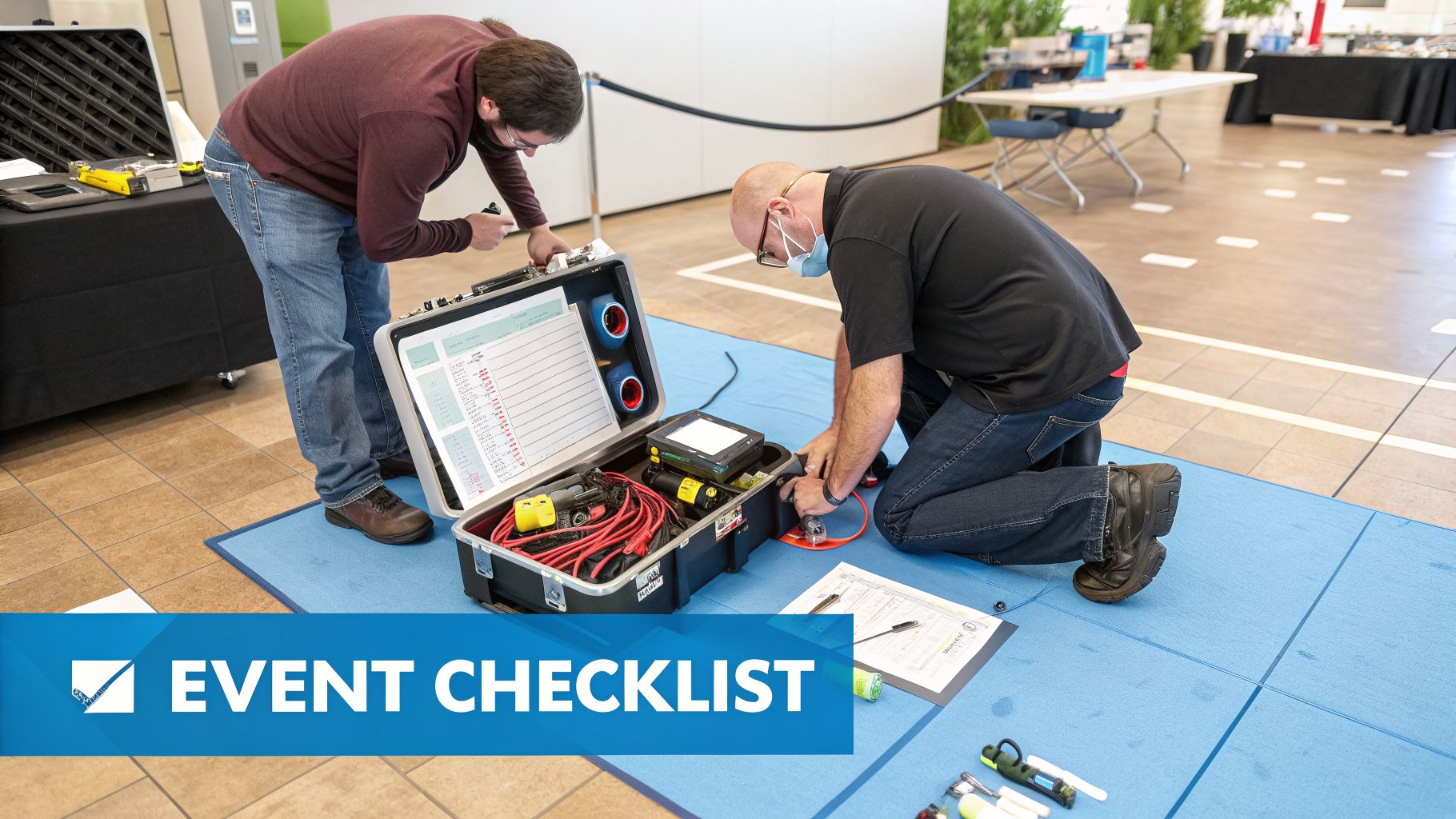
Let's be honest, the thought of bringing a sophisticated piece of equipment like a kids driving simulator to your event might seem like a logistical headache. But when you work with an experienced provider, it's actually one of the smoothest parts of the day.
A stress-free event day is all about what happens before the doors open. It all comes down to solid pre-event planning and clear communication. We handle all the technical heavy lifting, but we see it as a partnership, keeping you in the loop so there are no surprises.
This guide demystifies the entire process, from the first site check to the final pack-down. You'll know exactly what to expect.
Pre-Event Coordination and Site Checks
The groundwork for a flawless activation is laid weeks, not hours, in advance. Once you've chosen your simulator, we dive into a detailed logistical review. This goes far beyond just measuring floor space; it’s about getting to know your venue’s quirks to head off any day-of dramas.
We'll liaise directly with you or your venue manager to nail down the critical details. We’re talking about access routes for our vehicles, the best loading bay to use, and flagging any potential obstacles like tight corridors or service lifts with sneaky weight limits. Think of it as our pre-flight check for your event.
Here are the key points we'll cover together:
- Venue Access: We’ll confirm arrival times, loading procedures, and the specific entry points our team will use. For a huge venue like the NEC Birmingham, knowing the exact hall number and service door is non-negotiable.
- Power Supply: We need to pinpoint the location of the nearest 13-amp sockets. If you're planning a multi-simulator setup, we may need a few dedicated circuits to avoid tripping the venue's breakers.
- Floor Loading: Simulators, especially the motion-based ones, have some heft. We’ll double-check that the floor in your chosen spot can handle the weight – this is especially important in older buildings or on mezzanine levels.
- Install and Teardown Times: We agree on a firm schedule. This ensures our team has plenty of time to set up and test before your first guest arrives and can pack down efficiently the moment your event ends.
By sorting these details out early, we eliminate 99% of potential problems. It's the difference between a slick, professional load-in and a frantic last-minute hunt for an extension lead while your guests are walking in.
On-Site Installation and Staffing
On event day, our technicians arrive on-site at the agreed time, ready to go. Our team is self-sufficient, equipped with all the necessary tools and a detailed setup plan. You just need to show us to the pre-arranged space and power points.
The installation itself is clean and efficient. Our techs will unload the flight cases, move the equipment into the activation zone, and begin assembly. A standard single-seater kids driving simulator can be fully built, tested, and ready for action in about 60-90 minutes. For more complex jobs with multiple linked units or extensive branding, we'll simply factor in the extra time needed.
But our job doesn't stop once the rig is built. Our on-site staff then switch hats from technicians to friendly, engaging hosts. Their role covers:
- Operating the Equipment: They manage the software, reset the experience for each child, and ensure the simulator runs perfectly from the first driver to the last.
- Engaging Guests: Our team members are brilliant at drawing people in, explaining how to drive, and hyping up a bit of friendly competition. They’re key to creating that buzzing atmosphere around the attraction.
- Managing Competitions: If you're running a ‘fastest lap’ challenge, our staff will manage the leaderboard, track the scores, and help you get everyone excited for the winner's announcement.
This complete, full-service approach means the technical side is entirely off your plate. You can relax, knowing the attraction is being run safely and professionally, and focus on your attendees.
Post-Event Teardown and Removal
Once the last race is run and your event is winding down, our teardown is just as swift and professional as our setup. As soon as the attraction closes, or at the pre-agreed time, our team gets to work dismantling the simulator.
We know venues have tight turnaround schedules. We work quickly to pack everything away, leaving your event space exactly as we found it. A standard teardown is usually done and dusted in under an hour. Our goal is simple: to be the most hassle-free supplier you work with, from the first call to the final load-out.
Ensuring Total Safety and Compliance