
Experiential marketing is all about creating live, immersive events that let your audience actually interact with your brand. It’s the difference between telling customers your product is exciting and letting them feel that excitement for themselves through a genuinely memorable, shared experience.
Why Experiential Activations Are Your Strongest Marketing Tool
In a world saturated with digital ads and fleeting social media posts, cutting through the noise can feel impossible. Your customers have become experts at tuning out the constant barrage of traditional marketing. This is where experiential marketing completely changes the game by shifting the focus from passive consumption to active participation.
Instead of just broadcasting a one-way message, you’re inviting your audience into a story. You create a physical, multi-sensory environment where they can touch, play, and connect with your brand on a much deeper, emotional level. This move from telling to showing is what forges genuine, lasting bonds.
The Power of Human Connection
People crave authentic connections, now more than ever. A great activation provides the perfect platform for this, turning a crowd of individuals into a community of engaged participants.
Think about it. What’s more powerful? Seeing a social media ad for a new sports drink, or taking part in a branded pop-up basketball challenge at a city festival? The latter creates a real memory and a positive emotional link that an ad simply cannot replicate.
This strategy is brilliant because it transforms attendees into your most powerful brand advocates. A well-run event gives them something to talk about, both online and off. They become your most credible marketing channel, sharing their positive experiences with friends, family, and followers. That kind of organic word-of-mouth is invaluable.
The core idea is simple: create an experience so memorable that people feel compelled to share it. When someone has a genuinely fun, exciting, or meaningful interaction with your brand, they don't just remember it—they talk about it.
Driving Tangible Business Results
While the focus is on connection, the business impact is concrete and measurable. In the UK, investment in experiential marketing is soaring for one simple reason: it delivers results.
Recent data shows a major shift in marketing budgets, with event marketing now claiming an average of 14% of the total spend. A staggering 80% of companies are increasing their experiential budgets, recognising its superior performance. For more insight, check out the findings from industry experts at Team Tecna on the growth of experiential marketing spend.
This investment is clearly paying off. UK marketers report that events are their number one channel for driving footfall and increasing dwell time at trade shows and retail locations. Why? Because these activations don't just attract attention; they hold it.
Just look at these compelling figures:
- 77% of marketers see events as their top channel for generating footfall.
- The average ROI for events consistently hits between 25-34%.
- 59% of marketing professionals state that experiential activations deliver a greater return than traditional advertising.
Picture this: at a corporate trade show, a standard booth with brochures might get a passing glance. Now, imagine a booth featuring an F1 racing simulator from PSW Events. It becomes a magnet. It draws crowds, sparks friendly competition with a live leaderboard, and gives your sales team a completely natural way to start conversations with genuinely interested prospects while they wait for their turn. The experience itself becomes the perfect lead generation tool, delivering not just quantity, but quality.
Developing an Activation Concept That Resonates
Before you even think about logistics, staffing, or floor plans, every great experiential activation starts with a single, compelling idea. Forget the generic, off-the-shelf stuff. We’re talking about creating an interaction so engaging that people are still talking about it—and sharing it—long after they’ve left your event.
It all boils down to one question: what’s the goal? You have to be crystal clear on what you want to achieve. Are you at a trade show trying to hoover up high-quality leads? Launching a new product and need to create a massive social media splash? Or maybe you want to give attendees a really deep, hands-on understanding of your brand.
Your primary goal is your north star. It dictates everything. If lead generation is the name of the game, the experience needs to have a slick, integrated way to capture data. If it’s all about creating buzz, then every element should be designed to be shareable and look fantastic on an Instagram feed.
From Brand Values to Interactive Fun
Once you’ve nailed down your 'why', it’s time for the fun part: turning your brand's personality into something people can actually do. This is where you connect what your brand stands for with a tangible, memorable activity.
Think about it. If you're a tech company that prides itself on speed and precision, what better way to show that than letting people feel it? A branded F1 racing simulator from PSW Events does just that. Suddenly, you're not just telling them you're fast; you're giving them the adrenaline rush to prove it. Or, if you’re a wellness brand all about mental clarity, a Batak Pro reaction game makes the concept of focus tangible and competitive.
This is the fundamental shift happening in marketing. We're moving beyond just throwing ads at people and instead, we're building worlds they can step into and interact with.
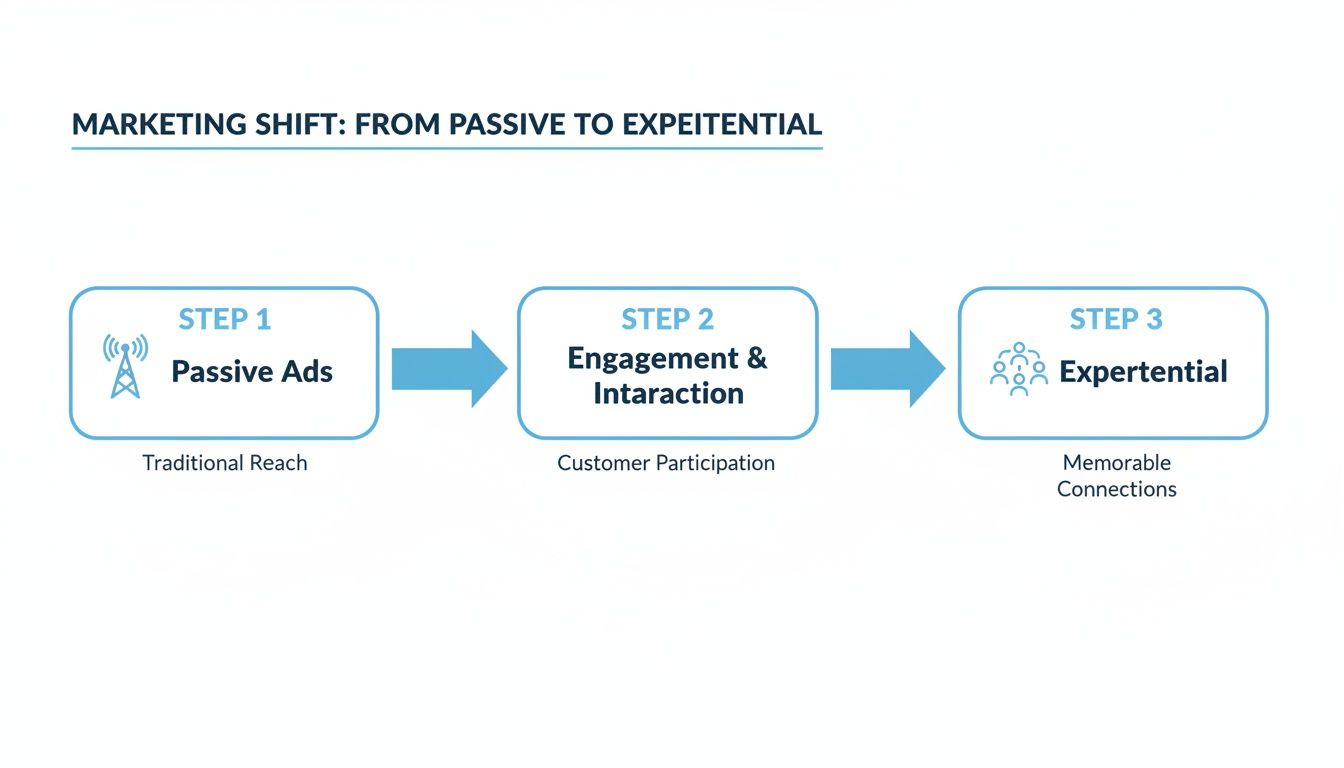
The best concepts build a bridge between your brand's promise and your audience's desire for genuine fun. If you're looking for more inspiration, you can find a whole host of our corporate event entertainment ideas to get the creative juices flowing.
To make this even clearer, here’s how you can match specific goals to activation concepts and the metrics that matter.
Matching Activation Concepts to Marketing Goals
| Marketing Goal | Activation Idea (PSW Example) | Key Performance Indicator (KPI) |
|---|---|---|
| Lead Generation | Branded F1 Simulator with a 'Top Gear' style leaderboard. Entry requires an email scan. | Number of qualified leads captured per hour. Cost per lead. |
| Social Media Buzz | Customised Boxing Machine (Arcade Boxer) with brand logos and a unique hashtag. | Number of social media posts using the event hashtag. Total reach and impressions. |
| Brand Education | Batak Pro challenge, demonstrating the need for focus and precision (core brand values). | Dwell time (how long people engage). Post-event survey scores on brand attribute recall. |
| Networking | 2-player race simulator setup (e.g., Twin F1 Simulators) to encourage friendly competition. | Attendee feedback on networking opportunities. Number of new connections made (tracked via app). |
Thinking this way from the start ensures your creative idea is directly tied to a measurable business outcome.
Making It Personal and Relevant
The most effective activations feel like they were designed specifically for the person taking part. Personalisation is a massive factor, especially in the UK market. We know that 71% of consumers expect brands to deliver personalised interactions. It’s no longer a 'nice-to-have'.
We see this all the time. When we customise our racing simulators or boxing challenges with a client's branding for an event at a venue like Wembley, the entire experience becomes theirs. It's not just a hired game; it's a unique brand moment. It's why 59% of marketers report a better ROI from experiential compared to other types of advertising.
To make sure your concept hits the mark, always filter it through these three questions:
- Who is the audience? What gets C-suite executives excited at a conference is very different from what will thrill families at a public festival.
- What is the environment? Is this for a loud, packed exhibition hall, an outdoor fan zone, or an exclusive evening product launch?
- What's the feeling? Are you aiming for pure excitement, nostalgia, friendly competition, or a sense of premium luxury?
The best activation concepts aren't just creative—they're empathetic. They're built on a genuine understanding of what your audience actually finds entertaining, valuable, and worth their time.
Nailing your concept from the outset makes everything that follows—planning, execution, and especially measurement—so much easier. This is the foundation for an experience that doesn’t just get noticed, it gets results.
Using Technology to Amplify Engagement
Technology is the secret sauce that can take a good experiential activation and make it truly unforgettable. It’s not about throwing tech at a problem for the sake of it; it's about being clever and strategic with the tools you use. The right tech can create deeper immersion, spark some friendly competition, and bring your brand's story to life in a way that’s genuinely exciting. It doesn't just grab attention—it holds it.
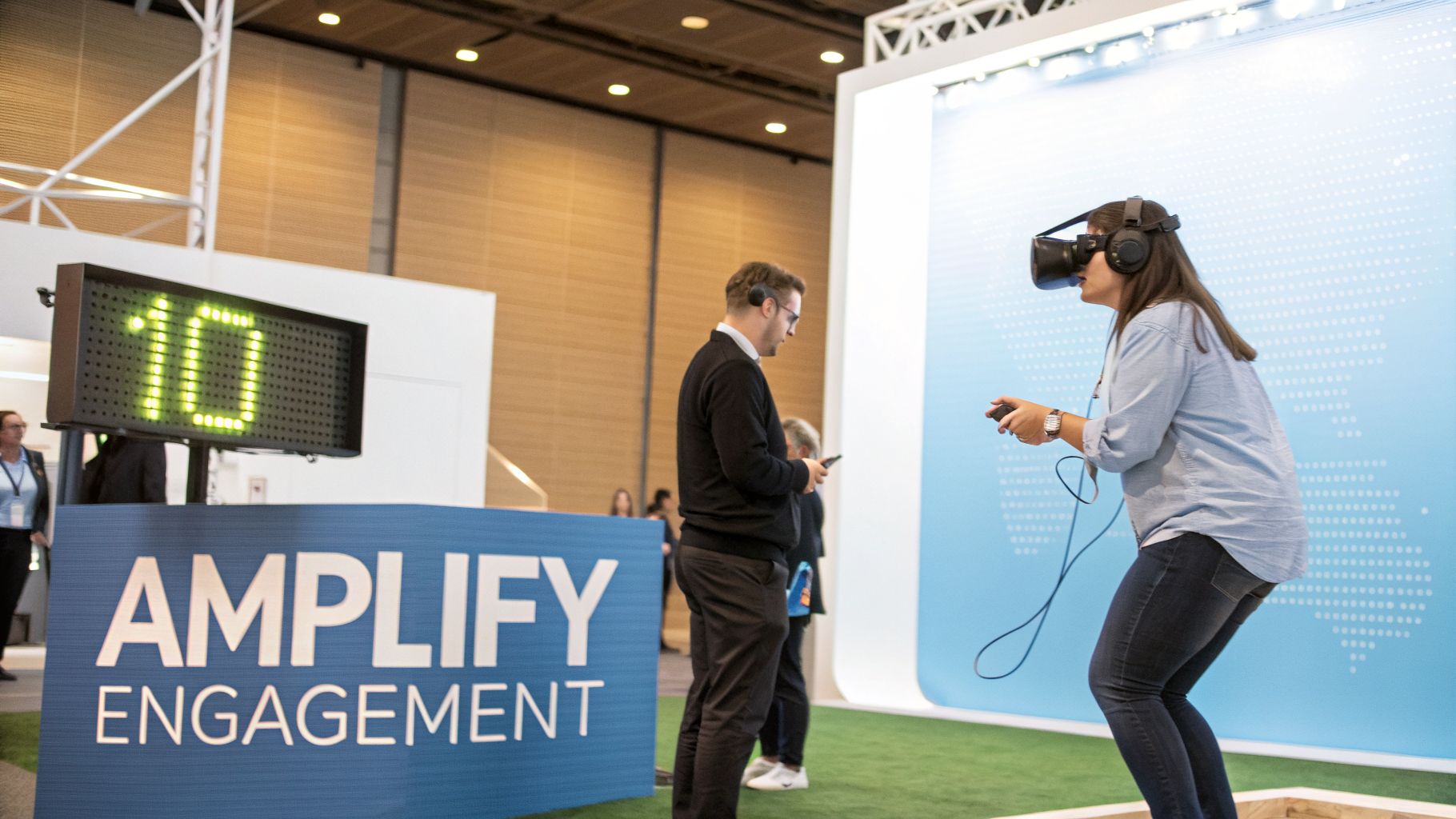
Instead of just telling guests your brand is innovative, let them feel it. Imagine launching a new product where attendees put on a VR headset and are instantly transported into your brand's world. That's a world away from just watching a presentation. It’s active participation, and it forges a powerful emotional connection to your message.
Fuelling the Competitive Spirit with Gamification
One of the surest ways to get people involved is by tapping into our natural love for a good challenge. Gamification turns a simple activity into a compelling contest that keeps people hooked and coming back for more. This is where something as simple as an electronic leaderboard really earns its keep.
Think about an F1 simulator at a busy trade show. On its own, it’s a lot of fun. But add a real-time leaderboard showing the fastest lap times, and you’ve suddenly created a high-energy focal point for the entire hall. People will keep coming back to your stand throughout the day to try and beat their score or knock the leader off the top spot. This massively increases how long they spend with you and how many times they interact with your brand.
That leaderboard also doubles as a brilliant, organic lead capture device. To get their name on the board, a participant just needs to scan their badge or pop in an email address. It’s a seamless value exchange: they get a shot at glory, and you get a qualified, highly engaged lead.
Blending Digital and Physical Worlds
The activations that get people talking are the ones that blur the lines between the physical and digital, creating what some call 'phygital' experiences. These are moments designed to be so visually impressive and personally rewarding that sharing them on social media is the most natural thing in the world.
UK consumers are already big fans of these kinds of experiences. The data shows that a massive 85% are more likely to buy from a brand after taking part in an activation. Immersive tech like AR and VR just pours fuel on that fire; neuroscience studies have shown that VR can trigger 27% more emotional engagement and lead to 34% better memory recall than traditional 2D media. For a closer look at these trends, you can find more insights about experiential marketing effectiveness at Profiles Creative.
We see this all the time at PSW Events. When we set up our golf or American football simulators at brand launches, the mix of physical action and instant digital feedback keeps corporate teams completely captivated. Dwell times go through the roof, and the integrated leaderboards make gathering valuable contact info a breeze. If you're looking for more ways to make your exhibition stand out, have a look at our guide on interactive exhibition ideas.
The real goal of technology in experiential marketing is to create a moment so immersive and personal that your guest forgets they're being marketed to. The tech should become invisible, leaving only the experience and the feeling behind.
Extending Your Reach Beyond the Event Floor
The impact of your activation shouldn't stop when the event doors close. Technology is the perfect bridge for extending your reach and creating a lasting digital footprint.
- Photo/Video Booths: These are a classic for a reason. Integrate branded overlays, logos, and hashtags into photos or short video clips that guests can instantly email to themselves or share on their social channels.
- AR Filters: Create a custom AR filter for Instagram or Snapchat that people can use at the event and long after, effectively turning your audience into brand ambassadors.
- Influencer Integration: A great way to amplify your tech-driven activation is to bring in the right people. Integrating influencer marketing for events can generate buzz before, during, and long after the activation itself.
By giving attendees high-quality, branded content that’s easy to share, you’re empowering them to tell your story for you. This user-generated content is authentic, credible, and massively expands your brand's visibility far beyond the physical walls of the venue.
Mastering Logistics for a Flawless Execution
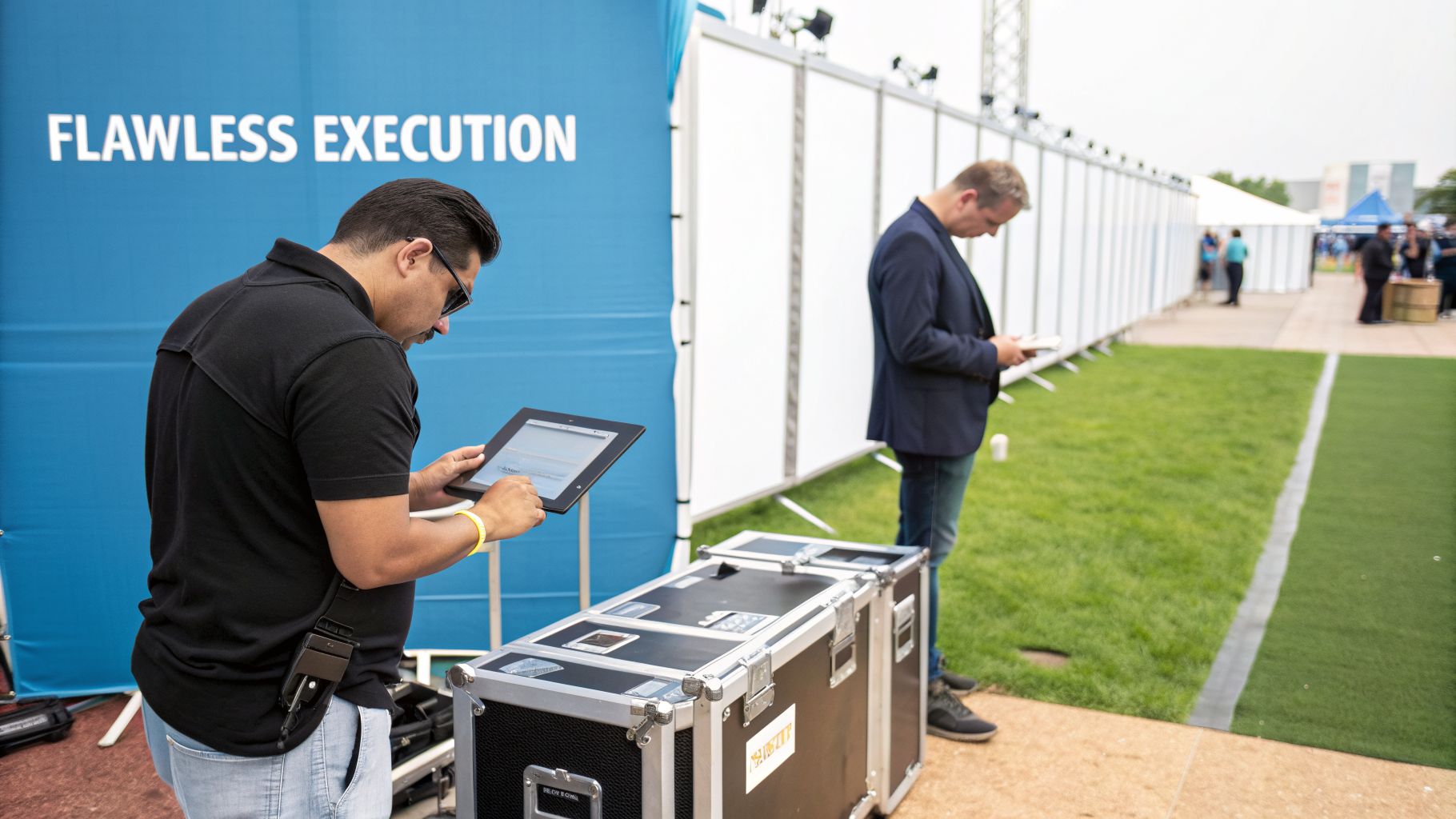
A brilliant idea for an activation is one thing, but pulling it off is another entirely. Without rock-solid logistics, even the most creative concept can fall apart on the day. This is our playbook for handling the nuts and bolts, making sure your event runs so smoothly that your only job is to connect with your audience.
The secret isn’t just hoping for the best. It’s about planning for what could go wrong and having the systems in place to sort it before it ever becomes a problem.
Pre-Event Logistics Checklist
Your event's success is decided long before the doors open. It’s easy to underestimate just how many small details can trip you up. I’ll never forget arriving at a major brand launch to find the spot for our F1 simulator had no direct vehicle access and not enough power. We made it work, of course, but that last-minute panic was completely avoidable.
Use this checklist to get out in front of the common logistical headaches:
- Venue & Site Inspection: Is there enough level floor space for your attractions? Look for pillars, low ceilings, or anything else that could get in the way. Critically, you need to check the loading bay access, lift dimensions, and the exact route from the delivery lorry to your activation spot.
- Power & Tech Needs: An interactive attraction like a racing simulator or VR station demands its own reliable power source. Confirm exactly what you need – a 13-amp socket is common, but always double-check. Make sure the sockets are close enough to avoid creating a trip hazard with long cables.
- Health & Safety Compliance: This is absolutely non-negotiable. You’ll need detailed risk assessments and method statements (RAMS) for every single activity. Your supplier must provide these, along with proof of their £10 million public liability insurance.
- Branding & Asset Delivery: When do your branded assets need to be ready? This includes things like backdrops, banners, or custom graphics for the games. Agree on deadlines with your supplier so everything is produced and delivered to them before they load the lorry for your event.
This is where working with a turnkey supplier like PSW Events pays off. A dedicated project manager will handle all of this—from site visits to liaising with venue staff—giving you one point of contact and total peace of mind.
On-Site Management and Staffing
On the day, your focus needs to switch from planning to pure execution. The team on the ground is the public face of your activation, and their professionalism is a direct reflection of your brand. The right people are crucial for managing the flow of guests and keeping the energy high.
The host's energy shapes the guest's experience. A stressed, disorganised team creates a chaotic atmosphere, while a calm, professional team fosters an environment of fun and engagement. Your staff aren't just there to operate equipment; they're there to be brand ambassadors.
A professional supplier provides trained, uniformed staff who are experts on the equipment and, just as importantly, on guest interaction. Their job is about much more than just pressing a start button.
They’re responsible for:
- Queue Management: Keeping lines moving, engaging with people while they wait, and explaining the experience to build excitement.
- Technical Troubleshooting: Sorting out any minor tech glitches quickly and quietly, ensuring minimal downtime and a seamless experience for every participant.
- Driving Engagement: Stoking friendly competition around the leaderboard, coaching players on how to get the most out of the game, and hyping up the crowd to maximise the fun.
- Upholding Safety: Making sure everyone uses the equipment correctly and safely, and keeping the entire activation area clear and free of hazards.
The difference is night and day. A well-staffed activation feels polished and premium. An understaffed one just feels chaotic and unprofessional. When we staff an event, our team is on-site early for the full setup, stays to manage the entire experience, and then handles the complete breakdown and removal. This frees your team up to do what they do best: network and hit your marketing goals. It’s the operational backbone that makes ambitious experiential marketing a repeatable success.