
Let’s be honest, making your exhibition stand or corporate event genuinely memorable is a tough gig. You're competing for attention in a sea of pop-up banners and branded pens. If you want to cut through the noise, boost foot traffic, and actually have real conversations with people, you need something that stops them in their tracks.
Driving simulators are that 'something'. They're not just a novelty item; when used smartly, they become a serious tool for engagement and lead capture.
How Simulators Drive Real Corporate Engagement
In a crowded event hall, being different is everything. The usual tactics often just don't create a lasting impression, meaning your brand gets lost in the shuffle. This is where getting a bit more creative with experiential marketing, especially with high-energy attractions, really pays off.
Driving simulators have a unique pull. They tap into that almost universal love for a bit of speed and competition, instantly creating a focal point that draws attendees to your stand. And it's not just about a bit of fun – it’s a strategic move to hit your business goals.
So, Why Do Simulators Work So Well at Events?
It's a few things, really. First, a full-size F1 car replica or a rally simulator just looks incredible. It’s an instant head-turner. Then, the interactive side of it keeps people engaged, which means they spend more time at your stand, giving your team a natural, easy opening for a conversation.
A well-placed driving simulator doesn't just entertain; it acts as a magnet for your ideal audience. Throw in a digital leaderboard, and you’ve got a competitive element that encourages people to come back for another go and share their times online. Suddenly, your brand’s reach is extending far beyond the event floor.
And this isn't a niche idea anymore. The UK driving simulator market was valued at USD 183.45 million and is on track to nearly double, hitting a projected USD 354.19 million by 2033. This boom shows just how many brands are catching on to their power for activations and corporate functions.
At the end of the day, a simulator gives you a platform to create a genuinely memorable moment that people will link directly back to your brand. They are easily one of the most effective corporate event entertainment ideas for creating a real buzz. Whether you're after lead generation, a team-building activity, or just want to make a bold statement, a simulator can deliver a proper return by turning passive attendees into active, engaged participants.
Matching the Right Simulator to Your Event Goals
Picking the right piece of kit is probably the most critical decision you'll make when you hire a driving simulator. The model you go for directly impacts the guest experience and, ultimately, whether you hit your event targets.
It’s not about just getting the biggest, most expensive rig you can find. It’s about being smart and aligning the tech with what you’re trying to achieve.
A simple, single-screen racing seat could be the perfect fit for a small exhibition stand where the goal is just to create a bit of fun and scan some badges. But if you’re at a major product launch and need to make a massive brand statement, a full-motion F1 replica with wrap-around screens and bone-rattling force feedback is going to deliver that "wow" factor. The trick is to think about why you want a simulator before you decide what simulator you want.
Aligning Simulators with Event Objectives
Different simulators are built for different jobs. A multi-car setup, where you link two or more rigs for some head-to-head racing, is an absolute winner for internal events. We’ve seen them work brilliantly for team-building days because they bring out that natural, friendly competition and get everyone buzzing.
If you’re after ideas on how to structure these kinds of activities, there are some great concepts for corporate team-building events that really get teams working together.
On the flip side, an immersive VR racing simulator is a fantastic choice if you’re at a tech event or want your brand to look innovative and modern. That virtual reality element adds a real sense of novelty, gets people talking on social media, and puts your brand at the forefront.
This decision tree helps you visualise how your main goal—whether it's pulling in foot traffic, grabbing leads, or just creating a buzz—points you towards a specific type of simulator.
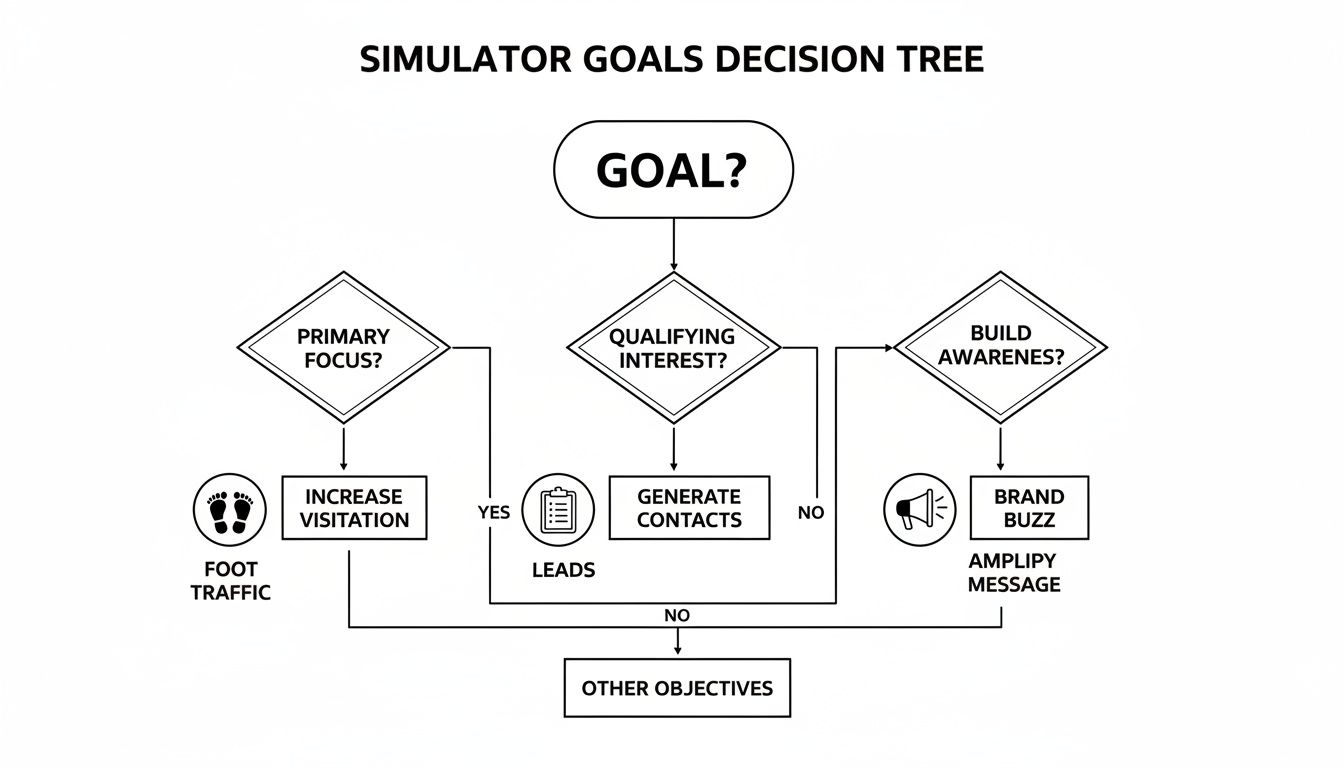
As you can see, your core objective is the starting point. Let it guide you to the hardware that’s actually fit for purpose, and you'll get a much better return on your investment.
To make this even clearer, here's a quick breakdown of common simulator types and where they shine.
Simulator Types and Best Event Fit
| Simulator Type | Key Features | Ideal For | Space Requirement (Approx.) |
|---|---|---|---|
| Static Racing Seat | Single screen, fixed seat, wheel & pedals. Compact and accessible. | High-footfall exhibitions, quick brand interactions, small stands. | 2m x 1.5m |
| Motion GT Simulator | Moving platform (2-3 axis), realistic feedback, single or triple screens. | Product launches, premium brand experiences, generating high-quality leads. | 3m x 2m |
| Full-Size F1 Replica | Authentic F1 car shell, often with motion, high-end visuals. | Major sponsorship activations, "hero" attractions, high-impact marketing. | 5m x 2.5m |
| VR Racing Simulator | VR headset for 360° immersion, often paired with a motion seat. | Tech-focused events, youth marketing, creating shareable social media moments. | 2.5m x 2m |
| Linked/Multi-Player | Two or more sims networked for head-to-head competition. | Team building, internal competitions, engaging large groups over time. | Varies (Approx. 3m x 3m for two) |
This table should give you a solid starting point for shortlisting the kind of rig that will work best for your space and your goals.
Real-World Scenarios in Simulator Selection
Let’s put this into practice. Imagine a software company exhibiting at a big finance conference. Their goal is to get high-quality leads from an audience that's pretty analytical and loves a bit of competition.
- Bad Fit: A basic, non-competitive arcade racer. It might be fun for a minute, but it won't hold the attention of this crowd or give them a compelling reason to hand over their contact details.
- Good Fit: A pair of linked GT-style simulators running a proper circuit like Silverstone. Stick a big screen up with a 'Top 10 Fastest Laps' leaderboard and offer a decent prize for the day's winner. This creates a competitive hub on your stand, encourages people to come back for another go, and gives your staff a perfect, natural opening to chat and capture details for the prize draw.
This is what strategic thinking looks like in practice. The simulator becomes more than just a fun gimmick—it becomes a hardworking part of your event marketing machine, actively helping you hit your business goals.
Sorting Out Space, Power, and Access On-Site
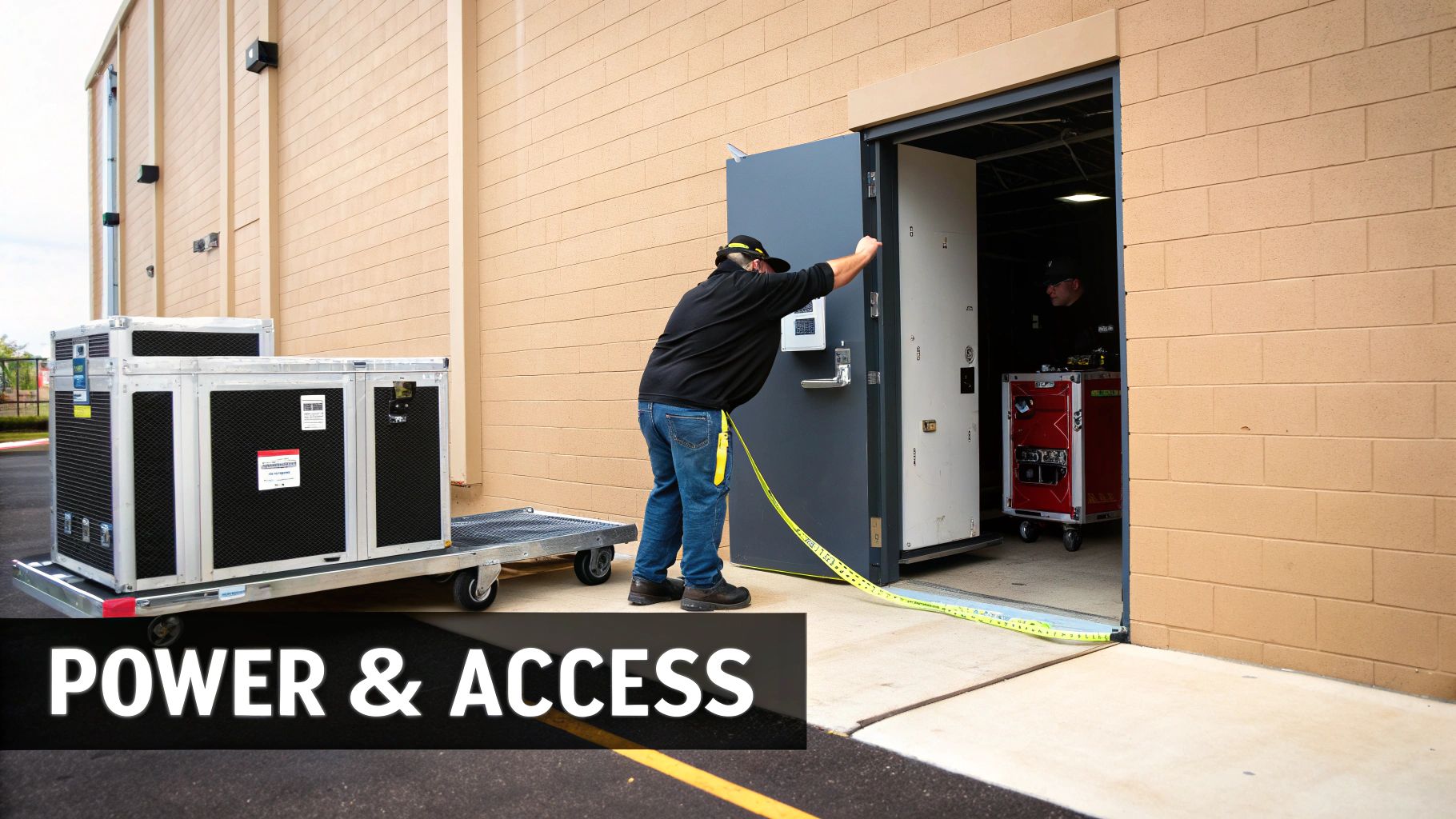
This is where the real-world planning kicks in. Honestly, the success of your simulator often hinges on the practical details you nail down weeks before anyone even arrives. Getting the on-site logistics of space, power, and physical access right is what separates a slick, professional setup from a last-minute scramble.
First up, space. It’s so much more than just the footprint of the simulator itself. You absolutely have to account for a buffer zone for people to move around safely, for your branding like pop-up banners, and for participants to get in and out without tripping over cables or each other. A compact single-seater might only take up 2m x 1.5m, but you should be marking out at least a 3m x 3m area on your floor plan to operate it properly.
And for the big boys, like a full-size F1 car replica? That can easily demand a space bigger than 5m x 2.5m before you even think about where spectators will stand. My advice is simple: get the exact dimensions from your supplier, then add at least a metre of breathing room on every side.
Getting the Power Right
Power is the other big one where a simple assumption can bring everything to a grinding halt. Please, don't just assume a standard wall socket will do the trick. While some of the more basic driving simulators in the UK can happily run off a single 13-amp plug, the more impressive motion systems are much thirstier.
I’ve seen it happen: a fantastic bit of kit gets delivered, and it can’t even be switched on. A quick chat with the venue's ops manager early on can confirm if you have the 16-amp or 32-amp supplies that high-performance simulators often need. It’s a five-minute conversation that can save you a world of pain.
Your supplier will give you a clear power spec sheet. Don’t just file it away – send it straight over to the venue’s technical team and get their sign-off.
Can You Actually Get It in the Building?
Finally, you have to think about the physical journey the equipment will take from the lorry to your stand. The most incredible simulator on the market is completely useless if you can’t get it through the front door.
- Get the Tape Measure Out: Ask your hire company for the exact cased dimensions of all the simulator parts. Then, physically walk the route and measure every doorway, corridor, and especially any service lifts.
- Know Your Venue: A modern exhibition hall like ExCeL London is built for this stuff, with massive loading bays and goods lifts. But a historic hotel or a listed building? You could be dealing with narrow Victorian doorways and tight corners that are a total non-starter for large flight cases.
- Stairs Are the Enemy: Professional simulator rigs are delivered in seriously heavy-duty flight cases on wheels. They weigh a ton. Carrying them up a flight of stairs is almost never a safe or viable option. You must have a step-free, ramp-accessible route planned out.
Thinking through these three areas—space, power, and access—turns your installation day from a potential disaster into just another smooth part of your event plan. A quick site visit or a detailed call with the venue manager is one of the most valuable hours you can spend.
Making Your Brand the Star of the Show
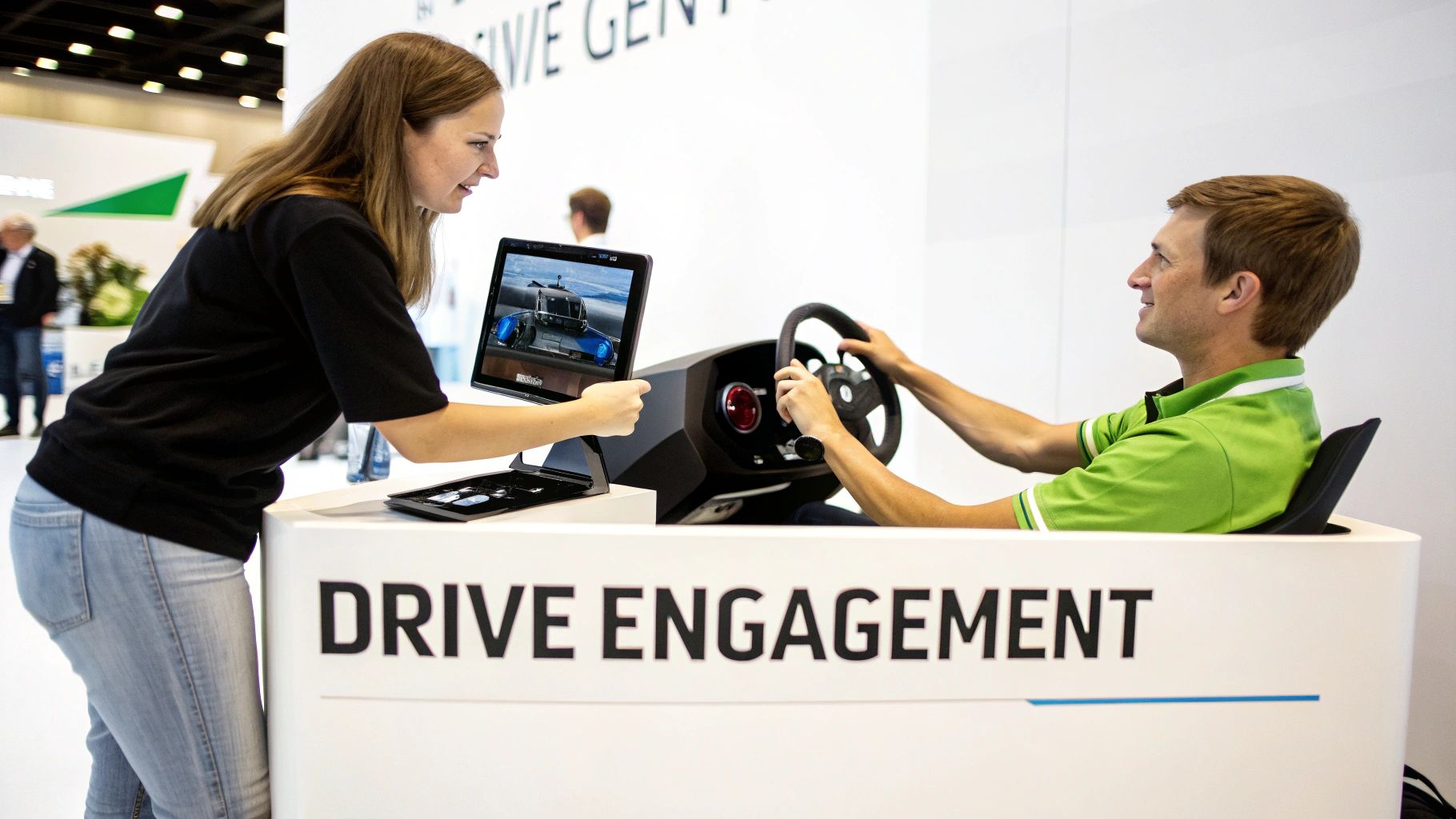
A driving simulator is a brilliant way to pull a crowd, but its real power is unlocked when you turn it from a simple attraction into a proper marketing engine. This is where you move beyond just "a bit of fun" and start generating measurable results, like qualified leads and a proper social media buzz.
The visual impact is your first win. Most professional driving simulators UK suppliers will offer customisation, and you should grab this with both hands. Don't just stick a logo on the side and call it a day. Think bigger: a full vinyl wrap for the simulator's body, branded barriers to cordon off the area, and even custom-printed floor mats. You're creating a self-contained brand zone.
Done right, this physical branding makes sure every photo snapped and shared online has your company front and centre. The goal is to make your brand an inseparable part of the memory.
Weaving Your Brand into the Digital Experience
The physical hardware is only half the story. The real magic happens when you get your branding inside the game itself, creating a much deeper and more authentic connection with the user.
Chat with your supplier about the possibilities for digital branding. You can often include:
- Custom Car Liveries: Get the virtual race car wrapped in your company's colours and logos.
- Trackside Banners: Place digital billboards featuring your campaign messaging around the virtual circuit.
- Branded Leaderboards: Make sure your logo and event hashtag are splashed across the big screen next to the top lap times.
These digital touches reinforce your brand identity at every turn (quite literally). You're building a seamless brand world that participants are completely immersed in.
Don't forget, the simulator isn't just an activity; it's a communications platform. Every single visual element, from the chassis to the in-game banners, is a touchpoint for your message and helps solidify brand recall long after the event is over.
Turning Your Staff into Brand Ambassadors
The people running the simulator are so much more than queue managers or button-pushers. They are the human link between the experience and your business goals. Just having someone there to press 'start' is a huge missed opportunity.
Brief your team properly and train them to be proactive brand ambassadors.
For instance, while a guest is waiting for their go, your team member could ask a few light qualifying questions: "So, what brought you to the event today?" or "Are you currently looking for solutions in [your industry]?" This turns dead waiting time into a valuable pre-qualification chat. Staff can also be tasked with hyping up the competition, encouraging social media shares with a specific hashtag, and dropping in key brand messages in a natural, friendly way.
Using Competition to Drive Data Capture
A digital leaderboard is your secret weapon for engagement and lead generation. The simple human desire to compete is an incredibly powerful motivator. By offering a decent prize for the fastest lap of the day, you give attendees a really compelling reason to hand over their contact details.
Build your data capture process around the competition. To get their name on the leaderboard and enter the prize draw, participants need to provide their name, company, and email via a tablet or QR code. This feels so much more natural than a cold ask for their business card.
Suddenly, you're not just collecting random contacts; you're building a list of genuinely engaged people who have actively spent time with your brand. If you're looking for more inspiration, have a look at our guide on other great interactive exhibition stand ideas that deliver similar results.
Getting to Grips with Costs, Contracts, and Insurance
Let's talk about the brass tacks: money and paperwork. Navigating the financial and legal side of hiring a driving simulator in the UK doesn't have to be a headache. Once you know what to look for in the quote, the contract, and the insurance documents, you can book with total confidence.
The final price tag is more than just a simple hire fee. Understanding the full breakdown is the key to building a realistic budget and avoiding any nasty surprises when the final invoice lands.
What Goes Into the Hire Cost?
When you get a quote from a supplier, it should be clearly itemised. If it isn't, ask for a more detailed breakdown. You need to know what each line means because the total cost is much more than just the simulator itself.
Your final bill will usually be made up of these parts:
- Base Hire Fee: This is the core cost for the simulator hardware itself, usually for a standard day rate (e.g., 8 hours on-site).
- Delivery & Collection: This covers the logistics of getting the rig to your venue and taking it away afterwards. It's almost always calculated based on mileage and the time involved.
- Staffing: Good suppliers will always include trained staff to operate the simulator safely and, just as importantly, to engage with your guests. This is rarely an optional extra, and for good reason.
- Custom Branding: If you've gone for a full vinyl wrap, in-game branding, or a bespoke leaderboard, this will appear as a separate line item covering the design and production costs.
Always insist on a fully itemised quote. It shows you exactly where your money is going and is the hallmark of a professional, transparent hire company.
What to Look for in the Hire Contract
The hire agreement is there to protect both you and the supplier, so don't just skim it. Pay close attention to a few key clauses that can make a huge difference if things don't go perfectly to plan.
A solid contract isn’t just a formality; it’s the blueprint for a successful event partnership. It should clearly spell out everyone's responsibilities, timings, and what happens if things go sideways. This is what gives you proper peace of mind.
Zero in on the sections covering cancellation terms, liability for any damage to the equipment, and the confirmed operational hours. The contract needs to state exactly what time the simulator will be set up and ready for guests, and when it will be powered down. No ambiguity.
Don't Skip the Insurance Check
This is completely non-negotiable. Any legitimate supplier of driving simulators UK wide must have adequate insurance. The big one to check is their Public Liability Insurance. This is what covers injury to people or damage to property that might happen in connection with their equipment or staff at your event.
Ask to see a copy of their insurance certificate. A pro company will have it ready to send over without a moment's hesitation. For most corporate venues in the UK, a minimum of £5 million in Public Liability cover is the standard, though you'll find many top-tier suppliers hold £10 million as a matter of course.
It's also smart to clarify who is responsible in different scenarios. For example, what happens if damage is caused by a guest versus a technical fault with the machine? Getting this straight from the start ensures everyone is protected and your event can run without a hitch.