Once seen as a bit of a corporate jolly, company away days have become an essential part of the modern business toolkit.They are dedicated, off-site events designed to boost team morale, improve collaboration, and get everyone pulling in the same direction. In today's hybrid world, they've moved from a 'nice-to-have' perk to a strategic necessity for building a team that genuinely connects.
In a world of Slack channels and Zoom calls, the natural glue that holds a team together can start to weaken. Those casual chats by the coffee machine or the spontaneous brainstorming sessions that sparked real relationships are few and far between. This is precisely where a company away day makes its mark—not as a simple day off, but as a powerful, strategic intervention.
Think of it as a hard reset. It pulls people away from their screens and puts them in the same room, breathing the same air. This intentional change of scenery is brilliant for breaking down the silos that inevitably spring up when teams are spread out. It's a golden opportunity to rebuild your company culture, strengthen personal bonds, and spark the kind of creative thinking that only happens with real, face-to-face connection.
A well-timed away day is the perfect antidote to the challenges of this new dynamic. It helps you to:
Away days aren't just about socialising (though that's a big part of it!). They create a unique space for tackling big-picture challenges and aligning the whole team on the road ahead. When you strip away the daily grind and operational noise, you give people the headspace to think creatively and strategically.
This dedicated time allows for those unstructured conversations where the best ideas often pop up. Whether you’re kicking off a huge new project, celebrating a major win, or just making sure every department is on the same page, an away day creates a focused, memorable experience that drives real results. It’s about building a team that isn't just connected online, but is truly aligned in purpose and spirit.
VIDEO
Before a single venue is scouted or an activity is booked, the best company away days always start with one simple question: why are we doing this?
If you want an event that genuinely makes a difference, you have to move past the vague notion of a "team get-together". Nailing down a clear purpose is what separates a truly impactful day from a forgettable afternoon out of the office. This vision becomes your north star, guiding every single decision from here on out.
Is the goal to celebrate smashing a huge project and reward everyone's hard work? Maybe it's more strategic, like finally breaking down the walls between the newly merged marketing and sales teams. Or perhaps you're launching a massive company-wide initiative and need to generate real excitement from day one. Each of these scenarios calls for a completely different kind of day.
Defining Your Core Objectives
Let’s get specific. Fuzzy goals like "improving morale" are nearly impossible to plan for, let alone measure. The trick is to turn those vague ideas into tangible, actionable outcomes.
Think about framing it like this:
Instead of "improving morale": Let's "celebrate the successful launch of Project Phoenix, recognise key contributors, and reinforce our culture of appreciation."Instead of "better collaboration": We will "integrate the new engineering team by facilitating cross-functional problem-solving workshops that build genuine personal connections."Instead of "team building": Our focus is to "align the entire company on our new Q3 strategic goals in an inspiring and interactive environment."
Getting this level of clarity isn't a solo job. It means having honest chats with leadership to understand what's really on their minds. What challenges are they seeing across the business? What behaviours do they want to encourage? Aligning your away day's purpose with these top-level goals is your ticket to getting the budget signed off and proving it was money well spent.
Listening to Your Team
While leadership sets the strategic direction, the day's success ultimately hangs on whether your employees actually connect with it. A top-down plan, made without any team input, can easily feel forced or miss the point entirely.
The easiest way to avoid this? Just ask them.
An anonymous survey is your best friend here. It's a brilliant way to get honest feedback on what your team actually wants and needs from a day away from their desks.
Keep the survey short and sweet. Ask about their preferred style of activity (active vs. relaxed, competitive vs. collaborative), any learning topics they're interested in, and what they think would most benefit their team right now. This data is absolute gold.
This simple step ensures the event isn't just strategically sound but is something people are genuinely looking forward to. When employees feel their opinions matter, you'll see their engagement and enthusiasm go through the roof.
Case Study: A Startup in Hyper-Growth
Picture a tech startup that’s doubled in size over the past year. New hires barely know anyone outside their immediate team, and that original, close-knit culture is starting to feel strained. Leadership knows they need to reconnect everyone, and fast.
The Vision: Host an away day that brings the company's core values back to life, helps new and old employees build real relationships, and gets everyone fired up about the future.The Objectives:
Foster Connections: Design activities that force people from different departments to team up and solve problems together.Reinforce Culture: Carve out time for a storytelling session where founders and early staff share pivotal moments from the company’s journey.Align on Future: Present the 12-month roadmap in an engaging, interactive way, then break out into smaller groups for feedback.
With this clear vision, the agenda practically writes itself. It rules out purely social fluff in favour of a balanced day with real purpose. Every single element, from the icebreakers to the evening drinks, is carefully designed to hit one of those core objectives, making sure the investment creates value long after the day is over.
Designing Activities That Spark Real Connection
Once you've got a crystal-clear vision for your company away day, the real fun begins. This is where you move from high-level strategy to the hands-on experience of it all—choosing activities that bring your goals to life and forge some genuine, lasting connections. Get this right, and you can turn a good day into a truly unforgettable one.
Forget the tired clichés of awkward icebreakers and mandatory trust falls. The key here is to be intentional. A day designed to spark innovation among your product team is going to look completely different from a multi-day retreat for a leadership group that needs to build deeper, more personal bonds. It's all about matching the activity not just to your goals, but to the unique personality and dynamics of your team.
From Workshops to Immersive Retreats
The format of your away day has a huge say in what you can realistically plan. A single-day event is perfect for high-energy workshops, focused problem-solving sessions, or competitive challenges that get everyone buzzing. Think of it as a concentrated burst of team engagement.
A multi-day retreat, on the other hand, offers something a single day just can't: depth. Giving your team the chance to properly switch off and stay overnight allows them to fully disconnect from the daily grind. This is where the real conversations happen, not just in scheduled sessions but over dinner or a morning coffee.
We're seeing this shift across the UK corporate events sector. In 2024, the use of overnight accommodation for corporate events saw a 15.4% increase . It’s a clear sign that businesses recognise the greater impact of immersive, multi-day programmes. When you take the pressure of the commute home off the table, you create the space for relationships to form far more organically. You can read more about these 2025 event trends on bvevents.co.uk .
Choosing Activities with Purpose
Every single item on your agenda needs a "why" behind it, tying directly back to your original objectives. If your goal is to break down silos between departments, a collaborative challenge where people have to rely on each other is miles more effective than a passive listening session.
Here's how we match activities to goals:
To Boost Collaboration: Pick tasks where success is literally impossible without teamwork. A virtual reality escape room, for instance, forces engineering and design teams to communicate clearly under pressure to solve complex puzzles together.To Spark Healthy Competition: Got a sales team that thrives on a bit of friendly rivalry? A competitive F1 racing simulator challenge can be a massive hit. Stick a live leaderboard up and you tap right into their natural drive while creating a fun, shared memory.To Encourage Strategic Thinking: A business simulation game or a "Dragon's Den" style innovation challenge gets different teams working together on a fresh strategic problem, pushing them to think creatively outside of their usual roles.To Foster Relaxation and Connection: Sometimes the goal is just to help your team unwind and connect as people. A relaxed cooking class, a guided nature walk, or even a sophisticated wine tasting can provide the perfect low-pressure environment for conversation to flow naturally.
The most memorable away days strike a perfect balance. We often pair a high-intensity, focused workshop in the morning with a more relaxed, social activity in the afternoon. This mix caters to different personality types and energy levels, making sure everyone finds something to enjoy.
A Framework for Selection
When you're staring at a sea of options, it's easy to get overwhelmed. We've found that grouping activities helps planners narrow down the choices and make sure they align perfectly with the team and the day's objectives.
The table below shows a few examples of how you can start matching specific activities to your away day goals. It's not about picking an activity for the sake of it, but about understanding the why behind your choice.
Matching Activities to Away Day Objectives
Away Day Objective
Activity Idea
Rationale
Energise & Motivate Sales Team F1 Racing Simulators
Taps into their competitive nature with a high-energy challenge and live leaderboard, celebrating success in a fun environment.
Break Down Departmental Silos Collaborative Mural Painting
Requires teams from different areas (e.g., marketing, finance, ops) to work together on a shared creative vision, fostering communication.
Develop Strategic Leadership Skills Business Simulation Challenge
Puts leaders in a hypothetical scenario where they must make tough decisions, analyse data, and collaborate to achieve a business goal.
Integrate New Team Members Group Cooking Class
A relaxed, social, and low-pressure setting where new and existing staff can chat and get to know each other on a personal level.
Ultimately, the best activities are the ones that feel authentic to your company culture. By understanding your team's interests and carefully aligning each part of the day with your core purpose, you move beyond just filling a schedule. You start designing a powerful, shared experience that builds a stronger, more connected team.
For more inspiration, you might be interested in these corporate team building events .
Nailing the Logistics Without the Headaches
Alright, you've got the vision and the activities mapped out. Now for the nuts and bolts – the operational details that quietly separate a seamless, professional event from a chaotic one.
Great logistics should be invisible. They let the day flow so smoothly that your team can forget the details and just focus on connecting and engaging. Getting this right means thinking through everything from transport to tech support, and it all starts with a rock-solid budget.
Building a Budget That Breathes
It’s a classic mistake: creating a budget that only covers the big-ticket items like the venue and catering. To avoid any nasty surprises down the line, you need to account for all those smaller, easily missed costs that have a habit of adding up fast. A well-planned budget isn’t just a list of expenses; it's the tool that lets you deliver an amazing experience without breaking the bank.
Make sure you build these line items into your plan right from the get-go:
Transportation: How is everyone actually getting there? Factor in coach hire, train tickets, or even mileage reimbursement for staff who are driving themselves.Insurance: Does your standard corporate policy cover off-site events, or will you need a specific event policy? Your suppliers should all have public liability insurance, but it's absolutely vital to check your own coverage, too.Supplier Staffing: Don't forget to budget for the people who make things happen on the day – the on-site technicians for simulators, facilitators for workshops, or extra event staff to keep things running smoothly.Contingency Fund: Always, always build in a contingency of 10-15% of your total budget . This buffer is your safety net for those inevitable last-minute costs, like needing extra equipment or a taxi for a late-arriving speaker.
A detailed budget is your best defence against stress. When you anticipate costs like AV technicians, branded materials, and even staff travel expenses upfront, you can make smarter decisions and avoid having to compromise on the quality of the experience later on.
Finding the Perfect Venue
The right venue really does set the tone for the entire away day. It's so much more than just a physical space; it's the backdrop for every single interaction. When you're looking at potential locations, try to look beyond the glossy photos and think about the practicalities that will affect your team's experience.
Create a checklist of your non-negotiables to guide your search. A few key things to confirm include:
Accessibility: Is the venue easy to get to by public transport and car? Is it fully accessible for team members with mobility needs?Tech Capabilities: Is the Wi-Fi reliable and high-speed, especially if you have online activities planned? What about AV equipment like microphones, projectors, and screens? Don't just take their word for it; ask for specifics.Layout and Flow: Does the space offer a good mix of large rooms for keynote sessions and smaller breakout areas for group work? A flexible layout is your best friend for a dynamic agenda.
Vetting Your Suppliers Like a Pro
Your suppliers, from the caterers to the entertainment providers, are basically an extension of your team on the day. Choosing reliable, professional partners is essential. The stakes get even higher when you’re bringing in interactive attractions like racing simulators or VR experiences.
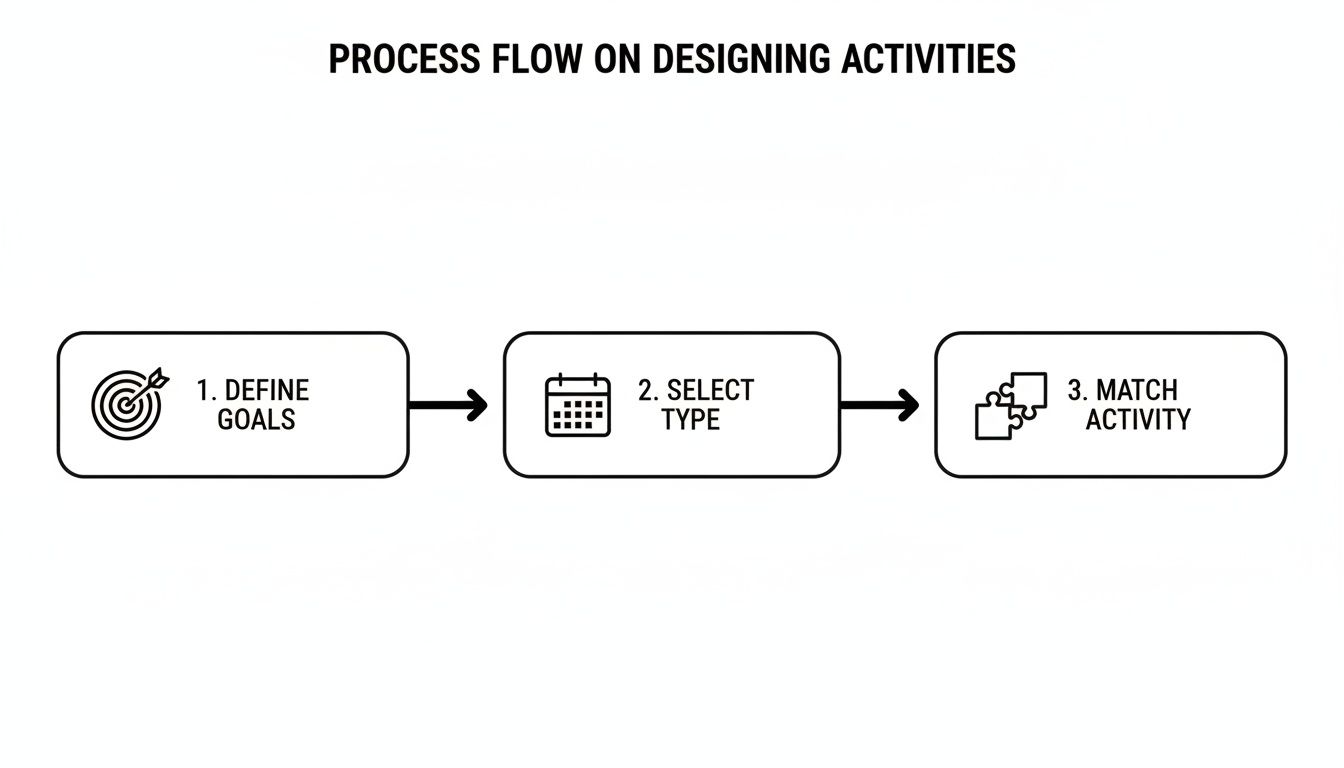
The process below is a simple way to think about aligning your activities with your goals, which is what you should do before you even start looking for suppliers.
This approach ensures you're searching for suppliers who can deliver an experience that directly supports your objectives, rather than just picking something that looks fun. Once you have a shortlist, it's time to do your homework.
When you're thinking about catering, for instance, don't overlook the environmental angle; exploring eco-friendly packaging options can be a great way to align the event with your company's sustainability goals. A supplier's commitment to details like this is often a good sign of their overall professionalism. And if you need some inspiration, you can discover a whole range of corporate event entertainment ideas to liven things up.
A solid vetting process should always include these steps:
Requesting Credentials: Ask for proof of public liability insurance (a minimum of £5-10 million is standard), risk assessments for their activities, and any relevant safety certifications.Checking Testimonials and Case Studies: Look for reviews from companies of a similar size or in a similar industry to yours. A proven track record is the best indicator of how they'll perform for you.Clarifying the On-Day Service: Confirm exactly what's included in the price. Will they provide trained staff to operate the equipment and engage with your team? What are their setup and breakdown procedures and timings?
By meticulously planning your budget, venue, and suppliers, you can get ahead of the complex logistics. This frees you up to focus on what truly matters on the day: creating a memorable and impactful experience for your team.
Turning a Great Day into Lasting Change
The real magic of a company away day isn't what happens on the day, but what you do with it afterwards. The buzz, the breakthroughs, and the renewed team spirit are brilliant, but that energy can vanish into thin air without a proper plan to weave it into your everyday culture.
This is your chance to prove the event was a smart investment, not just a nice day out. The trick is to stop thinking about it as a one-off and start seeing it as a catalyst for genuine, long-term improvement. That means getting serious about measuring what actually changed and actively keeping the momentum going.
Measuring What Truly Matters
First things first: ditch the simple "happy sheets." Asking if everyone had a good time is fine, but it tells you absolutely nothing about the business impact. To get meaningful data, you need to go right back to the objectives you set at the very beginning.
Your post-event survey needs to be sharp and strategic, asking questions that gauge real shifts in behaviour and thinking.
If your goal was to improve cross-departmental collaboration: Don't ask, "Did you meet new people?" Instead, try: "On a scale of 1-10, how confident do you now feel approaching someone from the marketing team with a new idea?" or "Are you more likely to collaborate with the engineering team after the away day?"
If your goal was to align everyone on the company vision: A great question would be, "After the strategy session, how clearly do you understand our priorities for the next six months?" Now that’s concrete data you can take straight to leadership.
This kind of targeted feedback gives you rich, qualitative data that demonstrates real value. The insights are incredibly powerful for justifying future company away days and fine-tuning your approach next time. For a deeper dive into event strategies that deliver, our guide on product launch event planning has some great transferable tips.
Keeping the Momentum Alive
A great follow-up strategy is all about making the outcomes of the away day visible and actionable. You have to build tangible reminders and systems that plug that newfound energy back into the daily grind. Without this, even the most inspiring day will just become a nice memory within a couple of weeks.
The single biggest mistake is having no post-event plan. The ideas and enthusiasm generated are a perishable resource. Your job is to capture that energy and channel it into ongoing projects, conversations, and cultural habits.
You need to act fast. Within 48 hours , send out a thank you message with a link to that all-important survey and a sneak peek of some photos. That immediate touchpoint keeps the good vibes going.
From there, build out a simple but effective plan:
Create a Dedicated Channel: Set up a space on Slack or Teams called something like #AwayDayWins or #ProjectSpark. Get people posting thoughts, ideas, or new collaborations that came up during the event.
Share a Highlight Reel: A short, punchy video (2-3 minutes ) capturing the best moments is gold. It’s a fantastic reminder of the atmosphere and shared experiences, cementing the bonds that were built.
Embed the Key Takeaways: Did a brainstorming session produce a killer new idea? Assign someone to champion it and get a follow-up meeting in the diary. Weave key messages from the day into your regular team meetings and internal comms for the next month.
The business case for doing all this is rock solid. Research shows that 88% of employees believe in-person events like away days are critical for building strong long-term relationships. That connection has a direct impact on the bottom line, with some studies showing a potential 26% increase in productivity after an offsite. By measuring properly and following up with purpose, you ensure your event delivers a return that lasts.
Answering Your Burning Away Day Questions
Even with the best-laid plans, a few tricky questions always seem to pop up when you're organising a company away day. Getting the details ironed out is what separates a good event from a truly great one.
Let's dive into some of the most common queries we get from event planners, with some straightforward, real-world advice to help you get it right.
How Far Out Should I Start Planning?
To keep the stress levels down, you really want to give yourself at least 3-6 months' notice . This is especially critical if you're coordinating for a larger team or planning an overnight stay that involves booking accommodation. Trust me, this window is your best bet for snagging your dream venue and top suppliers before they're snapped up.
Giving yourself that much runway does more than just secure bookings; it gives you breathing room. You’ll have time to:
Chat with Leadership: You can have proper conversations about the goals for the day and get the budget signed off without a last-minute panic.Get the Team's Input: Fancy running a few surveys? Now you can. Collecting feedback early on helps make sure you’re planning a day people are actually excited about.Nail the Logistics: It allows you to calmly manage all the little things, from booking transport to sorting out dietary needs.
If it’s just a small, local get-together for a single team, you might be able to pull it off in 2-3 months. But honestly, more time is always your friend in event planning.
What are the Most Common Mistakes to Avoid?
The single biggest mistake we see? Not having clear objectives. If you don't know why you're having the away day, it can quickly become a random, unfocused event that’s hard to justify when the bill comes in.
Another classic slip-up is picking activities that only appeal to one type of person. A day jam-packed with intense, physical challenges is a surefire way to make your more introverted or less athletic colleagues feel left out and awkward.
Resist the urge to schedule every single second. Some of the best ideas and strongest connections happen in the gaps – during coffee breaks or just casual chats. Build some unstructured downtime into your itinerary and let the magic happen on its own.
Finally, a massive missed opportunity is not having a follow-up plan. All the great energy, new ideas, and positive vibes from your company away days will just evaporate if you don't have a strategy to capture that momentum and carry it back to the office.
How Do We Make Sure the Day is Genuinely Inclusive?
This is non-negotiable. Making sure every single person feels welcome, included, and able to join in is the bedrock of a successful away day. This isn't just about ticking a box; it's about creating an experience that truly brings your whole team together.
A simple, anonymous survey sent out well in advance is a brilliant place to start. It’s a discreet way to gather info on people’s interests, physical comfort levels, and any specific needs like dietary requirements or accessibility concerns. That feedback is gold dust for making thoughtful choices.
When you're looking at activities, aim for a real mix that caters to different personalities and energy levels. For example, you could balance a competitive game like a racing simulator challenge with something more collaborative and creative, like a team-building workshop. The goal is simple: you want everyone to head home feeling seen, valued, and genuinely glad they came.