
Let's face it, we're all tired of boring ads and mindless scrolling. Experiential marketing cuts through that noise. It’s not about shouting your brand’s story from the rooftops; it’s about inviting people to step inside and live it, even for a moment.
This is marketing that creates immersive, memorable, and shareable real-world moments. It’s the difference between being a passive audience and an active participant.
What Is Experiential Marketing?
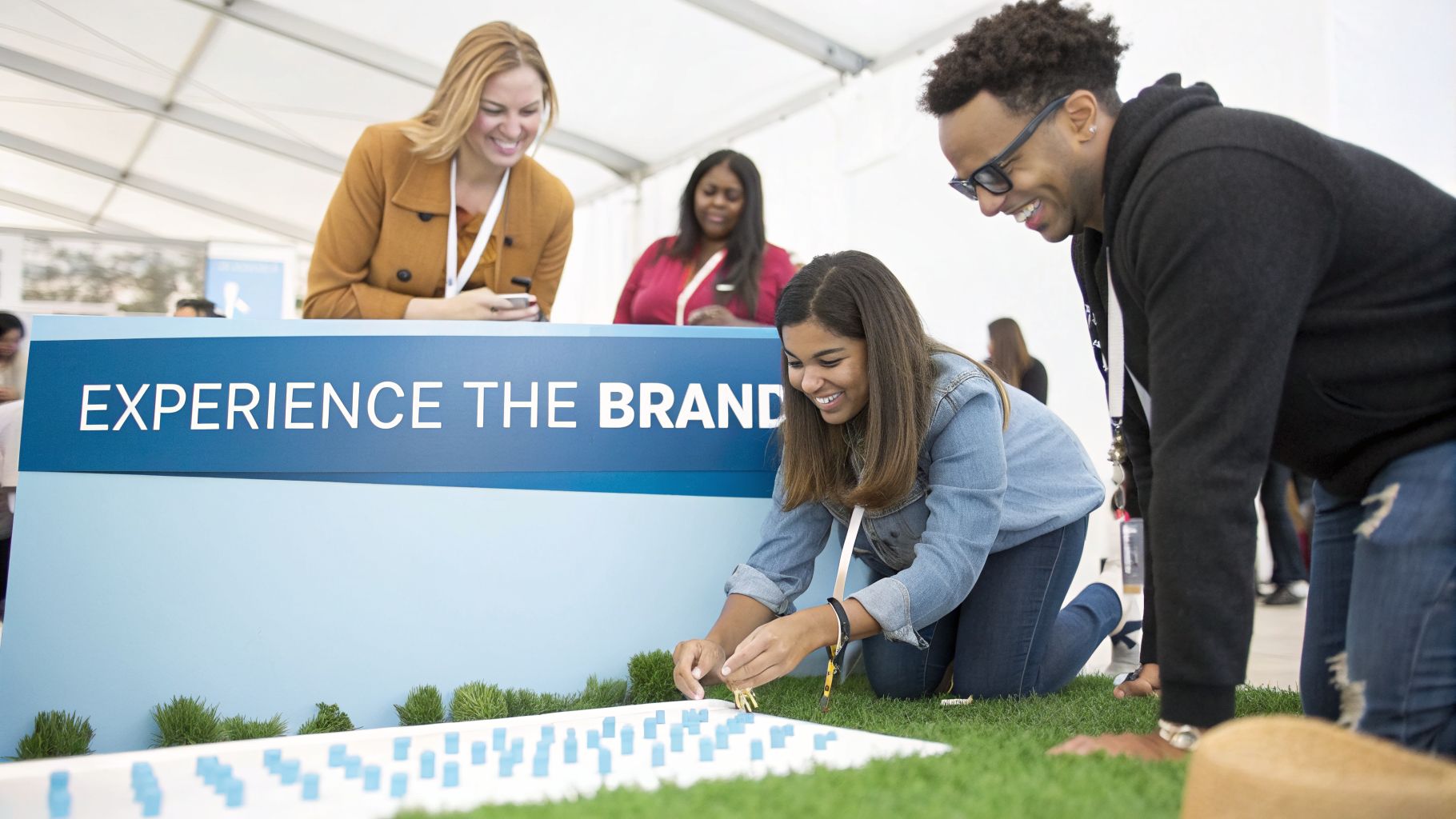
At its core, experiential marketing is a strategy built on creating genuine emotional connections through multi-sensory brand activations. Think of it like this: you can read a restaurant’s menu, or you can actually taste the chef's signature dish. One simply informs you; the other lets you feel something.
This approach ditches the one-way street of a TV commercial or a print ad. Instead, it sparks a two-way dialogue where customers can interact, play, and engage directly with your brand. That hands-on involvement is what sticks, creating powerful personal bonds and lasting memories.
The Power of Participation
Traditional advertising often feels like an interruption. Experiential marketing, on the other hand, is an invitation. It centres on a value exchange: attendees give you their time and attention, and in return, they get something tangible—a fun experience, a new skill, or simply a thrilling moment they won’t forget.
That positive association is the real secret sauce here.
These experiences are also inherently designed to be shared. In a world driven by social media, a well-planned event becomes a magnet for user-generated content. Your attendees become your most authentic storytellers, snapping photos and recording videos because they're genuinely excited about what they’re doing.
From Attendee to Advocate
The goal isn't just to draw a crowd; it's to build a community. When someone has a truly positive and memorable interaction with your brand, they don't just walk away and forget. They talk about it, they recommend it, and they’re far more likely to become a loyal customer.
Experiential marketing's core strength lies in its ability to forge lasting emotional connections. It's about creating moments so impactful that they turn a passive consumer into an enthusiastic brand advocate.
Here in the UK, the results speak for themselves. Experiential marketing is often cited as the most effective tactic by industry pros, with a 38.34% success rate that blows digital ads and content marketing out of the water.
The data backs it up: after an event, 85% of consumers are more likely to make a purchase, and a staggering 70% go on to become repeat customers. You can explore the full research on experiential marketing effectiveness to see just how powerful this strategy is. It’s this simple shift from telling to showing that has so many brands investing in live, interactive brand moments.
The Tangible Benefits of Immersive Brand Experiences
While the buzz around an immersive activation is great, the real value of experiential marketing shows up in the business results. It’s about creating outcomes that passive advertising can't touch. That’s what happens when you turn a memorable, shared moment into genuine brand loyalty.
When you invite people directly into your brand's world, you create a personal connection. This bond is far stronger than anything built from a one-way sales pitch. It’s the difference between telling someone about your brand and making them feel like part of its story.
Think about how major brands build these kinds of relationships. The Starbucks Rewards program, for example, turns casual customers into regulars. Experiential events take this principle and amplify it through face-to-face interaction.
Building Lasting Brand Loyalty
A great brand experience is like making an emotional deposit with your audience. When people feel seen, engaged, and entertained, they develop a real affinity for the brand that made it happen. This isn’t just about making one sale; it's about creating a long-term advocate for your business.
This positive feeling has a direct impact on future buying decisions. Someone who has a brilliant time at your event is far more likely to choose you over a competitor when the need arises. This is loyalty you earn, not buy.
The core benefit of experiential marketing is its ability to forge an emotional connection that outlasts the event itself. It transforms the customer relationship from a simple transaction into a meaningful, personal bond.
Fuelling Organic User-Generated Content
In the age of social media, a well-planned event becomes a content-creation machine. If you create something visually impressive or just plain fun, people will want to share it. They effectively become a volunteer marketing team, broadcasting their experience to their own networks.
This user-generated content (UGC) gives you two key advantages:
- Authenticity: A post from a friend or peer comes across as far more credible than a corporate ad. It's powerful, third-party validation for your brand.
- Reach: UGC extends your event's reach far beyond the people in the room, exposing your brand to a much wider audience with no extra media spend.
A simple branded hashtag, a photo booth, or a competitive game with a leaderboard can massively increase social sharing. These are just a few of the many interactive exhibition ideas that get people talking online.
Generating High-Quality Leads
Experiential marketing isn't just about brand-building; it’s an incredibly effective tool for lead generation, particularly in a B2B setting. At a busy trade show, a standard stand can easily get lost in the noise. An interactive attraction, however, acts as a magnet.
Take an F1 simulator at a corporate event. It doesn't just draw a crowd; it creates an organised queue of engaged prospects. While they wait their turn, your sales team has the perfect chance to start natural, low-pressure conversations, qualify leads, and gather contact details.
This method delivers not just quantity but quality. These leads are already warmed up because they’ve just had a positive, memorable interaction with your brand. The investment clearly pays off. In fact, 93% of UK event marketers are now hosting in-person or hybrid events. This is backed by results, with 77% of marketers calling live events their single most effective channel, and 85% of consumers admitting they are more likely to buy after attending one.
Exploring Different Types of Experiential Activations
Experiential marketing isn't just one thing. It's a whole collection of different activation types, and choosing the right one is like a mechanic picking the right tool for the job. Your goal is always to stop people from just passively watching and instead, pull them into a moment with your brand.
This means getting to grips with what's possible, from a clever stunt on a street corner to a full-blown technical installation at a corporate event. Each format has a specific job to do, whether that’s getting you all over social media, building a premium feel around your brand, or sparking valuable conversations.
Let's break down some of the most effective formats we see in the field.
Pop-Up Shops and Brand Takeovers
A branded pop-up shop is essentially a temporary home for your brand that appears somewhere unexpected. It’s a physical space people can walk into, touch, and feel. Because it’s not permanent, it creates a real sense of urgency – people know they have to visit now before it’s gone.
Pop-ups are brilliant for launching a new product, dipping a toe into a new market, or just creating a world that screams your brand's name. Think of a drinks company setting up a summer-themed lounge in a city centre, complete with free samples and cool photo spots. It gives people a real, multi-sensory taste of the brand’s personality.
Similar to this is the brand takeover, where you reskin an existing venue to make it your own. We've seen coffee brands take over libraries during exam season to create the perfect study hub (with free coffee, of course), or film studios transform a Tube station platform to look like a movie set. It’s a smart way to weave your brand into people’s daily lives, making it feel both surprising and useful.
Guerrilla Marketing and Street-Level Stunts
Guerrilla marketing is all about surprise. These are the unconventional, often low-cost activations that are designed to grab as much public attention and social media buzz as possible. They usually happen in busy public spaces, catching people completely off guard with something clever or thought-provoking.
The real aim here isn't always about engaging thousands of people on the spot. It's more about creating a spectacle so interesting that it gets filmed, shared, and talked about online, making its reach grow exponentially.
A few classic guerrilla tactics include:
- Creative installations: Placing an oversized or completely bizarre object in a public square.
- Interactive street art: Using chalk or temporary projections to create art that people can step into and become part of.
- Flash mobs: Performances that seem to erupt from nowhere, instantly capturing the attention of everyone around.
While they can be incredibly effective for creating buzz, these stunts need meticulous planning to make sure they're safe, legal, and actually fit the brand you're promoting.
Interactive Technology and Immersive Simulators
When you get to corporate events, exhibitions, and product launches, interactive technology is what really drives engagement. This is where things get seriously exciting, using advanced kit to create moments people genuinely won't forget. These activations are perfect for pulling a crowd at a packed trade show or injecting some high-octane energy into a brand event.
This category covers a huge range of powerful tools:
- Sports Simulators: These are always a massive draw. Whether it's testing a golf swing or trying to score a penalty on a rugby or football simulator, these games tap into that natural competitive streak everyone has.
- Racing Simulators: Nothing grabs attention quite like the roar of an F1 engine. Racing rigs, especially the full-motion ones, deliver an adrenaline rush that’s incredibly shareable and creates a magnetic centre of gravity for your stand.
- Flight Simulators: For a more sophisticated thrill, motion flight simulators let guests pilot a helicopter or aircraft. It’s a unique, premium experience that works perfectly for innovative or luxury brands.
- VR/AR Experiences: Virtual and augmented reality can transport your guests anywhere. A property developer can let clients walk through a building that hasn’t been built yet, or a car brand can let people customise and sit inside a new model in a virtual showroom.
This kind of tech is more than just a bit of fun; it’s a powerful business tool. An electronic leaderboard running alongside a simulator, for instance, not only encourages people to come back and try again but also captures vital lead data. You can see a wide variety of options by exploring different experiential marketing activations available to hire.
The right technology doesn’t just entertain. It creates a focused, exciting environment where your sales team can have meaningful conversations with people who are already warmed up and genuinely interested.
Your Blueprint for a Successful Experiential Campaign
Pulling off a powerful experiential campaign isn’t about one lightning-bolt idea. It’s a structured, strategic process. You’re taking a concept and moving it methodically into a flawless real-world execution. This roadmap will walk you through the essential stages needed to bring a compelling brand experience to life, making sure every piece works together to deliver results you can actually measure.
It all starts with your goals. Without a defined target, your activation is just a bit of fun with no real business purpose. You have to ask: what are we actually trying to achieve here? The answer will dictate every single decision you make, from the creative concept right through to how you measure success.
Setting Clear Objectives
Before you even start daydreaming about cool ideas, you need to define what success looks like. Your goals are the compass for the entire project. Are you looking to get your brand name in front of as many eyes as possible, or is the real aim to generate high-quality sales leads?
Common objectives we see for experiential marketing campaigns include:
- Lead Generation: This is a top priority for most B2B marketers, especially at trade shows. The goal is to capture contact details from qualified prospects in a way that feels engaging, not transactional.
- Social Buzz and Amplification: If you want your brand to trend, the objective is to create moments so good people can't help but share them. It’s all about encouraging user-generated content and hashtag use.
- Brand Engagement: This is about deepening the relationship with your existing audience. You're building loyalty by creating positive, memorable interactions that make people feel seen.
- Product Launch or Demonstration: The objective is simple: let people see, touch, or try a new product. It’s about getting it into their hands in an exciting, hands-on environment.
Once you have a primary objective, you can build your strategy around it. A campaign focused on lead generation, for example, might be perfectly suited for an F1 simulator with a data-capture leaderboard. A campaign chasing social buzz, on the other hand, would benefit more from a stunning visual installation that’s practically begging to be put on Instagram.
Understanding Your Target Audience
With your objectives locked in, the next vital step is getting inside the heads of your target audience. An experience that wows one group might completely fall flat with another. You need to know what makes them tick—what they love, what their problems are, and what they genuinely value.
Get some research done to find those crucial insights. What do they find entertaining? Where do they hang out, both online and offline? What kind of experience would feel valuable to them, not just like another marketing ploy?
An experiential campaign succeeds when it feels like it was made for the audience, not just aimed at them. This resonance is the key to creating a genuine connection.
This deep understanding ensures your concept lands authentically. An activation designed for tech executives at a conference will look vastly different from one built for families at a public festival. One might involve sophisticated VR, while the other could feature a simple, competitive game. You can see how different concepts connect with different audiences by checking out these brand activation examples.
Creative Brainstorming and Brand Alignment
Now for the fun part: brainstorming the creative concept. This is where you connect your objective and your audience insights to a real, actionable idea. The absolute key here is brand alignment. The experience has to feel like a natural extension of your brand’s personality.
Is your brand innovative and tech-focused? A high-spec simulator or a VR experience is a fantastic fit. Is it more playful and family-friendly? An interactive game or branded photo booth might be the way to go. A mismatched concept just feels awkward and can undermine the whole effort.
This infographic breaks down a few of the core activation types you could consider, from guerrilla stunts to sophisticated tech installations.
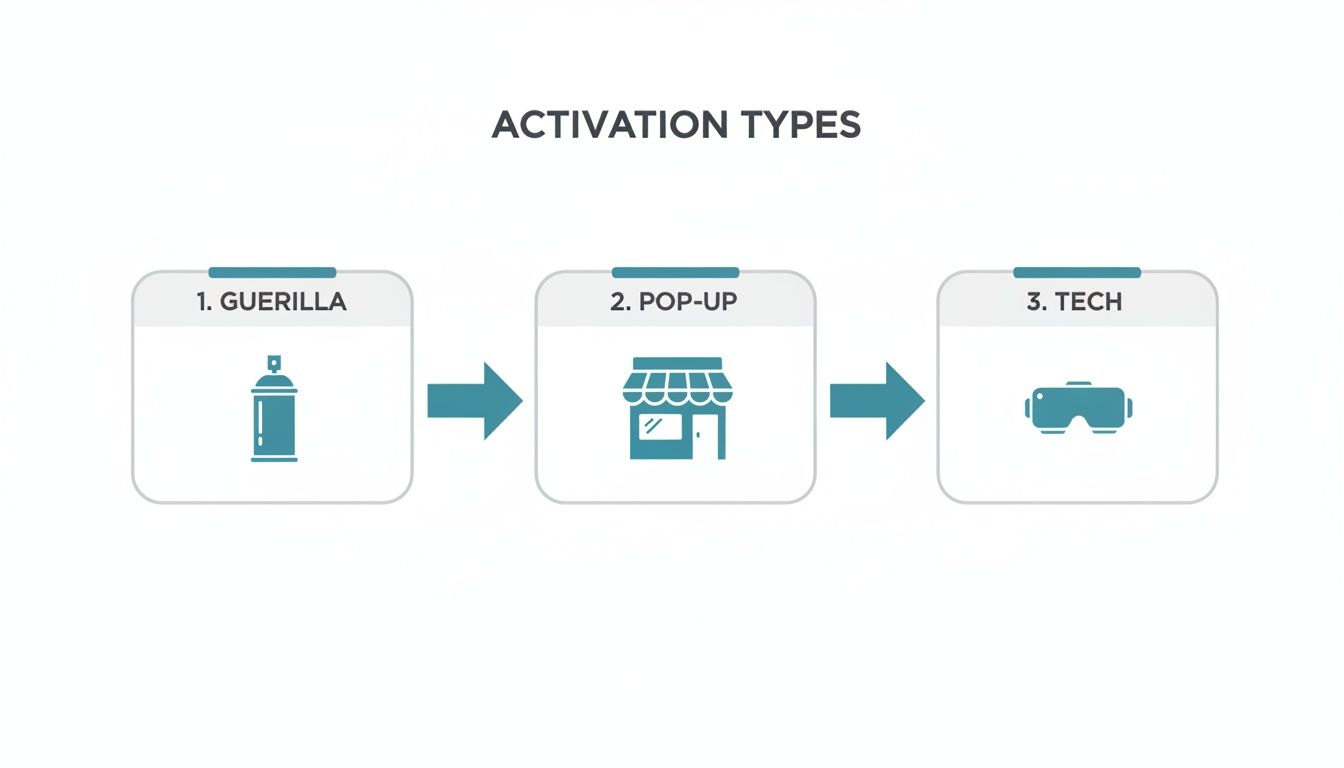
Each of these serves a different strategic purpose, so you can pick the right tool for the job based on your specific campaign goals.
Logistics Execution and Professional Partnership
An incredible idea is worthless without flawless execution. The logistics of experiential marketing are complex and full of potential tripwires, from technical glitches to serious safety hazards. This is where partnering with a specialist isn't just a good idea—it's essential.
Managing logistics involves a ton of moving parts:
- Technology and Equipment: Sourcing, delivering, and setting up gear like motion simulators requires specialist knowledge. It’s not plug-and-play.
- Staffing: You need professional, trained staff who can operate the equipment safely and serve as enthusiastic brand ambassadors.
- Health & Safety Compliance: This is completely non-negotiable. It involves detailed risk assessments, method statements (RAMS), and having the right public liability insurance in place.
- Venue Coordination: Liaising with the venue on power needs, floor plans, and access times is crucial for a smooth setup on the day.
Trying to juggle these elements in-house without deep experience is a massive risk. A professional event partner like PSW Events offers a turnkey solution, handling every detail from planning and branding to on-site management. This frees you up to focus on your guests while we ensure your event is not only engaging but also safe, compliant, and completely stress-free.
Measuring the Real ROI of Your Experiential Campaign
Creating an unforgettable brand experience is one thing, but how do you actually prove it delivered for the business? Answering that question is what separates a fun one-off from a strategic investment, and it’s what you need to justify your budget and fine-tune your next campaign.
It’s about moving past the high-fives and the general buzz to find hard numbers. The key is to tie every measurement directly back to the goals you set in the planning stage. If you wanted leads, counting smiles won't cut it. Your data needs to tell a story that proves you hit your targets, turning that subjective excitement into objective, boardroom-ready results.
Tracking Engagement and Interaction
Direct engagement is the heartbeat of any experiential activation. Thankfully, modern event tech makes it easier than ever to track what's really going on. These aren't just vanity metrics; they're solid indicators of how well your experience captured and held people's attention.
We’ve moved way beyond simply counting the number of people who walked past. Now, we can analyse precisely how they interacted with the activation itself.
Here are the key metrics we focus on:
- Dwell Time: Simple but powerful. This is how long, on average, people spend at your stand or in your activation zone. A longer dwell time is a clear sign that you’ve created something genuinely engaging.
- Interaction Rate: This tells you the percentage of visitors who got hands-on. What proportion of the crowd actually tried the F1 simulator or had a go on the Batak challenge? This metric shows how good you were at converting a passive audience into active participants.
- Repeat Plays: For competitive games like a golf simulator or giant Scalextric, how many people came back for another go? This is a brilliant indicator of pure enjoyment and stickiness.
These on-the-ground engagement figures provide a direct measure of your activation's "stickiness." They prove you didn't just attract a crowd, but you held their attention and delivered a genuinely compelling experience.
Measuring Brand Impact and Amplification
One of the biggest wins from experiential marketing is when attendees become your brand advocates, sharing their experience far and wide. Measuring this amplification is vital for understanding the true reach of your campaign, which almost always extends well beyond the physical event.
You're essentially trying to quantify the digital echo of your live activation. The best place to start is by tracking the social media activity your event generated.
Key brand impact metrics to watch:
- Social Media Mentions and Hashtag Usage: Keep a close eye on how many times your bespoke event hashtag or brand name was used across platforms like Instagram, LinkedIn, and X (formerly Twitter).
- User-Generated Content (UGC): Count the number of photos and videos attendees shared from your activation. This kind of content is gold—it’s authentic, trusted social proof for your brand.
- Sentiment Analysis: Go a step further and use social listening tools to gauge the tone of the online conversation. Was it overwhelmingly positive? This qualitative insight shows how your brand was perceived.
Linking Experience to Business Results
This is where the rubber meets the road. Ultimately, the most crucial metrics are the ones that connect your campaign directly to the bottom line. This is how you show that a fantastic experience also delivered tangible business growth.
To really nail this, you need a solid grasp of how to calculate marketing ROI as part of your wider marketing mix.
Start with the leads you captured. By using data capture systems built into your activation, you can track not just the quantity of leads, but their quality. If you score leads based on questions asked during the interaction (like job seniority or purchase intent), you get a much sharper view of the pipeline value you've generated.
From there, it's about connecting the dots to revenue. By tracking the customer journey after the event, you can attribute sales and conversions back to the leads from your activation. This gives you the final, undeniable Return on Investment (ROI)—the proof that your campaign wasn't just a memorable day out, but a strategic and financial success.
Got Questions About Experiential Marketing? We’ve Got Answers.
Once you get your head around the core idea of experiential marketing, the practical questions start popping up. It's one thing to understand the theory, but quite another to put it into action on a busy exhibition floor.
Let's dig into the common queries we hear from event planners and marketers to help you move forward with confidence.
How Much Does an Experiential Marketing Campaign Cost?
This is the big one, and the honest answer is: it varies massively. An experiential campaign can be anything from a few thousand pounds for a clever pop-up stunt to well into six figures for a huge, multi-city tour with bespoke tech. There’s no single price tag.
The final cost really comes down to a few key variables:
- Activation Complexity: How big and intricate is your idea?
- Technology Hire: Do you need advanced gear like motion simulators or VR rigs?
- Venue Costs: Prime locations like ExCeL London or Manchester Central come at a premium.
- Staffing: How many trained brand ambassadors will you need to run the experience?
- Promotional Spend: The budget you set aside to actually get people to your event.
A brilliant, cost-effective route for a corporate event is to hire a ready-to-go interactive attraction. Bringing in a specialist supplier like PSW Events to provide an F1 simulator or a golf challenge gives you a high-impact centrepiece without the logistical nightmare. The best approach is always to define your goals first, then work backwards to build a budget that delivers a clear return.
Can Experiential Marketing Work for B2B Companies?
Not only can it work, it's one of the most powerful tools in the B2B marketing kit. While consumer campaigns often chase mass awareness, B2B experiential is all about precision.
It’s perfect for building real relationships with high-value prospects, demonstrating a complex product in a way that just clicks, and generating genuinely qualified leads from key decision-makers.
In a B2B setting, experiential marketing isn't about pulling in any crowd; it's about attracting the right crowd and creating the space for a proper business conversation.
Picture it: you’re at a packed trade show. Instead of trying to shout your sales pitch over the noise, you invite a top-tier prospect to set a lap time on your branded F1 simulator. That shared, fun experience is the perfect icebreaker. It gives your sales team a natural way to start a real conversation and qualify that lead without any of the usual pressure. It’s how you stand out and prove your brand’s value, rather than just talking about it.
What Is the Difference Between Experiential and Event Marketing?
This question comes up all the time, and it’s a fair one. The distinction is actually quite simple.
Think of it this way: all experiential marketing is a form of event marketing, but not all event marketing is experiential.
Event marketing is the big-picture term. It’s the umbrella that covers any event a brand is involved with—from hosting a webinar or running a standard conference stand to sponsoring a gala dinner.
Experiential marketing, on the other hand, is a specific type of event marketing. Its defining feature is the focus on creating an immersive, two-way interaction for the guest. The whole point is to get the audience to participate, creating a personal, emotional connection with the brand.
A simple stand with a banner and a pile of leaflets is event marketing. That same stand, but with a motion racing simulator, a live leaderboard, and enthusiastic staff encouraging people to have a go? That’s experiential marketing. The difference is the jump from passive observer to active participant.
How Do I Ensure My Experiential Event Is Safe and Compliant?
When your activation involves interactive equipment like simulators or physical challenges, safety isn't just a priority—it's everything. One slip-up can lead to serious injury and do lasting damage to your brand’s reputation. This is one area you simply can't afford to cut corners on.
The single most effective way to guarantee safety is to partner with a professional and experienced supplier. A reputable company like PSW Events will handle the entire process, putting safety at the forefront from start to finish.
This means they provide the essential documentation and services you need:
- Comprehensive Risk Assessments and Method Statements (RAMS) to identify and remove potential hazards before they become a problem.
- Proof of significant Public Liability Insurance (e.g., £10 million) for total peace of mind.
- Trained, experienced on-site staff who are experts at operating the equipment, managing queues, and keeping every participant safe.
Leaning on this professional oversight takes the entire safety and logistical burden off your shoulders. It protects your guests, protects your brand, and frees up your team to do what they do best: connect with your audience.