
Let's be honest, finding an attraction for a corporate event that genuinely grabs people's attention can feel like a losing battle. For event planners I talk to across the country, hiring racing simulators in the UK has become their secret weapon. These aren't just video games; they are powerful tools for engagement that can turn a standard corporate gathering into something people actually talk about afterwards.
Why Racing Simulators Drive Unbeatable Event Engagement
In the crowded world of corporate events, a good product or a slick presentation often isn't enough to stand out. You need an anchor, something that pulls people in and keeps them there. This is exactly what professional racing simulators do. They act as a magnet for footfall at trade shows, conferences, and brand activations.
Picture your stand at a huge venue like ExCeL London. You're surrounded by competitors. But at your stand, people can hear the roar of a virtual F1 engine. They see a sleek, motion-enabled simulator. They don't just walk past. They stop, they watch, and they queue up for their turn. This isn't just about entertainment; it’s a serious strategic advantage.
The longer someone stays at your stand, the more time you have to build a connection and get your message across. A simulator dramatically increases that 'dwell time', turning a passing glance into a proper conversation.
From Entertainment to Business Results
This buzz translates directly into tangible business outcomes. The thrill of chasing a fastest lap time creates a completely natural, low-pressure way to capture leads. Instead of an awkward ask for a business card, you're simply getting their details to enter them onto the leaderboard. People are far more willing to share their information when there’s a bit of competition involved.
And this isn't some fleeting trend. The market for racing simulators in the UK is seeing massive growth. It was valued at USD 35.85 million in 2024 and is forecast to hit USD 115.78 million by 2033. This boom, as detailed in recent market analyses from firms like Deep Market Insights, shows the UK is a real hotspot for sim racing, building on our rich motorsport history.
This growth proves what many in the industry have realised: simulators are a valuable marketing tool. They offer a unique mix of benefits:
- Boosted Brand Recall: The adrenaline rush creates a powerful, positive memory linked directly to your brand.
- Increased Footfall: A quality simulator is a guaranteed crowd-puller, ensuring your stand is always the centre of attention.
- Qualified Lead Generation: Leaderboard competitions give you a compelling and fun reason to capture attendee data.
For larger corporate days or full-blown esports tournaments, you can take things even further. For instance, you can elevate your esports events with mobile LED trailers to broadcast the racing action live, making it a real spectator sport. Thinking about these and other interactive exhibition ideas will help you create an event that truly stands out from the crowd. At the end of the day, hiring a racing simulator is an investment in an experience—one that delivers real, measurable returns.
Choosing The Right Racing Simulator For Your Event
When you're looking at the huge range of racing simulators UK suppliers have on offer, it's easy to get lost in the tech specs. But honestly, the best choice has less to do with the hardware and more to do with your event's goals. What are you trying to accomplish? Are you aiming for a high-energy buzz, a list of qualified leads, or an exclusive VIP experience?
Your core objective should be your starting point. After all, the needs of a high-footfall exhibition at the NEC Birmingham are worlds apart from an intimate team-building day for 20 execs in a London hotel.
This simple decision tree can help you focus on the right path, depending on whether you're chasing pure engagement or strategic lead generation.
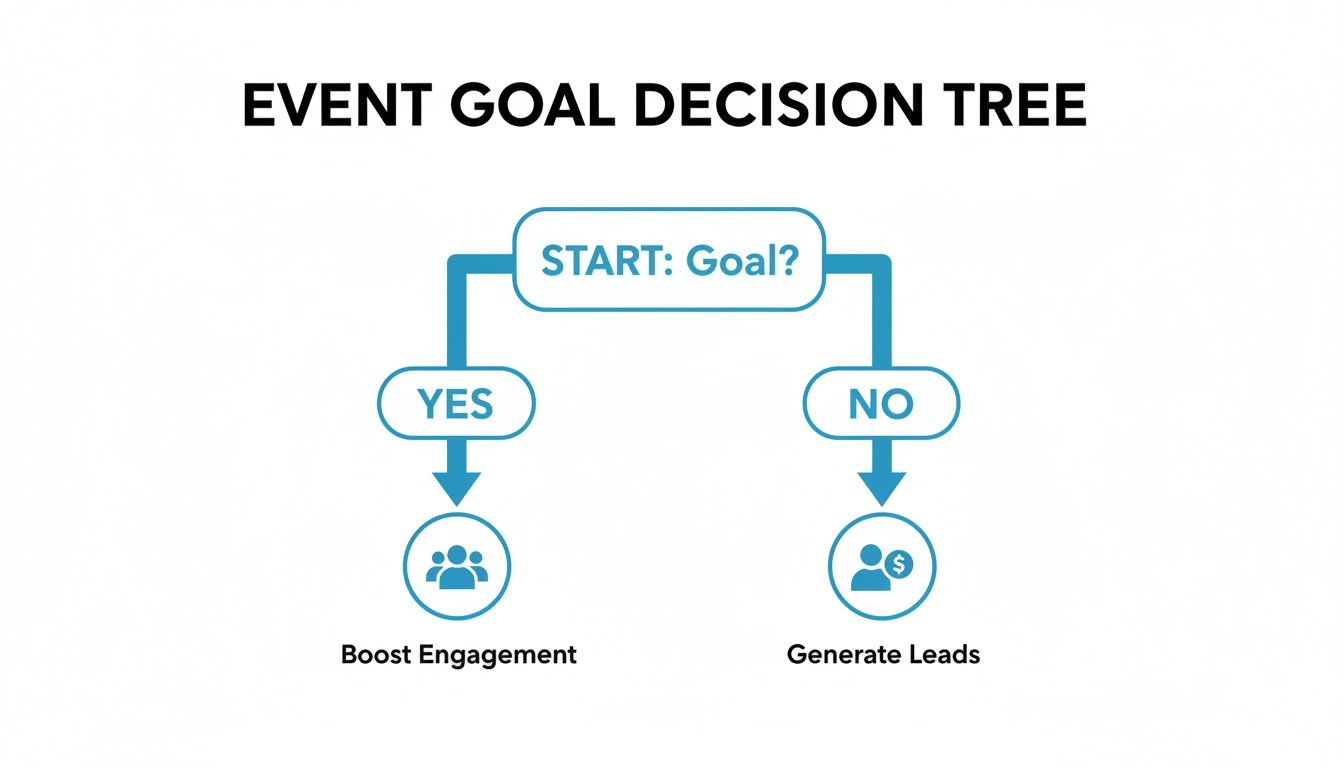
As you can see, there’s a clear split. If your main aim is to get people interacting and create a fun, memorable experience, one type of simulator is perfect. If you have more focused marketing goals like data capture, a different setup will serve you better.
To make this even clearer, here's a quick comparison of the main options you'll come across.
Racing Simulator Hire Options At A Glance
| Simulator Type | Best For | Space Requirement | Typical Impact |
|---|---|---|---|
| Static Simulators | High-throughput, brand awareness, competitions | Compact (approx. 2m x 2m per rig) | High engagement, attracts crowds, accessible |
| F1 Show Cars | Maximum visual impact, photo opportunities, brand launches | Large (full car size, ~5m x 2m) | Unmissable centrepiece, high social media shareability |
| Full-Motion Platforms | VIP experiences, client entertainment, premium rewards | Medium to Large (from 3m x 2m per rig) | "Wow factor", unforgettable adrenaline rush, high perceived value |
| Linked Multi-Car Systems | Team-building, internal competitions, large group events | Varies (multiples of rig space) | Fosters competition & camaraderie, excellent for groups |
This table should give you a solid overview, but let’s dive into what makes each one tick so you can really nail down the perfect fit for your event.
Static Simulators And Show Cars
If you need to make a big visual splash or you're tight on floor space, static simulators and F1 show cars are fantastic options. They deliver a massive impact without the logistical footprint of their motion-based cousins.
Static Simulators: These rigs pack a punch. You get a professional racing seat, wheel, and pedal setup, usually paired with large screens for an immersive view. While they don't have motion, they provide a brilliant racing experience that’s accessible to just about everyone. We find they’re perfect for trade show stands where high throughput and broad appeal are key.
F1 Show Cars: Let’s be honest, nothing stops people in their tracks like a full-size F1 replica. These are primarily incredible photo opportunities, but many can be fitted with a playable simulator right there in the cockpit. They are the ultimate centrepiece for a brand launch or any event where making a bold statement is priority number one. We've got a whole guide detailing the specifics in our F1 car racing simulator setup.
We often recommend a pair of linked static simulators for an exhibition stand. This setup naturally encourages friendly competition, which in turn draws a crowd as people gather to watch the head-to-head battle. It’s a proven way to keep your stand buzzing all day.
Motion Platforms And Linked Systems
When your goal is to create a truly visceral, unforgettable experience, motion simulators are in a league of their own. These rigs physically move, tilt, and vibrate to replicate the feeling of acceleration, braking, and cornering G-forces.
Motion platforms really are the top-tier choice for high-impact events. The immersive 6DOF (Six Degrees of Freedom) platforms make them ideal for competitive team-building, product launches for top clients, or exclusive hospitality.
Here's where they truly excel:
- Full-Motion Simulators: This is the premium attraction. The physical feedback makes drivers feel every single bump and turn, creating a genuine adrenaline rush. They're our go-to for VIP hospitality and client entertainment events where you want to deliver an experience that money can't typically buy.
- Linked Multi-Car Systems: For team-building, nothing beats linking several simulators—either static or motion—together. You can run a proper race day format with a qualifying session followed by a grid-start final. It’s an incredibly powerful way to spark some healthy competition and camaraderie among colleagues.
Ultimately, the best racing simulator for your UK event is the one that directly supports your vision of success. Whether that's a long queue of excited guests or a small group of key decision-makers enjoying an exclusive thrill, the right choice is out there.
Mastering The Logistics Of Simulator Hire
A jaw-dropping racing simulator might be the star of your event, but its success hinges entirely on the behind-the-scenes stuff. Let's look past the glamour and get into the nitty-gritty logistics every event planner needs to nail for a smooth, professional simulator hire in the UK.
First, you need to think like a roadie. Before you even think about signing a contract, you have to physically walk the entire route from the delivery bay to the exact spot the rig will sit. Are the doorways wide enough? Is there a goods lift? If so, what are its precise dimensions and, crucially, its weight capacity? A full-size F1 show car, for instance, has absolutely no chance of fitting through a standard single door, and even the larger modular rigs need a clear, obstacle-free path.
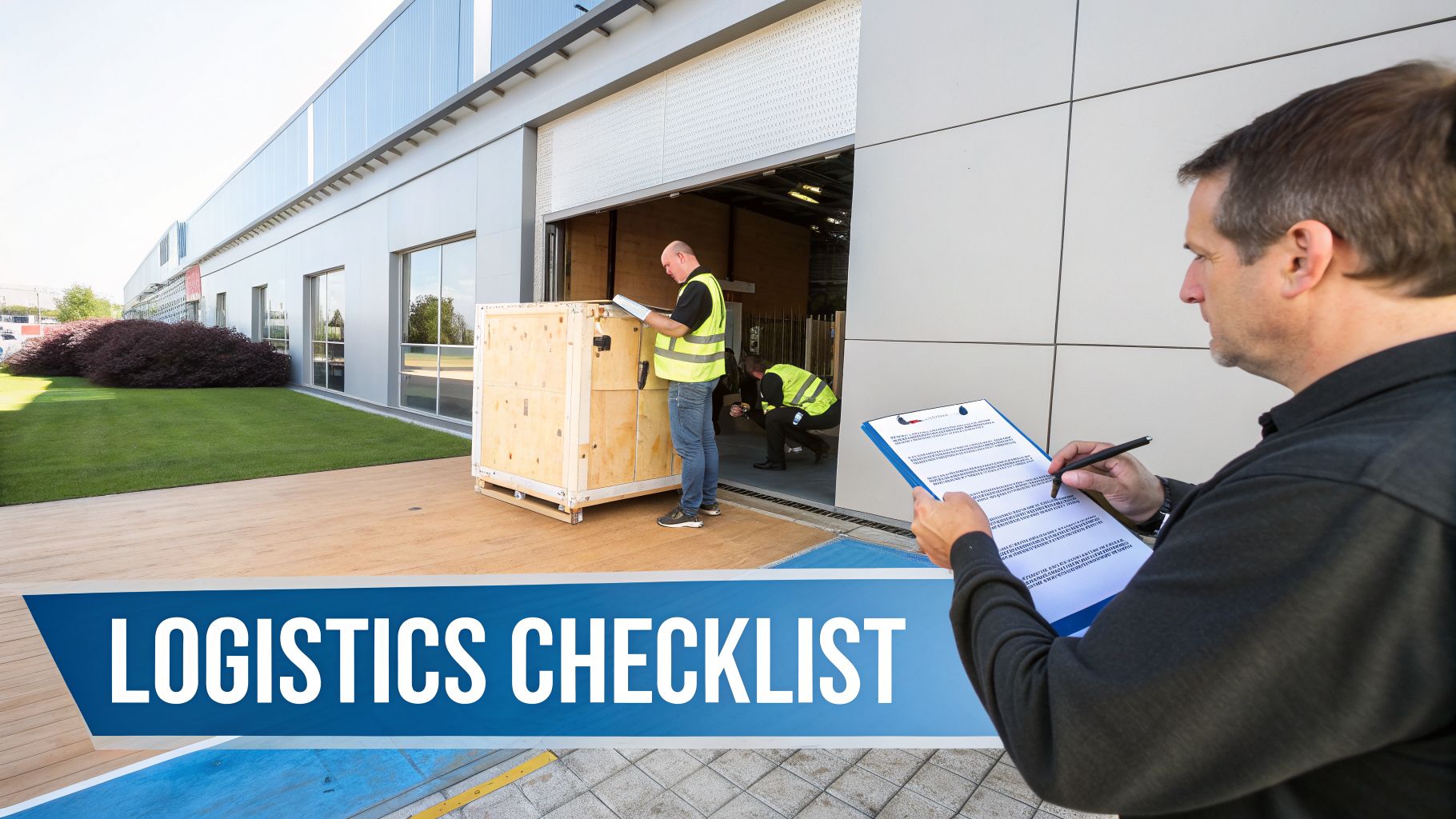
This process is called a venue recce, and it's non-negotiable. Don't just take the venue's floor plan as gospel; get a tape measure out and check it yourself, or better yet, have your supplier do it. This one simple action can be the difference between a smooth setup and an absolute disaster at a major venue like Manchester Central or the SEC Glasgow.
Power And Space Calculations
Next up are the two classic logistical tripwires: power and space. Never, ever assume a standard 13-amp plug socket will cut it. Top-tier motion simulators are power-hungry beasts and often need a more serious supply, sometimes even requiring 3-phase power, which isn't just lying around in every venue. Get this clarified with your supplier from the very first call.
Getting your space calculation right is just as important. It’s not just about the footprint of the rig itself. You absolutely must factor in:
- Queueing Space: How are you going to manage the inevitable line of excited guests without creating a fire hazard or blocking walkways?
- Spectator Area: Watching is half the fun. You need a dedicated area for people to stand and see the action unfold.
- Branding & Staff: Don't forget room for pop-up banners, a big-screen leaderboard, and space for the operator to do their job without being crowded.
As a solid rule of thumb, take the simulator's direct footprint and double it. That's your realistic total floor space. A 3m x 2m rig doesn't need 6 square metres; it needs closer to 12 square metres to be a truly effective activation.
For corporate event planners, getting these details sorted means you have a reliable, high-impact attraction that pulls in crowds and increases dwell time. Picture a fully branded F1 simulator at ExCeL London, complete with live electronic leaderboards and VR headsets, effortlessly drawing a crowd and capturing leads—all because the logistical groundwork was laid perfectly. You can read more about how the UK market is embracing such high-impact attractions and discover why the pros swear by this approach.
Your Venue Logistics Checklist
Before you sign anything, get clear, confirmed answers to these questions from both your venue contact and your simulator supplier.
- What are the loading bay access times and any vehicle restrictions?
- Can you confirm the exact dimensions (width and height) of all doorways and lifts on the access route?
- What is the floor loading limit in the event space? (This is vital for heavy kit like F1 show cars).
- Where are the nearest suitable power sockets, and what is their amperage? Is it a standard socket or something more industrial?
- Is there reliable, open-access Wi-Fi for online leaderboards and any data capture software?
Getting these logistical headaches sorted out early on removes all the friction. It lets your supplier focus on what they do best: delivering a brilliant, unforgettable experience for your guests.
Get More Than Just Bragging Rights: Branding, Data Capture, and ROI
Let’s be honest, the thrill of a racing simulator is a massive draw. But once the crowd gathers, how do you turn that buzz into something you can take back to the office? This is where a good sim hire moves from being just a fun activity to a seriously effective marketing tool. We’re talking about moving beyond counting footfall and tracking real, valuable results.
It all starts with making the simulator undeniably yours. Don't just park a generic rig on your stand. The branding potential is huge, and you can transform the entire setup into a living, breathing advertisement for your business.
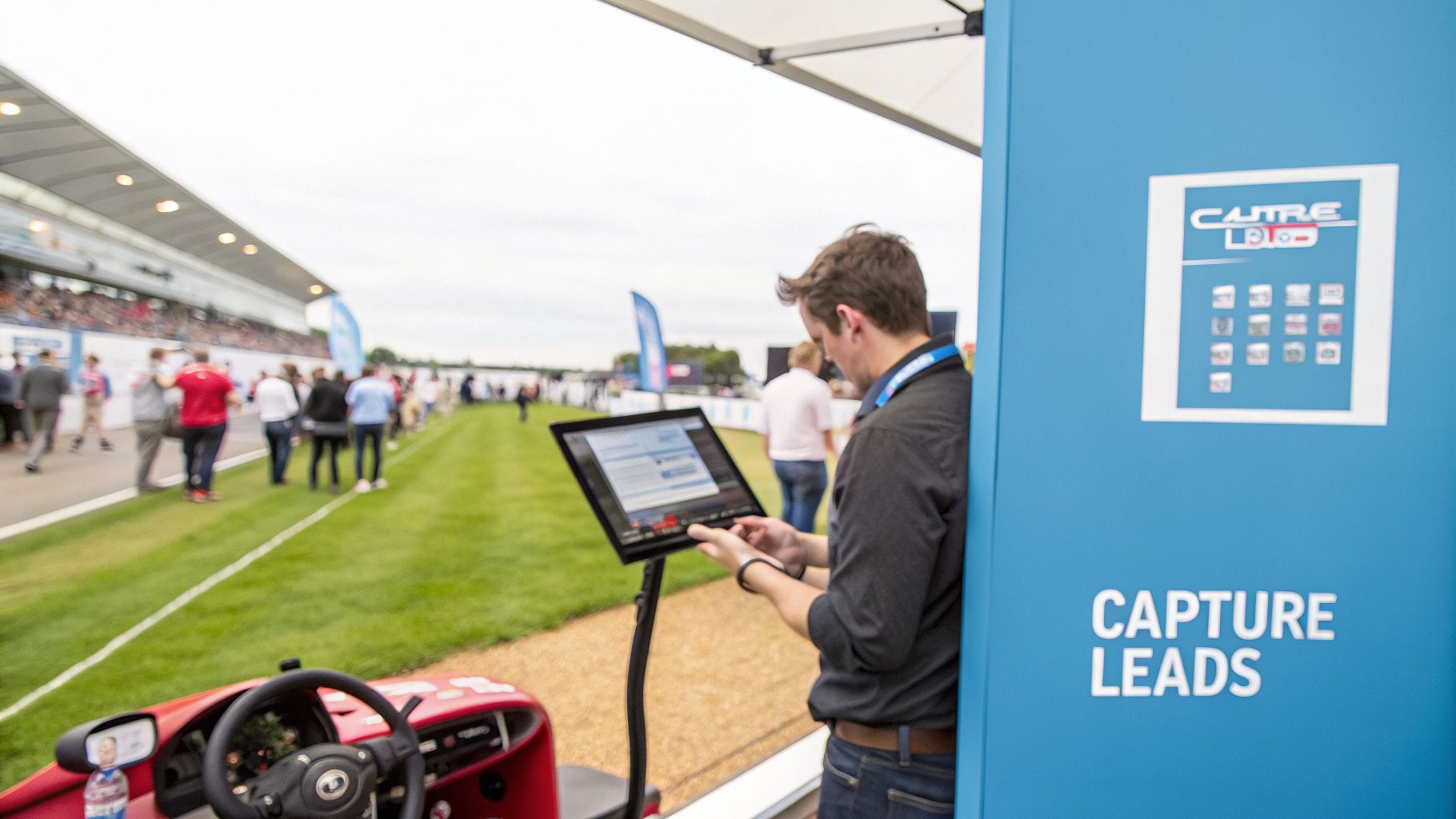
Think beyond just a few logos. Yes, you can (and should) wrap the entire simulator chassis in your company’s colours. But the best suppliers go further, integrating your brand right into the game itself. Imagine custom car liveries, trackside banners featuring your slogans, and even branded loading screens. Your brand becomes part of the action, not just a bystander.
From Fast Laps to Warm Leads
Once you’ve got their full attention, it’s time to capture it. A little friendly competition is your best friend here. A simple ‘fastest lap’ contest is the most organic way I’ve seen to get attendees queuing up to share their details.
A big, bright digital leaderboard is a must-have. It becomes the centrepiece of your stand, stoking that competitive fire and making people desperate to see their name in lights. The secret? Make data entry a quick, GDPR-compliant step to get their lap time officially on the board.
A well-run competition doesn't feel like a marketing ploy to your guests; it feels like part of the fun. They happily give you their details for a shot at glory, and you walk away with a list of genuinely engaged leads to connect with later.
This works brilliantly across the UK. With over 90% of the population online, people are completely comfortable with this kind of digital sign-up. Whether you’re at a huge conference at the Glasgow SEC or a smaller B2B event, a digital lead capture process feels natural and delivers a clear return. For anyone wanting to dig deeper, you can discover more insights on the racing simulator market from deepmarketinsights.com.
Proving the Value
This is how you justify the spend to your boss or client. Instead of just saying "it was popular," you can hit them with hard data that speaks their language.
- Lead Generation: "We captured 250 qualified leads from people who entered the fastest lap competition."
- Social Media Buzz: "Our branded F1 car appeared in 500+ social media posts using our event hashtag."
- Stand Engagement: "The average visitor spent 15 minutes at our stand, a huge jump from 5 minutes last year."
Suddenly, the simulator isn’t an expense; it’s a strategic investment.
By pairing the adrenaline of the race with a smart data strategy—like a prize draw for the day's top driver—you amplify your results. You could even double down by adding another interactive tool to the mix; in fact, you might be interested in our guide on using a spinning prize wheel for events. It’s this kind of thinking that ensures you leave the event with a positive return, proving just how powerful racing simulators UK event hire can be.